
Ancient Coin Hoard Discovery Encourages Stronger Treasure Protection Laws
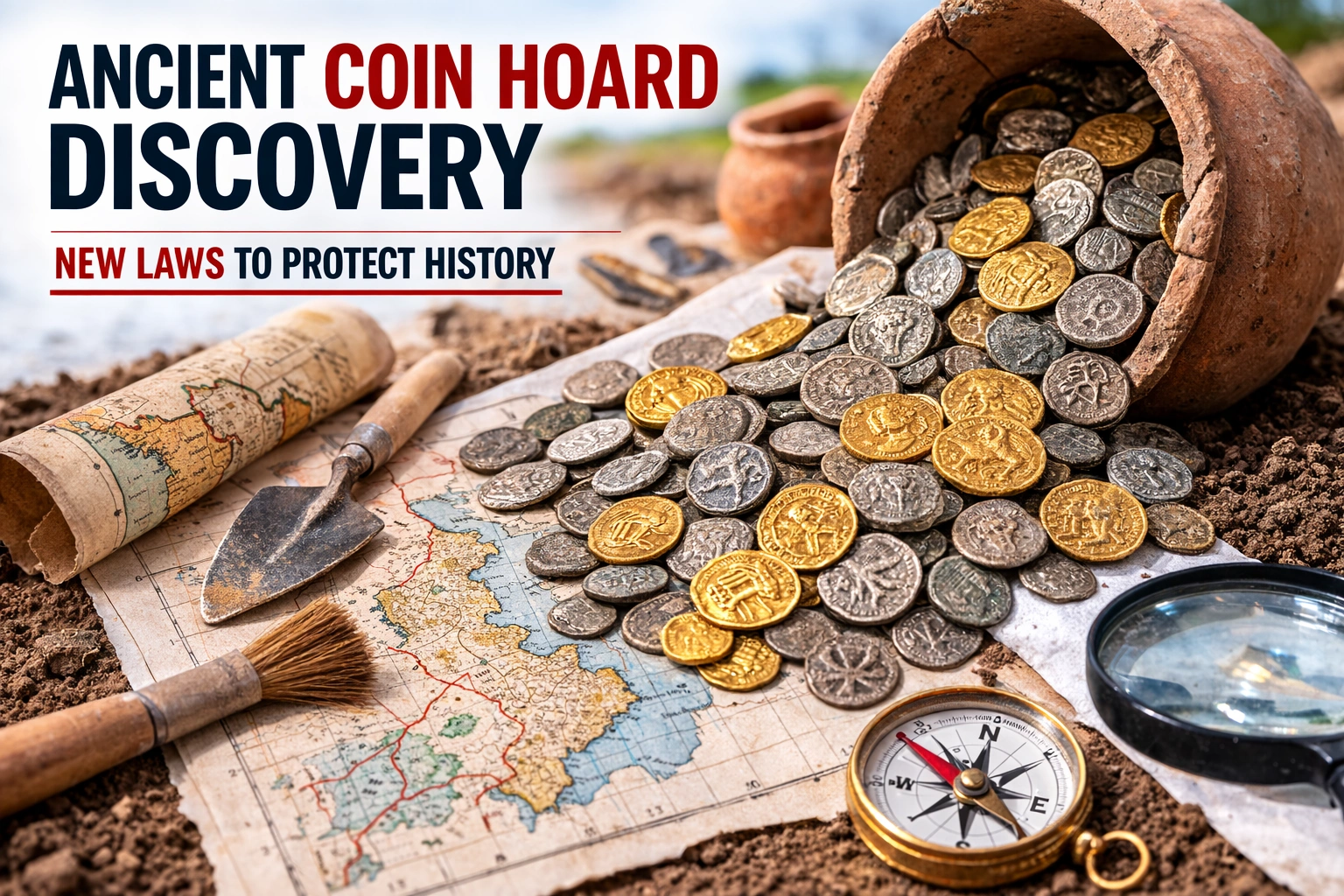
A Historic Discovery That Changed Treasure Reporting
In recent years, a remarkable archaeological discovery on a European island brought global attention to the importance of protecting buried history. Two independent metal detector enthusiasts uncovered an enormous collection of ancient coins buried beneath farmland. What initially appeared to be a small cluster of objects turned out to be one of the largest hoards of early coinage ever discovered.
The find included nearly 70,000 ancient coins, along with precious metal fragments and historical objects believed to date back to the Iron Age, roughly more than two thousand years ago. These coins were found tightly packed together in a large mass, covered with soil and hardened over centuries underground.
The discovery not only revealed valuable pieces of history but also triggered an important conversation about how archaeological finds should be handled, recorded, and preserved for future generations.
For collectors, historians, and enthusiasts who study gold and silver coins, discoveries like this provide extraordinary insight into ancient trade, wealth storage, and cultural exchange.
Why Hidden Treasures Matter to History
When a hoard of ancient coins is discovered, it is far more than a financial treasure. Each coin acts like a tiny historical document. The images, inscriptions, and metal composition reveal important details about ancient societies.
Historians can learn:
- Which rulers or tribes issued the coins
- How trade networks developed across regions
- The economic strength of civilizations
- Artistic styles and symbols used in early cultures
In this particular discovery, experts believe the coins were buried during a time of conflict or political uncertainty. Throughout history, people often hid their wealth underground to protect it from invasion or war.
Sometimes the owners never returned, leaving these hidden collections untouched for centuries.
Such discoveries allow modern researchers to reconstruct stories that would otherwise remain lost forever.
A New Legal Framework for Archaeological Finds
Following the discovery of the massive coin hoard, authorities introduced stronger heritage protection rules to ensure future finds are properly documented and preserved.
The updated law requires anyone who uncovers a possible archaeological object to report the find and its location within a short time period.
This system was created for several important reasons:
- Protect historical sites from damage
- Ensure discoveries are studied by experts
- Prevent illegal sale of cultural artifacts
- Create fair rules for both finders and landowners
Under the new system, failure to report an important discovery can lead to severe penalties, including heavy fines and possible imprisonment.
Providing false information when reporting a discovery can also lead to serious legal consequences.
These measures were designed to protect historical heritage and prevent valuable artifacts from disappearing into private collections without proper documentation.
Fair Rewards for Finders and Landowners
One of the key elements of the new legislation is the introduction of a reward system.
When a legitimate archaeological discovery is reported, experts evaluate the historical importance and market value of the objects. If the items are preserved for historical collections or research purposes, a financial reward may be offered.
This reward is typically shared between the finder and the landowner, creating a balanced and fair system.
Such policies encourage responsible reporting while recognizing the efforts of those who discover buried artifacts.
The goal is to promote cooperation rather than secrecy.
By doing so, societies can protect their heritage while ensuring that individuals who make important discoveries are treated fairly.
Responsible Metal Detecting and Archaeology
Metal detecting has become a popular hobby in many parts of the world. While it can lead to exciting discoveries, experts emphasize that responsible behavior is essential.
Responsible detectorists follow several key principles:
- Always obtain permission from landowners
- Avoid disturbing protected archaeological sites
- Carefully document the exact location of discoveries
- Report historically important objects to authorities
These practices ensure that discoveries contribute to historical knowledge rather than damaging it.
In the case of the massive coin hoard discovery, proper reporting allowed researchers to carefully study the objects and preserve them for public education.
Without responsible action, much of the historical context could have been lost.
What the Coins Reveal About Ancient Civilizations
Early analysis of the discovered coins has provided fascinating insights into ancient societies.
Many of the coins were created by Celtic tribes who lived across parts of Europe before the expansion of the Roman Empire. These coins were often made using precious metals and featured stylized designs inspired by nature, mythology, and tribal identity.
The hoard also contained pieces of metal believed to have been used as raw material for coin production or trade.
Researchers believe the hoard may have represented the wealth of a community leader or an important trading group.
The sheer quantity of coins suggests the region may have played a major role in ancient commerce.
For collectors and historians studying gold and silver coins, discoveries like this offer rare opportunities to examine the evolution of early currency systems.
The Importance of Recording Archaeological Context
One of the most valuable aspects of any archaeological discovery is not just the objects themselves but the context in which they are found.
Archaeologists carefully document:
- Soil layers surrounding the objects
- The arrangement of items within the hoard
- Nearby artifacts or structures
- Geographic location and landscape features
This information helps researchers understand why the objects were buried, who may have owned them, and what historical events may have influenced their burial.
If items are removed without documentation, this valuable context disappears forever.
That is why modern heritage laws emphasize professional investigation and careful preservation.
Preserving Heritage for Future Generations
Cultural heritage belongs not only to the present generation but also to future ones. Ancient coins and artifacts connect modern societies with their past.
Museums and research institutions play a crucial role in protecting and studying these objects. When preserved properly, artifacts can educate millions of people about history, culture, and the evolution of human civilization.
Large coin hoards are particularly valuable because they provide a snapshot of economic life during a specific historical period.
They can reveal:
- Currency circulation patterns
- Metal sources used in coin production
- Political alliances reflected in coin imagery
By protecting such discoveries, societies ensure that historical knowledge continues to grow.
A Growing Interest in Precious Metal History
Interest in historical coins and precious metals has grown significantly in recent years. Collectors, investors, and historians are increasingly fascinated by the stories behind ancient currency.
Coins made from precious metals often served both economic and symbolic roles in ancient societies. They represented power, trade influence, and artistic achievement.
Learning about historical coinage also helps modern collectors better understand the long-standing value of precious metals.
Those interested in deeper knowledge, collecting guidance, or market insights can explore educational resources available through DEI Gold and Silver Coins, where enthusiasts can learn about historical currency, precious metal collecting, and responsible coin ownership.
Lessons From One Extraordinary Discovery
The discovery of an enormous ancient coin hoard demonstrates how a single moment can reshape our understanding of history.
It also highlights the importance of responsible reporting, proper archaeological research, and fair systems that respect both heritage and individual discovery.
Key lessons from this event include:
- Historical artifacts must be documented carefully
- Clear laws help protect cultural heritage
- Responsible treasure discovery benefits everyone
- Ancient coins provide valuable insights into past civilizations
When handled responsibly, discoveries of gold and silver coins become more than hidden treasures. They become pieces of history that enrich our understanding of the world.
Final Thoughts
Hidden beneath the soil, countless historical objects still wait to be discovered. Each one has the potential to reveal new knowledge about ancient cultures and forgotten societies.
However, preserving these discoveries requires cooperation between finders, landowners, historians, and heritage authorities.
With responsible practices and clear legal systems in place, future discoveries can continue to expand our understanding of the past.
For collectors, historians, and enthusiasts, the story of this remarkable coin hoard serves as a powerful reminder that history often lies just beneath our feet—waiting patiently to be rediscovered.
Source: Based on reporting from BBC News and verified market data
Precious Metals Market Sees Dramatic Swings as Investors Close a Remarkable Year
The global precious metals market has concluded one of the most remarkable years in modern financial history. Gold and silver—two of the world’s most recognized stores of value—experienced dramatic swings during the final days of the year, closing a period marked by strong investor demand, geopolitical caution, and growing economic uncertainty.
Market observers describe the year as a “blockbuster cycle for precious metals,” defined by rapid upward momentum followed by volatile movements near the close of trading sessions. Investors across the world turned toward tangible assets as concerns surrounding inflation, government debt levels, and financial market instability shaped investment behavior.
Despite the volatility witnessed toward the year’s end, the overall narrative remains clear: precious metals have reasserted their historic role as financial safe havens.
A Year of Powerful Momentum in Precious Metals
Throughout the year, gold and silver captured the attention of both institutional investors and individual wealth preservers. Market sentiment gradually shifted toward assets capable of retaining long-term value during uncertain economic periods.
The strong rally observed during the year was fueled by several interconnected factors:
- Expectations of looser monetary policies
- Increased demand for safe-haven assets
- Expanding global debt levels
- Continued geopolitical uncertainty
- Rising inflation concerns across major economies
These dynamics encouraged investors to increase their exposure to physical precious metals as a form of financial stability and long-term wealth protection.
Many market participants also viewed precious metals as an alternative to volatile equity markets, which experienced significant fluctuations during the same period.
Investor Psychology: Why Precious Metals Attracted Attention
Financial markets are driven not only by economic data but also by investor psychology. During times of uncertainty, investors often search for assets that have demonstrated resilience across centuries.
Gold and silver occupy a unique position in the global financial system because they are tangible, limited in supply, and globally recognized.
When economic outlooks become uncertain, investors often prioritize assets that:
- Preserve purchasing power
- Maintain global liquidity
- Carry intrinsic value independent of currencies
As a result, precious metals have historically seen increased interest during periods of financial transition.
The recent surge in attention reflects a broader trend in which investors are reconsidering the role of physical assets in diversified portfolios.
The Influence of Monetary Policy Expectations
One of the most influential forces behind the strong performance of precious metals has been the anticipation of policy adjustments from major central banks.
When interest rate expectations shift toward lower levels, non-yielding assets such as gold and silver often become more attractive. Lower interest rates can reduce the opportunity cost of holding physical metals compared to interest-bearing investments.
This dynamic played a key role throughout the year as markets assessed the potential direction of global monetary policy.
Investors increasingly interpreted potential policy easing as supportive for precious metals demand, reinforcing bullish sentiment within the market.
Central Banks Continue Building Strategic Reserves
Another significant development has been the steady accumulation of precious metals by central banks.
Governments around the world have expanded their strategic reserves of gold as part of broader financial security strategies. Central bank purchases are widely interpreted as a signal of confidence in precious metals as long-term stores of value.
Analysts believe these acquisitions reflect a desire to diversify national reserves and reduce dependence on currency-based assets.
The continued expansion of official reserves has reinforced investor confidence, strengthening the perception that precious metals remain a core pillar of global financial stability.
Silver’s Unique Role in the Modern Economy
While gold often dominates headlines, silver has quietly become one of the most strategically important metals in modern industry.
Silver is widely used in numerous advanced technologies, including:
- Electronics manufacturing
- Renewable energy systems
- Medical equipment
- Electric vehicle components
This combination of industrial demand and investment interest gives silver a distinctive position within the precious metals market.
When industrial production expands, silver demand tends to rise alongside investor interest in physical metals. This dual demand structure contributes to periodic price volatility while also strengthening long-term market fundamentals.
Supply Constraints Add Market Pressure
Another important factor influencing market dynamics has been supply pressure within the silver market.
Major producing regions have introduced new resource protection policies aimed at conserving strategic minerals and environmental resources. These regulatory measures can influence global supply flows, particularly when large producing countries adjust export policies.
When supply becomes constrained while demand remains strong, markets can experience rapid shifts in price dynamics.
Such developments have contributed to the dramatic swings observed toward the end of the year.
Market Volatility: A Natural Part of Precious Metal Cycles
Although the year delivered significant gains, analysts caution that strong rallies are often followed by periods of consolidation or correction.
Financial markets operate in cycles, and precious metals are no exception.
When an asset experiences substantial upward momentum, some investors may eventually choose to secure profits. This can trigger temporary pullbacks as market participants rebalance their portfolios.
However, many analysts emphasize that volatility does not necessarily signal weakness. Instead, it reflects the dynamic nature of markets responding to evolving economic conditions.
For long-term investors, these fluctuations are often considered a normal component of precious metals investing.
Safe-Haven Demand Remains a Key Driver
Despite short-term volatility, the broader investment narrative surrounding precious metals remains intact.
Global investors continue to value gold and silver as safe-haven assets capable of preserving wealth during uncertain times.
This demand tends to increase when markets experience:
- Inflationary pressure
- Geopolitical instability
- Currency fluctuations
- Financial market volatility
Because these conditions remain present across several major economies, many analysts expect precious metals to continue attracting attention from cautious investors.
Industrial Demand and the Future of Silver
Silver’s outlook is closely tied to technological progress and industrial expansion.
As industries continue developing advanced electronics, renewable energy infrastructure, and electric transportation technologies, demand for silver is expected to remain significant.
This growing industrial reliance strengthens silver’s strategic importance within global supply chains.
However, analysts also caution that rapid market rallies can lead to corrections if investor enthusiasm moves ahead of underlying demand fundamentals.
Such adjustments are considered natural in commodity markets.
How Investors Are Responding
Across global financial markets, investors are approaching precious metals with a renewed sense of strategic awareness.
Rather than viewing gold and silver purely as speculative assets, many investors now treat them as long-term components of diversified portfolios.
Wealth advisors frequently emphasize that precious metals can serve several purposes simultaneously:
- Portfolio diversification
- Inflation protection
- Currency risk mitigation
- Long-term wealth preservation
Because of these characteristics, physical precious metals have regained attention among both experienced investors and newcomers exploring financial security strategies.
Navigating the Precious Metals Market
For individuals interested in learning more about the evolving precious metals landscape, education and careful research remain essential.
Understanding market cycles, supply dynamics, and global economic forces can help investors make more informed decisions.
Investors seeking deeper insight into precious metals ownership, market developments, and guidance on physical metal strategies often explore specialized platforms such as DEI Gold and Silver Coins, where educational resources and market perspectives help individuals navigate the complexities of the precious metals sector.
Such platforms offer valuable insights into how precious metals function within modern financial planning and long-term wealth protection.
Outlook for the Coming Year
Looking ahead, analysts expect precious metals markets to remain closely linked to global economic developments.
Several factors may influence future trends:
- Monetary policy decisions
- Inflation developments
- Government debt levels
- Geopolitical stability
- Industrial demand for strategic metals
While strong gains in recent months may lead to periods of consolidation, many observers believe the fundamental drivers behind precious metals demand remain firmly in place.
As economic uncertainties persist, investors are likely to continue evaluating the role of tangible assets within their portfolios.
The Enduring Appeal of Precious Metals
Gold and silver have served as stores of value for thousands of years, surviving economic upheavals, currency transitions, and financial crises.
Their enduring appeal lies in three fundamental qualities:
- Scarcity: limited natural supply
- Durability: physical longevity
- Global recognition: universal acceptance as valuable assets
These characteristics ensure that precious metals remain relevant even as financial systems evolve.
Final Perspective
The past year has reaffirmed the powerful role precious metals continue to play in the global financial ecosystem. Dramatic market movements highlighted both the opportunities and the volatility inherent within commodity markets.
For investors focused on long-term wealth preservation, the lesson remains consistent: precious metals represent a timeless hedge against economic uncertainty.
As financial markets move forward into a new economic cycle, gold and silver will likely remain central to discussions surrounding stability, diversification, and the protection of long-term purchasing power.
Source: Based on reporting from BBC News and verified market data
Buy or Sell Gold & Silver Coins with Confidence
Work with a trusted Las Vegas coin dealer offering fair pricing, honest appraisals, and expert guidance every step of the way.