Introduction
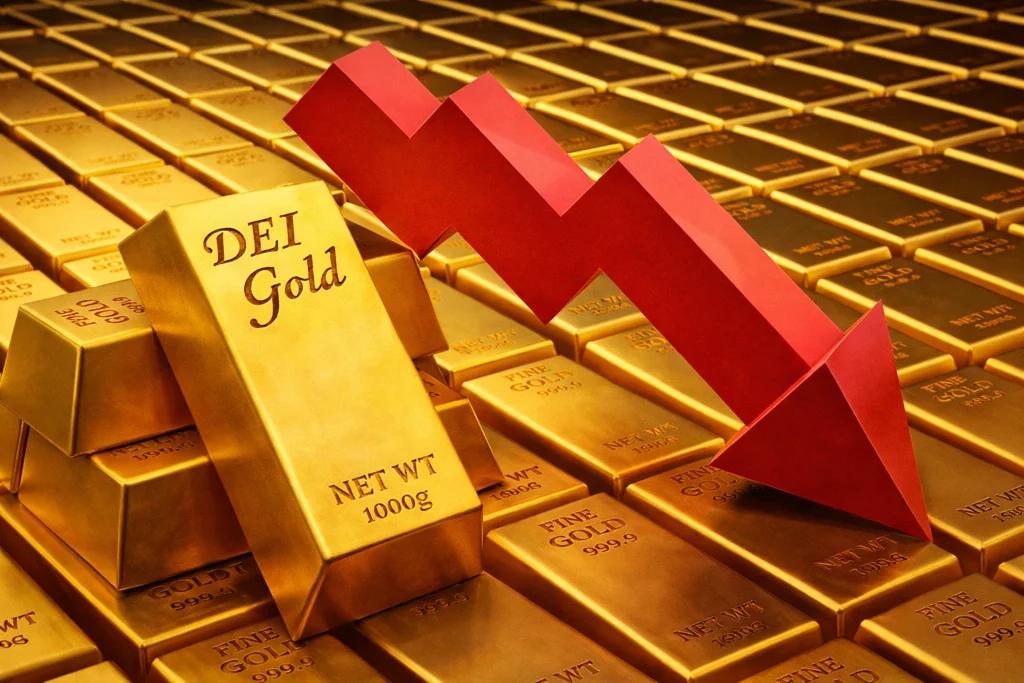
If markets are unstable and fear is rising, shouldn’t gold be soaring instead of sinking?
That’s the exact question many investors across the U.S.—from Wall Street to Las Vegas—are asking right now. Traditionally, gold has been the ultimate safety net during uncertainty. Yet, despite ongoing economic tension and global instability, gold is falling, leaving even experienced investors puzzled.
Here’s the reality: the rules of the game have changed.
Gold no longer reacts to panic the way it used to. Instead, a complex mix of interest rates, currency strength, and investor behavior is reshaping the market.
In this guide, you’ll learn:
- The real reasons behind the gold price falling
- Why traditional safe-haven logic is breaking down
- Key gold price decline reasons backed by market behavior
- Practical strategies U.S. investors can apply immediately
Let’s break it down in a way that actually makes sense.
Why Is Gold Falling Even During Market Panic?
At first glance, this situation feels completely backward. Panic should drive gold up—but that’s no longer guaranteed.
The primary reason gold is falling is that modern markets are driven more by monetary policy than fear itself. Investors today respond faster to interest rates and liquidity than to headlines.
What’s Really Driving the Decline?
- Rising real interest rates
- Strong demand for cash and short-term assets
- Profit-taking after previous gold rallies
Real-World Example
During recent global tensions, instead of buying gold, many institutional investors sold portions of their holdings. Why? Because gold had already surged earlier, making it a prime target for profit-taking.
Expert Insight
Gold reacts to expectations, not just events. If fear is already priced in, prices may fall instead of rise.
Key takeaway: Panic alone doesn’t move gold anymore—policy and positioning do.
How Do Interest Rates Influence Gold Price Falling Trends?
If you’re trying to understand why gold is dropping, this is the most important factor.
Gold doesn’t generate income. It doesn’t pay dividends or interest. So when interest rates rise, investors naturally shift toward assets that do.
What Happens When Rates Increase?
- Bonds and savings accounts become more attractive
- Investors move away from non-yielding assets like gold
- Demand for gold weakens → prices fall
Simple Breakdown
Think of it like this:
Would you rather hold gold earning 0% or a bond paying 5%? Most investors choose the latter.
Case Study
When U.S. Treasury yields rise, gold typically declines. This inverse relationship has become even stronger in recent years.
Pro Tip
Track real interest rates (interest minus inflation). When they rise, expect continued gold price falling trends.
Is a Strong U.S. Dollar Causing Gold Price Decline?
Yes—and it’s one of the biggest hidden forces behind the gold price decline reasons.
Gold is priced globally in U.S. dollars. When the dollar strengthens, gold becomes more expensive for international buyers.
What That Means in Practice
- Strong dollar → reduced global demand for gold
- Lower demand → falling prices
Real Example
When the U.S. economy shows resilience, global investors pour money into dollar-based assets. This strengthens the currency and simultaneously weakens gold.
Why It Matters for U.S. Investors
If you’re investing from places like Las Vegas:
- A strong dollar boosts purchasing powe
- But irt reduces gold’s attractiveness as a hedge
Quick Analogy
Gold and the dollar are like a seesaw—when one rises, the other often falls.
Why Isn’t Inflation Supporting Gold Prices?
Here’s where many investors get confused.
Gold is supposed to protect against inflation. But right now, inflation isn’t helping—it’s actually contributing to the gold price falling.
Why This Happens
Inflation pushes central banks to:
- Raise interest rates
- Tighten financial conditions
- Increase real yields
And as you’ve learned, higher yields hurt gold.
Example Scenario
When inflation rises but interest rates rise even faster, gold struggles. This is exactly what’s happening.
Key Insight
Gold thrives in low-rate, high-inflation environments—not high-rate ones.
Buy or Sell Gold & Silver Coins with Confidence
Work with a trusted Las Vegas coin dealer offering fair pricing, honest appraisals, and expert guidance every step of the way.
Are Investors Losing Confidence in Gold as a Safe Haven?
Not entirely—but their behavior is evolving.
Gold is no longer the only “safe” asset. Investors now have more options.
Where Money Is Going Instead
- High-yield savings accounts
- Short-term government bonds
- Cash positions for flexibility
Case Study
During recent uncertainty, instead of rushing into gold, investors moved into liquid, income-generating assets. This shift reduced demand for gold.
Las Vegas Investment Perspective
In growth-focused markets like Las Vegas:
- Real estate and equities often take priority
- Gold plays a secondary role in diversification
Expert Insight
Modern portfolios are built for flexibility—not just safety.
Did Gold Become Overvalued Before This Drop?
Yes—and this is a critical factor many overlook.
Before the recent decline, gold experienced a strong rally. Prices climbed rapidly, attracting both long-term investors and short-term speculators.
What Happens After a Rapid Rise?
- Investors take profits
- Prices correct downward
Real-World Example
After reaching high levels, gold saw widespread selling—not because investors lost faith, but because they locked in gains.
Pro Tip
Whenever an asset rises too quickly, expect a correction. This is normal market behavior—not a sign of failure.
Should You Be Worried About Gold Price Falling?
Short answer: No—but you should adjust your strategy.
Gold is still valuable, but it’s no longer a “set it and forget it” asset.
Checklist: What to Do Right Now
| Situation | Action |
|---|---|
| Rising interest rates | Reduce gold exposure |
| Weakening dollar | Consider increasing gold |
| High uncertainty | Hold some gold for balance |
| Strong economy | Diversify into growth assets |
Expert Insight
Smart investors don’t panic—they reposition.
What Should Investors Do When Gold Is Falling?
Here’s where you can turn uncertainty into opportunity.
1. Diversify Your Portfolio
Don’t rely solely on gold. Balance your investments with:
- Stocks
- Bonds
- Real estate (especially strong U.S. markets like Las Vegas)
2. Follow Monetary Policy Closely
Interest rate trends are your best indicator of future gold movement.
3. Use Corrections Strategically
Falling prices can create buying opportunities—but only if they align with your long-term goals.
4. Avoid Emotional Decisions
Market panic often leads to poor timing. Stay focused on data, not headlines.
DEI Gold and Silver Coins Customer Feedback
Our customers’ satisfaction drives us daily. We invite you to read testimonials about our dedication to fair pricing, quick payment, and exceptional service. Your feedback helps us improve and maintain the highest standards.
Conclusion
So, why gold is falling despite market panic?
It all comes down to a new reality:
- Interest rates matter more than fear
- The U.S. dollar plays a dominant role
- Investor behavior is evolving
- Market corrections are natural after strong rallies
Gold hasn’t lost its importance—it’s simply reacting to a more complex financial environment.
If you’re investing in the U.S., especially in dynamic regions like Las Vegas, the key is adaptability. Understand the bigger picture, stay diversified, and make decisions based on strategy—not emotion.
Next step: Review your portfolio today. Are you aligned with current market dynamics—or relying on outdated assumptions about gold?
FAQ Section
1. Why is gold falling even during market panic?
Gold is falling because rising interest rates and a strong U.S. dollar are outweighing traditional safe-haven demand. Investors are prioritizing yield over security.
2. What are the main gold price decline reasons?
The biggest factors include higher real interest rates, strong dollar performance, profit-taking, and shifting investor preferences toward income-generating assets.
3. Is gold still a good investment?
Yes, but it should be part of a diversified portfolio rather than the primary asset. Its role has evolved.
4. Should I buy gold while prices are falling?
Buying during dips can be beneficial if it aligns with your long-term strategy and risk tolerance.
5. How does inflation affect gold prices?
Inflation can support gold, but only when interest rates remain low. Rising rates can offset inflation’s positive impact.
6. Does the U.S. dollar impact gold prices?
Yes. A stronger dollar reduces global demand for gold, leading to price declines.
7. Is gold losing its value permanently?
No. Gold remains a valuable asset, but its performance depends on broader economic conditions.