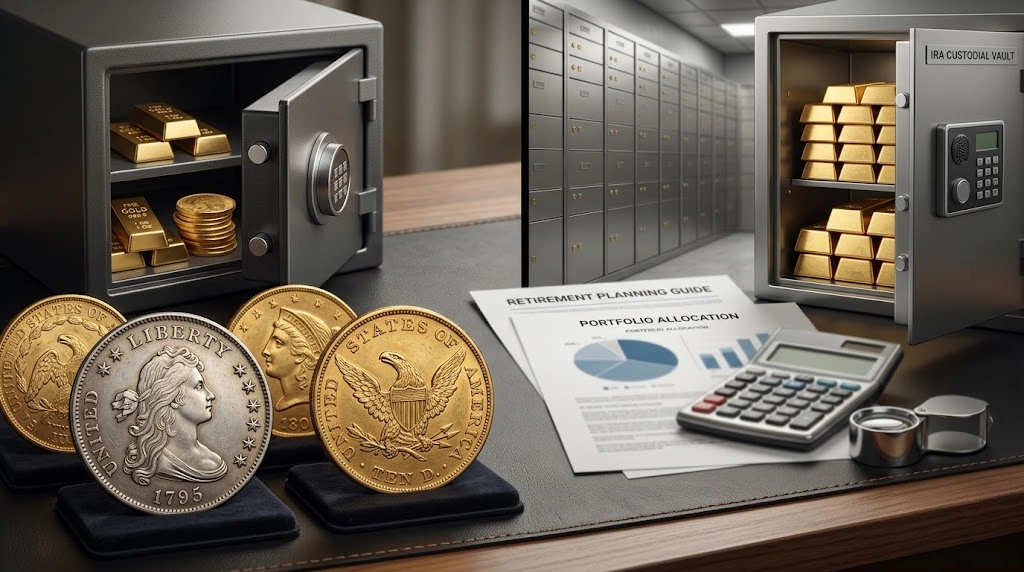
Metals tax is a critical factor many investors overlook when investing in gold and silver. While these precious metals can protect wealth during inflation, geopolitical instability, and market volatility, failing to understand how they are taxed can significantly reduce your overall returns.
Under rules enforced by the Internal Revenue Service (IRS), most physical precious metals are treated differently from stocks, bonds, and mutual funds. Failing to understand these distinctions can significantly reduce your after-tax returns.
This 2026 guide breaks down how bullion and coins are taxed, reporting requirements, estate considerations, IRA rules, and strategies to legally minimize tax exposure.
How the IRS Classifies Precious Metals
For tax purposes, most physical precious metals — including bullion bars and many coins — are classified as collectibles under IRC Section 408(m).
This classification directly affects capital gains rates.
What This Means for Investors
-
Short-term gains (held under 1 year)
Taxed at your ordinary income rate (up to 37% depending on bracket). -
Long-term gains (held over 1 year)
Taxed at a maximum 28% collectibles capital gains rate.
This is higher than the 15–20% long-term capital gains rate applied to most stocks and ETFs.
Bullion vs Coins: Are They Taxed Differently?
Many investors assume bullion and coins are taxed differently. In reality, most physical gold, silver, platinum, and palladium products fall under the collectibles category.
However, nuances exist:
- Government-issued coins may qualify for inclusion in IRAs.
- Certain legal tender coins still receive collectible tax treatment when sold outside retirement accounts.
- Rare and numismatic coins are also taxed at the 28% collectibles rate.
Understanding classification before purchasing helps you estimate true after-tax returns.
Capital Gains Tax on Precious Metals (2026)
Short-Term Capital Gains
If you sell metals within one year:
- Taxed as ordinary income.
- Rate depends on your income bracket.
This often results in higher taxation than long-term holdings.
Long-Term Capital Gains (Collectibles Rate)
If held more than one year:
- Maximum federal rate: 28%
- May also include state capital gains taxes.
Example:
- Purchase gold bullion for $50,000
- Sell two years later for $80,000
- Gain = $30,000
- Federal tax at 28% = $8,400
- Net profit after tax = $21,600
After-tax planning matters.
Common Precious Metals Tax Mistakes
In 2026, common investor errors include:
- Not tracking original purchase cost (cost basis)
- Assuming small transactions don’t need reporting
- Confusing ETF taxation with physical metals
- Ignoring the 28% collectibles rate
- Failing to document storage and dealer records
Even small mistakes can trigger IRS penalties, audits, or overpayment.
Precious Metals ETFs vs Physical Metals
Not all gold exposure is taxed equally.
For example:
- Mining stocks are taxed like regular equities.
- Some gold ETFs are structured as grantor trusts holding physical bullion.
Funds such as SPDR Gold Shares may be taxed similarly to physical metals because shareholders are treated as owning a proportionate share of the underlying bullion.
This surprises many investors.
Always review fund structure before investing.
IRS Reporting Requirements
All gains from selling precious metals must be reported, regardless of size.
Key Forms
- Form 8949: Reports capital gains and losses
- Schedule D: Summarizes capital gains
- 1099-B: Filed by certain dealers for reportable transactions
Even if a dealer does not issue a 1099-B, you are still legally required to report gains.
Failure to report can result in:
- Accuracy penalties
- Interest charges
- Potential audit exposure
Accurate recordkeeping is essential.
Dealer Reporting Thresholds for Precious Metals
Large precious metals transactions may also trigger dealer reporting obligations under rules enforced by the Internal Revenue Service. When certain quantities of bullion products are sold, dealers may be required to file Form 1099-B with the IRS. These thresholds typically apply to bulk sales of widely traded bars and coins rather than small retail transactions. Even if a dealer does not issue a reporting form, investors remain legally responsible for reporting all capital gains on their tax returns and maintaining accurate purchase and sale records.
State Sales Tax & Storage Jurisdiction
Federal tax is only part of the picture.
State-level rules vary:
- Some states fully exempt bullion from sales tax.
- Others tax coins but exempt bars.
- Some tax all precious metals purchases.
This can increase acquisition costs by 5–10%.
Storage location may also affect:
- Sales tax exposure
- Estate handling
- Reporting obligations
Jurisdictional planning is often used by high-net-worth investors for legal optimization — not tax evasion.
Offshore Storage Considerations
Some investors store bullion internationally for diversification and geopolitical risk management.
However, offshore storage can trigger additional reporting requirements:
- FBAR (if classified as a foreign financial account)
- Form 8938 (FATCA reporting in certain cases)
The IRS has increased global compliance oversight in recent years. Offshore storage must be properly structured and reported.
Rare & Numismatic Coins
Rare coins are also classified as collectibles.
If sold after more than one year:
- Gains are taxed at up to 28%.
Short-term gains are taxed at ordinary income rates.
Investors buying rare coins for appreciation should factor in tax drag when estimating ROI.
Estate Planning & Inheritance Rules
Precious metals planning doesn’t stop at capital gains.
Step-Up in Basis
When heirs inherit precious metals:
- Cost basis typically resets to fair market value at date of death.
- This may eliminate capital gains on prior appreciation.
This rule can significantly preserve family wealth.
Gifting Precious Metals
Gifting metals above the annual exclusion threshold must be reported to the IRS.
Important:
- The recipient generally receives a carryover basis.
- Capital gains tax liability transfers with the asset.
Strategic estate planning can reduce multi-generational tax exposure.
Precious Metals IRAs (Tax-Advantaged Option)
A Precious Metals IRA allows investors to hold certain approved bullion inside a retirement account.
Benefits:
- Tax-deferred growth (Traditional IRA)
- Tax-free withdrawals in retirement (Roth IRA)
- Avoid immediate capital gains taxation
IRS requirements include:
- Approved metals meeting minimum fineness standards
- IRS-approved custodian
- Approved depository storage
- No personal possession allowed
Failure to comply may result in account disqualification.
Global Precious Metals Regulation
Precious metals markets are increasingly influenced by global regulation and institutional oversight. Industry groups such as the World Gold Council and financial regulators continue working to improve transparency, ethical sourcing, and supply chain verification across the bullion industry. These efforts aim to strengthen investor confidence and prevent illegal mining or unverified bullion from entering global markets. For investors, purchasing metals from reputable dealers and maintaining proper documentation has become an important part of responsible precious metals ownership.
Market Trends Impacting 2026 Metals Strategy
Tax planning should align with market cycles.
According to industry data from the World Gold Council, institutional demand continues to influence pricing.
Key 2026 Trends
Central Bank Gold Accumulation
Governments increasing gold reserves.
Industrial Silver Demand
Driven by solar, EVs, and semiconductors.
Platinum & Hydrogen Economy
Fuel-cell expansion increasing structural demand.
Supply Constraints
Rising mining costs and environmental regulations limiting output.
Understanding macro trends helps investors time sales strategically to improve after-tax returns.
Buy or Sell Gold & Silver Coins with Confidence
Work with a trusted Las Vegas coin dealer offering fair pricing, honest appraisals, and expert guidance every step of the way.
Advanced Tax Planning Strategies
1. Hold Long-Term
Holding metals over one year avoids ordinary income taxation and qualifies for the 28% collectibles rate.
2. Use Tax-Loss Harvesting
Unlike securities, wash sale rules currently do not apply to physical precious metals. Investors can harvest losses and re-enter positions without waiting periods.
3. Offset Gains
Sell underperforming investments to offset precious metals gains.
4. Consider Asset Allocation
Many institutional portfolios allocate:
-
5%–15% to precious metals
This reduces volatility while preserving inflation protection.
Physical vs Paper Metals
Sophisticated investors often balance:
- Physical bullion (wealth insurance)
- ETFs or mining stocks (liquidity and flexibility)
This avoids forced liquidation of physical metals during short-term market swings.
Real-World Example
Silver Bullion Sale
- Purchase: $25,000
- Sale after 18 months: $40,000
- Gain: $15,000
- Federal tax at 28%: $4,200
Net gain: $10,800 (before state tax)
After-tax planning dramatically changes net returns.
Avoiding IRS Penalties
To remain compliant:
- Track cost basis and transaction records
- Understand dealer reporting thresholds
- File required forms accurately
- Consult licensed tax professionals when needed
The IRS enforces strict penalties for misreporting collectibles.
FAQ Section
1. Are bullion and coins taxed the same?
No, bullion is taxed as a commodity, while certain coins may be classified as capital assets, which can result in different tax rates.
2. What is the tax rate on precious metals in 2026?
Precious metals like gold, silver, and platinum are taxed at a higher long-term capital gains rate when held for over a year, due to their classification as collectibles.
3. Do I need to report small precious metals transactions?
All gains from the sale of precious metals must be reported, even below the reporting threshold, to comply with IRS rules. Understanding metals tax, including capital gains and collectible rates, is essential for protecting your investments and staying fully compliant.
4. Can I avoid taxes on precious metals?
While you cannot avoid taxes altogether, using strategies like holding for the long term, using a Precious Metals IRA, or offsetting gains with losses can minimize your tax burden.
5. How can I reduce taxes on my precious metals investments?
Consider holding your precious metals for over a year to benefit from long-term capital gains rates, or invest through a Precious Metals IRA to defer taxes until retirement.
6. Do all coins face the 28% tax rate?
No, only certain coins classified as collectibles face the higher collectibles tax rate. American Eagle coins, for example, may be taxed differently than foreign bullion coins.
7. Are there any exemptions for coin collectors?
Some coins, particularly those considered legal tender or issued by government mints, may be taxed differently than other collectible coins.
Key Takeaways for 2026 Investors
- Most physical precious metals are taxed as collectibles.
- Long-term gains are capped at 28% federally.
- Short-term gains may reach ordinary income rates.
- Reporting compliance is mandatory.
- IRAs offer tax-deferral opportunities.
- Estate planning can eliminate decades of unrealized gains.
- After-tax returns matter more than raw price appreciation.
Is It Safe to Buy Gold Coins Online?
Absolutely. With DEIGOLDANDSILVERCOINS, you get a safe, secure, and fully insured transaction process. Our reputation, volume, and customer satisfaction prove it.
We’re here 24/7 to help guide your investment. No matter if you’re just getting started or looking to expand your collection, our dedicated experts are only a message or a call away.
Our Customer Reviews
With a 4.9-star rating, our customers consistently praise our reliability, fast shipping, and quality products. See why investors continue to trust DEIGOLDANDSILVERCOINS through the experiences and success stories they’ve shared.
Final Thoughts
Precious metals remain a powerful hedge against inflation, currency debasement, and geopolitical risk. But without proper tax planning, a significant portion of gains can be lost to avoidable liabilities.
Understanding IRS classification rules, capital gains treatment, reporting requirements, and strategic planning options is essential in 2026.
Before making major transactions, consult a qualified CPA or tax advisor to ensure compliance with current regulations enforced by the Internal Revenue Service.
Smart metals investing isn’t just about buying gold — it’s about keeping more of what you earn.