You didn’t plan on selling jewelry on this trip. Maybe it’s an old ring you never wear, gold you brought as backup cash, or something inherited that’s just been sitting in a drawer — and now that you’re in Las Vegas, you’re wondering if this is the moment to finally cash it in. Selling gold in Las Vegas as a tourist is genuinely easier than in most cities, simply because the market here is so active — but that same demand also attracts less scrupulous buyers looking to catch visitors who don’t have time to shop around. This guide covers how the process actually works, what affects your payout, how to spot a fair offer, and how to protect yourself if you’re only in town for a few days.
Why Las Vegas Is Different for Selling Gold
Las Vegas has one of the most active precious metals markets in the country, driven by a mix of long-term residents, collectors, and constant tourist traffic. That volume means more buyers competing for your business, which is generally good news for sellers — more competition tends to mean better pricing. But it also means more buyers positioned specifically to catch visitors who need cash fast and won’t be around long enough to negotiate or return if something feels off.
Nevada law requires dealers to record identification and transaction details for gold and silver purchases, the same as anywhere else in the country, so a legitimate transaction here is just as documented and traceable as one back home. That’s a good thing for you as a seller — it means reputable dealers have a real paper trail and accountability, not less of one just because you’re a visitor.
How Selling Gold as a Tourist Actually Works
The process for a visitor is nearly identical to a local resident’s, with one key difference: timing. Here’s the general flow:
- Bring the item and valid photo ID. A driver’s license or passport is standard; dealers are legally required to verify identity on precious metals purchases.
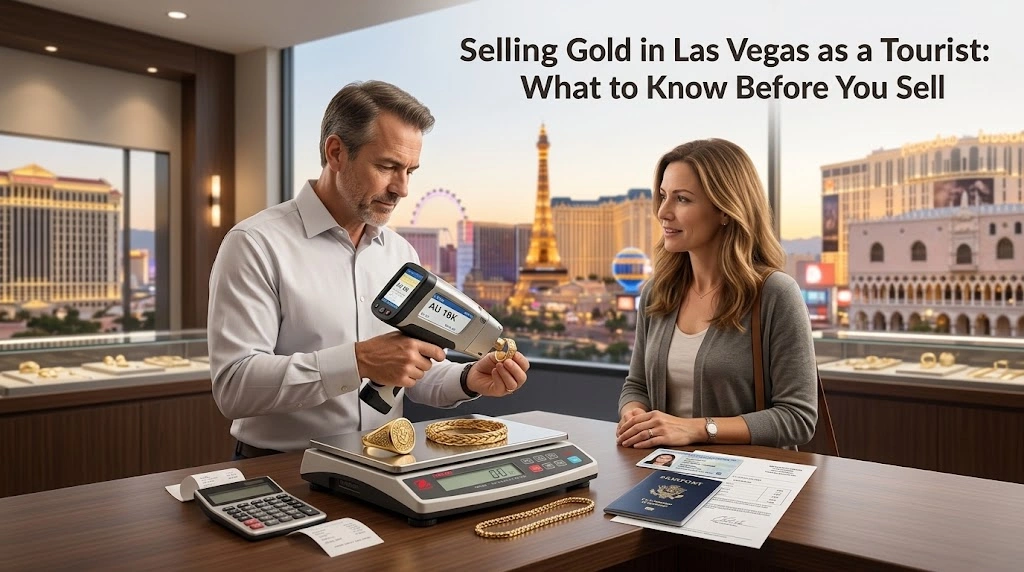
- The dealer weighs and tests the item. This typically involves a scale and a purity test — often XRF testing, a non-destructive method that uses X-ray fluorescence to identify the metal’s exact composition without cutting or damaging the piece.
- You receive an offer based on melt value. Melt value is what the raw gold or silver content is worth if melted down, based on the day’s spot price and the item’s purity and weight — this is the baseline for most jewelry and scrap transactions.
- You accept or decline — no obligation. A trustworthy dealer explains how the number was calculated and doesn’t pressure you to accept on the spot.
- Same-day payment. If you accept, payment is typically immediate, which matters when you’re only in town briefly.
The entire process, from walk-in to walkout, usually takes well under an hour for a standard jewelry or coin evaluation.
What Determines Your Payout
Several factors affect what you’ll actually be offered, and understanding them helps you evaluate whether a quote is reasonable:
- Purity (karat or fineness). 24-karat gold is pure gold; 18k, 14k, and 10k contain progressively less gold mixed with other metals. Purity is the single biggest factor in payout.
- Weight, typically measured in grams or troy ounces — a troy ounce (about 31.1 grams) is the standard unit used in precious metals pricing, and it’s slightly heavier than a standard “ounce” used for everyday items.
- Current spot price, which moves daily based on global markets.
- Craftsmanship or brand value, which matters for resale as jewelry but not for melt value — a scrap buyer pays for the metal, not the design.
- Gemstones, which are typically appraised and paid separately from the metal itself, if at all, depending on the dealer.
A Practical Example: A Visitor Selling an Inherited Ring
Consider a visitor from out of state who inherited a 14-karat gold ring and brings it in on the second day of a trip, unsure what it’s worth. A dealer weighs the ring at 6 grams, confirms the 14-karat purity through XRF testing, and calculates melt value based on that day’s gold spot price. Because the ring has no significant gemstone or notable maker’s mark, the offer is based almost entirely on melt value rather than design or brand.
The visitor compares this quote against a rough estimate calculated using the day’s spot price before arriving, confirms the numbers align reasonably, and accepts the same-day cash offer — leaving with payment well before their flight home. This is the kind of straightforward transaction that a same-day gold buyer near the Strip can typically complete in one visit, without requiring a return trip or follow-up appointment.
Vacation Gold Selling: What to Watch For
Selling jewelry while visiting Las Vegas comes with a few tourist-specific risks worth knowing before you walk in anywhere:
Red Flag | Why It Matters |
Offer given before any weighing or testing | A legitimate quote requires actual measurement — a number given on sight is a guess, not an appraisal |
Pressure to “decide now” | Reputable buyers let you leave and think it over; urgency tactics are a warning sign |
No explanation of how the offer was calculated | You should be told the purity, weight, and spot price used — vague math is a red flag |
Cash-only, no receipt offered | A real transaction leaves a paper trail; insist on documentation |
Location with no visible storefront or business history | A shop with an actual address and track record is easier to hold accountable than a pop-up counter |
Because tourists often don’t have time to comparison-shop across multiple dealers, it’s worth doing a five-minute check of the day’s gold or silver spot price on your phone before you walk in anywhere — that alone gives you a baseline to judge any offer against.
Same-Day Gold Buyer Near the Strip: Setting Realistic Expectations
If you’re searching for a same-day option close to where you’re staying, know that many of the most established, licensed dealers in the Las Vegas area — including long-running numismatic and bullion specialists — aren’t literally on Las Vegas Boulevard itself, but sit just a short drive away in nearby commercial areas, easily reachable by rideshare in well under 20 minutes from most Strip resorts. A short trip off the Strip to a dedicated, licensed dealer often gets you a more knowledgeable evaluation — particularly if your item has any collector or numismatic value beyond its melt value — than a walk-up counter positioned purely for tourist foot traffic.
What to Bring With You
To make the visit as fast as possible:
- Valid government-issued photo ID (driver’s license or passport)
- The item itself, ideally not cleaned or polished beforehand — original condition can matter for anything with collector value
- Any documentation you have, such as an appraisal, purchase receipt, or certification paperwork, though none of this is required
- A rough idea of current spot price, checked shortly before your visit, so you have a baseline for comparison
Getting Started
If you’re visiting Las Vegas and considering selling gold, jewelry, or coins, the safest approach is a licensed, established dealer who explains their process clearly and doesn’t rush you into a decision. Ask how the offer is calculated, confirm your ID requirement in advance if you’re short on time, and don’t feel obligated to accept the first number you hear — even on a tight schedule, a five-minute comparison against another quote or the day’s spot price can meaningfully change your payout.
FAQ
Q1. Can tourists legally sell gold in Las Vegas?
Yes. Tourists can sell gold, silver, or jewelry the same as residents, provided they present valid government-issued photo ID. Nevada requires dealers to record identification and transaction details on precious metals purchases, which applies equally to visitors and locals.
Q2. Do I need an appointment to sell gold as a visitor?
Not usually. Many established dealers accept walk-ins for standard jewelry or coin evaluations, though calling ahead can reduce wait time, especially during busy tourist periods or if you’re bringing a larger collection that needs more careful appraisal.
Q3. How fast can I get paid for selling gold in Las Vegas?
Same-day payment is standard for most straightforward jewelry, coin, or bullion transactions once you accept an offer. The evaluation itself — weighing, testing purity, and calculating melt value — typically takes well under an hour.
Q4. Will I get less money as a tourist than a local would?
Not at a reputable, licensed dealer — pricing is based on purity, weight, and the day’s spot price, not on whether you’re a visitor. The risk for tourists is less about lower pricing at legitimate shops and more about opportunistic buyers counting on visitors not having time to compare offers.
Q5. Should I clean my jewelry before selling it?
No. Leave items in their original condition. Cleaning or polishing won’t increase melt value and can actually remove details relevant to age, maker’s marks, or collector value that a knowledgeable dealer would otherwise be able to identify and price accordingly.
Conclusion
Selling gold or jewelry while visiting Las Vegas is straightforward when you know what to expect: valid ID, a purity and weight-based evaluation, and same-day payment from a legitimate dealer. The real risk isn’t the process itself — it’s rushing into an offer from a buyer counting on your limited time in town. A quick spot-price check before you walk in, combined with a licensed dealer who explains their pricing clearly, puts you in a strong position either way. DEI Gold & Silver Coins, a Las Vegas dealer certified by CAC, NGC, PCGS, GIA, and AGL with over 50 years of combined experience, offers same-day evaluations for visitors who want a straightforward, transparent transaction before they head home