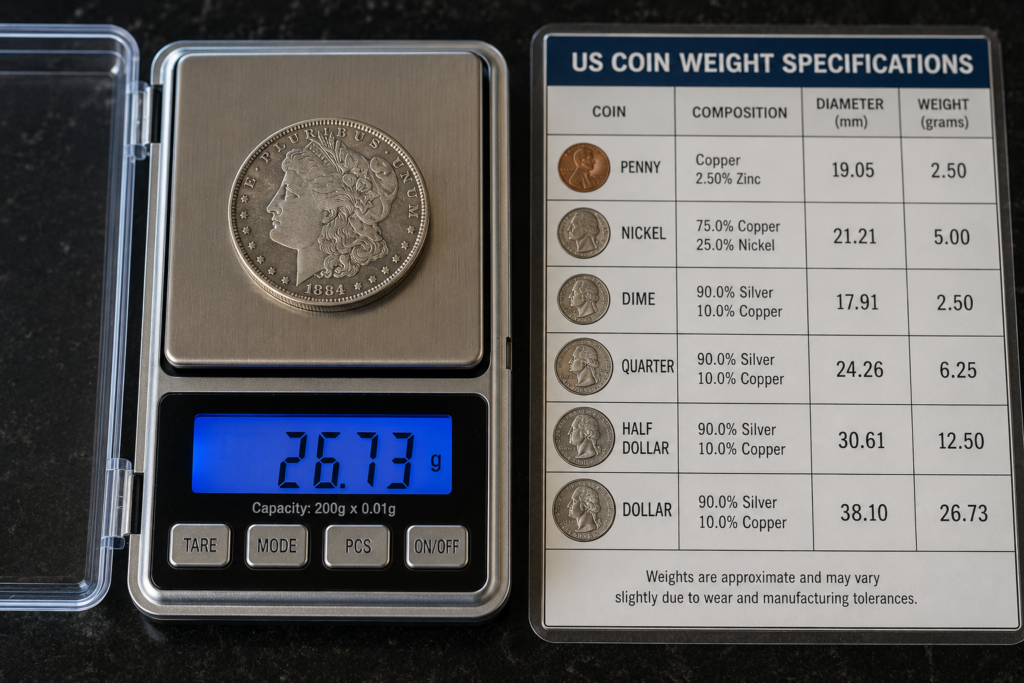
A collector called our showroom last week, kitchen scale in hand, trying to figure out if a “silver” quarter he’d found in an old jar was actually pre-1965 silver or just a modern clad coin — and he wasn’t sure what number he was even supposed to see. That’s exactly the kind of question a good coin weight specifications chart answers in seconds, without needing a lab or an expert on the phone.
This guide pulls together the official weights, diameters, and compositions for the U.S. coins collectors run into most often — modern circulating coins, pre-1965 silver, and popular bullion issues — so you can check what you have against the real numbers.
Coin Weight Specifications Chart: Modern US Circulating Coins
These are today’s everyday coins, all clad (layered) compositions rather than precious metal:
| Coin | Diameter | Weight | Composition |
| Lincoln cent (1982–present) | 19.05 mm | 2.500 g | Copper-plated zinc |
| Jefferson nickel | 21.21 mm | 5.000 g | Cupro-nickel |
| Roosevelt dime | 17.91 mm | 2.268 g | Copper-nickel clad |
| Washington quarter | 24.26 mm | 5.670 g | Copper-nickel clad |
| Kennedy half dollar (post-1971) | 30.61 mm | 11.340 g | Copper-nickel clad |
| Presidential/Sacagawea dollar | 26.49 mm | 8.100 g | Manganese-brass clad |
US Coin Diameter and Weight Guide: Pre-1965 Silver Coins
This is the chart most people actually come looking for — the one that tells you whether that old coin in a jar or estate box is genuine 90% silver:
| Coin | Diameter | Weight | Silver Content |
| Silver dime (pre-1965) | 17.9 mm | 2.50 g | 90% silver |
| Silver quarter (pre-1965) | 24.3 mm | 6.25 g | 90% silver |
| Silver half dollar (pre-1965) | 30.6 mm | 12.50 g | 90% silver |
| Morgan/Peace silver dollar | 38.1 mm | 26.73 g | 90% silver |
Notice that pre-1965 silver coins are only slightly heavier than their modern clad counterparts in most denominations — which is exactly why weight alone isn’t always a reliable identifier on its own for dimes and quarters, and diameter, edge reeding, and that distinctive silver “ring” when dropped matter too. This 90% silver is also commonly referred to as 90%, 40%, 35% US silver coin. If you are looking to verify vintage silver dollars, their precise specifications are essential to check.
Gold and Silver Bullion Coin Specifications
For modern bullion, exact specifications matter even more, since these coins are bought and sold based on guaranteed precious metal content:
| Coin | Diameter | Weight | Purity |
| American Silver Eagle (1 oz) | 40.6 mm | 31.101 g | .999 fine silver |
| American Gold Eagle (1 oz) | 32.7 mm | 33.931 g | .9167 fine gold (22K) |
| American Gold Buffalo (1 oz) | 32.7 mm | 31.108 g | .9999 fine gold |
Note that the American Gold Eagle weighs more than a “pure” troy ounce of gold (33.931 g vs. 31.103 g) because it’s alloyed with copper and silver for durability — it still guarantees a full troy ounce of actual gold content, just distributed across a heavier coin.
Why These Numbers Matter for Authentication
Weight and diameter are two of the fastest, most accessible ways to catch an obvious counterfeit before you even reach for testing equipment. A coin that’s noticeably off-spec — too light, too thick, or the wrong diameter — is an immediate red flag, since precise tolerances are one of the hardest things for counterfeiters to replicate convincingly, especially on bullion coins where the metal content itself is the entire value proposition.
That said, weight and diameter checks are a first screen, not a final verdict. Sophisticated counterfeits, including tungsten-filled gold pieces, can be engineered to match legitimate weight and dimensions closely, which is why professional authentication — including XRF testing or specific gravity checks — remains the only way to be fully confident on anything beyond common circulating coins.
Buy or Sell Gold & Silver Coins with Confidence
Work with a trusted Las Vegas coin dealer offering fair pricing, honest appraisals, and expert guidance every step of the way.
How to Use This Chart to Spot a Fake or Counterfeit
Weigh the coin on a scale accurate to at least 0.01 grams, ideally a jeweler’s or reloading scale rather than a kitchen or postal scale.
Measure the diameter with digital calipers if possible.
Compare both numbers against the chart above for the coin’s claimed denomination or type.
Treat any mismatch as a reason for professional evaluation — don’t assume a coin is fake or genuine based on a single measurement alone, especially for valuable bullion or rare coins.
Have a Coin You Want Verified? Bring It In
A weight and diameter chart can point you in the right direction, but nothing replaces a hands-on evaluation from a numismatist who checks specifications, surface details, and authenticity together.
Call or text DEI Gold and Silver Coins at (702) 460-5188 or contact our showroom to schedule a same-day appraisal. Whether you’re identifying an old coin, verifying bullion, or curious what something in an inherited collection is worth, our team will give you a clear, accurate answer.
Frequently Asked Questions
A pre-1965 90% silver quarter weighs 6.25 grams and measures 24.3 mm in diameter — very close to a modern clad quarter’s 5.670 grams, which is why weight alone can be a subtle difference to catch without a precise scale.
33.931 grams. It weighs more than a pure troy ounce (31.103 grams) because it’s alloyed with copper and silver for durability, while still guaranteeing a full troy ounce of gold content.
Weight and diameter checks are a useful first screening step and can catch obvious fakes, but sophisticated counterfeits can be engineered to closely match legitimate specifications. Professional testing is the only way to be fully certain, especially for valuable or bullion coins.
Both were struck to the same U.S. Mint specification: 26.73 grams, 38.1 mm in diameter, and 90% silver — the standard silver dollar spec used for both series despite their different designs and mint years.
DEI Gold and Silver Coins offers same-day coin identification and authentication at our Las Vegas showroom, using both precision measurement and professional testing equipment — call or text (702) 460-5188 to schedule an appointment.