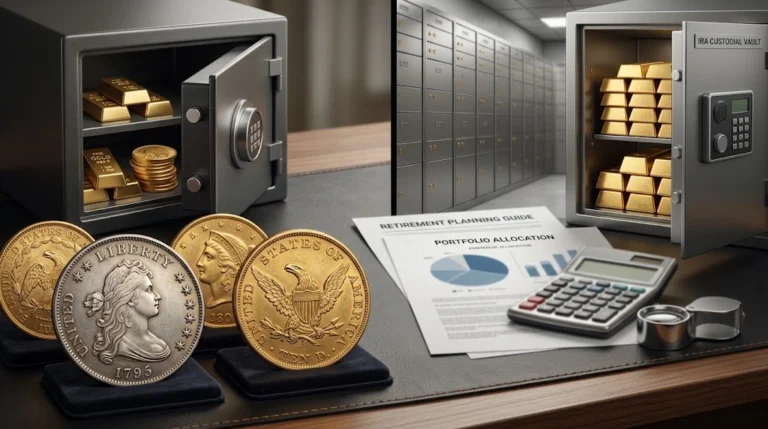
Metals tax rules trip up many gold and silver investors in three places: the collectibles rate, the records you need to prove what you paid, and reporting rules that are narrower than many people assume. This guide explains how U.S. federal tax applies when you sell physical gold and silver, what dealers do and do not report, and what changes for inherited coins, gifts, ETFs and IRAs.
This is general education, not tax advice. Tax rules change and individual situations differ, so confirm the details with a CPA or tax professional before a large sale.
The short version
- Physical gold and silver, including coins, bars, rounds and rare coins, are treated as collectibles for federal capital gains purposes.
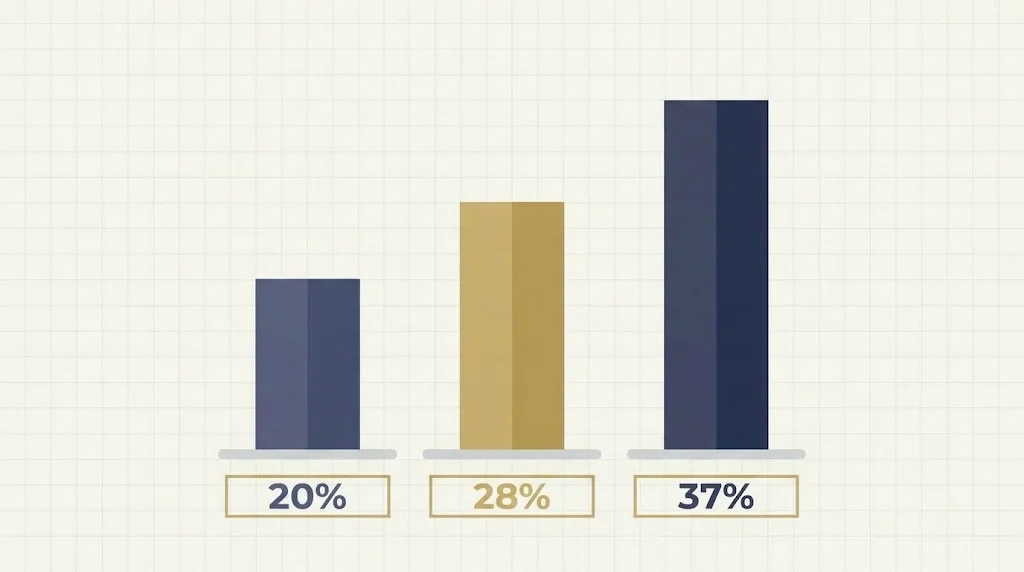
- A gain on metal held more than one year is taxed at your ordinary rate, capped at 28%. A gain on metal held one year or less is taxed at ordinary income rates, up to 37%.
- You owe tax on a gain whether or not a dealer sends you a form.
- Your gain is the sale price minus your cost basis, so receipts matter.
- Inherited metals typically get a basis reset to value at date of death. Gifted metals keep the giver’s basis.
How the IRS Classifies Gold and Silver
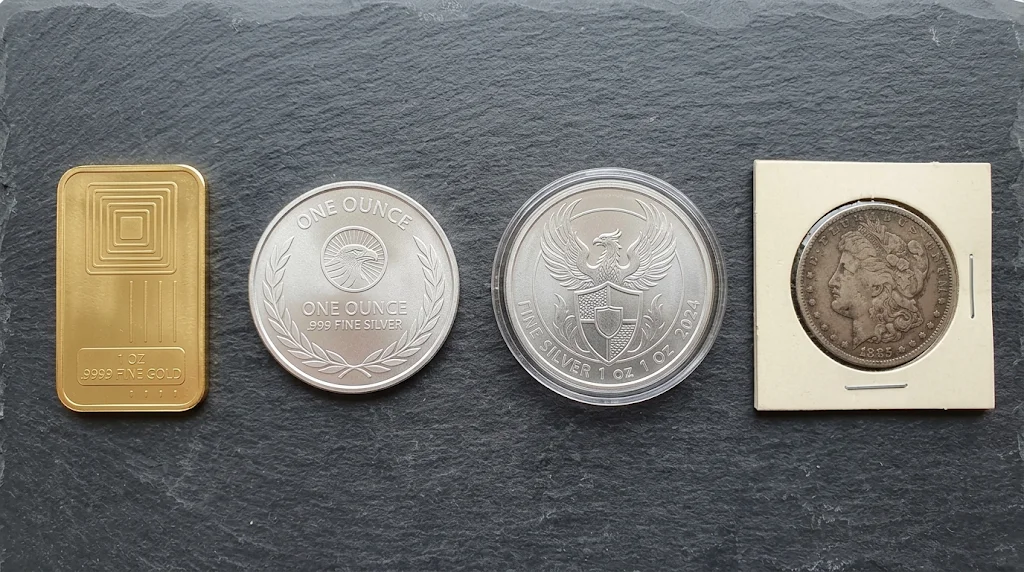
For capital gains purposes, the IRS treats gold, silver, platinum and palladium bullion and coins as collectibles. The definition comes from Internal Revenue Code Section 408(m), which the capital gains rules borrow.
This surprises people because U.S. Mint bullion such as American Eagles can be held in an IRA without being treated as a collectible there. That IRA exception does not carry over to the capital gains rate. When you sell American Eagles outside a retirement account, the gain is still collectibles gain. In practice, the collectibles rate applies to bars, rounds, bullion coins from any mint, and rare or numismatic coins alike.
How Metals Tax Works When You Sell Gold and Silver
Short-term vs. long-term
If you held the metal more than one year, the gain is long-term. If you held it one year or less, it is short-term and taxed as ordinary income at your bracket, which tops out at 37%.
The 28% rate is a ceiling, not a flat rate
For a long-term collectibles gain, you pay your ordinary rate, capped at 28%. If your bracket is below 28%, you pay the lower rate. This is higher than the 0%, 15% and 20% rates that apply to long-term gains on most stocks. Higher-income taxpayers may also owe the 3.8% net investment income tax on top, which applies above $200,000 of modified adjusted gross income for single filers and $250,000 for joint filers.
Worked example (illustrative)
You buy gold for $50,000 and sell it two years later for $80,000. The gain is $30,000. Ignoring state tax and selling costs:
| Your situation | Federal tax on the gain | Left after federal tax |
|---|---|---|
| Ordinary bracket 22% (long-term) | about $6,600 | about $23,400 |
| Ordinary bracket 32% or higher (long-term, capped at 28%) | $8,400 | $21,600 |
| Same gain sold within one year at 35% | $10,500 | $19,500 |
If the net investment income tax applies, add 3.8% of the gain, which is $1,140 on $30,000. Selling costs reduce the gain, and state taxes may add to the total.
Cost Basis: The Number Most Sellers Can’t Prove
Your taxable gain is the sale price, minus selling costs, minus your cost basis. Basis is generally what you paid, including the premium over spot and any fees or shipping that were part of acquiring the metal.
Basis follows the specific coins or bars you sell. If you built a position gradually, as with dollar-cost averaging into gold and silver, you need records showing what you bought, when and at what price. Without receipts, proving basis can be difficult.
Two related rules matter here. Trading one coin or bar for another is a taxable sale and a new purchase, because like-kind exchange treatment under Section 1031 is limited to real property. And basis works differently for inherited and gifted metals, covered below.
What Gets Reported, and by On your own return
You must report every sale, regardless of size, on Form 8949 and Schedule D. Collectibles gains are calculated separately using the 28% Rate Gain Worksheet in the Schedule D instructions. This applies even if no dealer sends you a form. IRS Topic 409 covers the capital gains basics.
Dealer Form 1099-B
Dealers file Form 1099-B only for certain sales. Under the IRS instructions, a precious metals sale is not reportable unless the metal is in a form that could settle a CFTC-approved futures contract and the quantity meets that contract’s minimum. In practice this points to large bar quantities, such as gold bars totaling one kilogram or more at .995 fineness, or 1,000-ounce silver bars.
The IRS posted a correction to the 2025 and 2026 instructions on January 30, 2026, clarifying that small coin sales below those contract minimums are not reportable. Dealers apply the rules to specific coin types in different ways, and some file voluntarily, so ask your dealer how they handle it. The current wording is on the IRS’s Form 1099-B page. Sales by one customer within 24 hours are aggregated, and splitting sales to avoid reporting can create problems.
A 1099-B reports proceeds, not profit. Not receiving one does not mean a sale is tax-free.
Form 8300 for large cash purchases
Separately, a dealer must file Form 8300 when it receives more than $10,000 in cash in a transaction or related transactions. Currency counts. Wire transfers and personal checks generally do not. This is an anti-money-laundering report on the payment, not a tax on your gain, and splitting payments to stay under the limit is itself a violation.
Gold and Silver ETFs, Mining Stocks and Physical Metal
Mining stocks are ordinary equities, so long-term gains get the 0%, 15% or 20% rates. ETFs structured as grantor trusts that hold physical metal, such as SPDR Gold Shares or iShares Silver Trust, are generally taxed as if you owned the metal, so long-term gains face the same 28% cap. Funds that use futures or other structures follow different rules, so read the prospectus. For how these compare beyond tax, see physical gold vs. gold ETFs vs. mining stocks.
Rare and Collectible Coins
Rare and numismatic coins are collectibles too, so a long-term gain is taxed at your ordinary rate up to 28%. What differs is basis and value. A rare coin’s price depends on grade, rarity and demand rather than metal content alone, and your basis includes what you paid, including any premium. Our guide to numismatic premiums vs. bullion explains why the two behave differently.
A loss on a coin held as an investment is generally a capital loss. A loss on a coin held purely for personal enjoyment is generally not deductible. Frequent buying and selling can also raise the question of whether you are operating a business, so talk to a tax professional if that describes your activity.
Selling at a Loss and Offsetting Gains
Capital losses offset capital gains. If losses exceed gains, up to $3,000 a year can offset ordinary income, and the rest carries forward.
The wash-sale rule disallows a loss when you buy substantially identical stock or securities within 30 days. It is written for securities, and physical gold and silver have generally not been treated as covered. Rules can change, and some metal products are securities, so confirm how it applies to yours before relying on it. Do not sell purely to manufacture a loss without a genuine reason.
Inherited and Gifted Metals
Inherited coins and bullion
Heirs typically receive a basis equal to fair market value at the date of death. That can erase tax on appreciation that occurred during the original owner’s life, and inherited property is generally treated as long-term regardless of how long the heir holds it. A documented appraisal near the date of death helps establish that basis. Our checklist for sorting an inherited coin collection walks through the first steps, and DEI GOLD AND SILVER COINS offers coin appraisals in Las Vegas.
Most estates fall below the federal estate tax exemption, so for most families the practical question is basis, not estate tax.
Gifts
For gifts, the recipient generally takes the giver’s basis and holding period, so the tax on appreciation travels with the metal. In 2026, you can give up to $19,000 per recipient without filing a gift tax return. Larger gifts require Form 709, though tax is usually not due until the lifetime exemption is used.
Buy or Sell Gold & Silver Coins with Confidence
Work with a trusted Las Vegas coin dealer offering fair pricing, honest appraisals, and expert guidance every step of the way.
Precious Metals IRAs
Metals held inside a self-directed IRA are taxed differently. In a traditional IRA, growth is tax-deferred and withdrawals are taxed as ordinary income, not at the 28% collectibles rate. In a Roth IRA, qualified withdrawals are tax-free.
The IRS rules are strict. The IRA must use an approved custodian, the metals must meet minimum fineness standards or be certain U.S. Mint coins, and they must be held by the custodian or an approved depository, not at home. Buying collectible coins with IRA funds can be treated as a taxable distribution. Be wary of any offer to keep IRA metals at home. For the trade-offs, see Gold IRA vs. physical gold.
State Taxes: Nevada and Elsewhere
Nevada has no state personal income tax, so Nevada residents owe no state tax on gains from selling metals.
Sales tax is more product-specific. Nevada’s rules treat coins sold at a premium differently from bullion valued mainly for its metal content, and the exemptions are narrow. Many coins sold at a premium are taxable, while some bars and rounds may not be. Ask the dealer how a specific item is taxed, or check with the Nevada Department of Taxation.
In other states, income tax on gains and sales tax exemptions vary widely. If you live in a state with an income tax, add it to your estimate.
Records to Keep
- Purchase invoices and receipts showing date, product, quantity and price paid, including premiums and fees.
- Shipping and insurance costs tied to acquiring the metal.
- Sale confirmations and any Form 1099-B you receive.
- For inherited metals, a date-of-death appraisal and estate paperwork.
- For gifts, the giver’s original purchase records.
- A simple log tying each coin or bar to its purchase and any later sale.
FAQ
1. Are gold and silver coins and bars taxed the same way?
For capital gains purposes, yes. Bars, rounds and coins, including American Eagles and rare coins, are collectibles. Where they differ is in dealer reporting, not in the tax rate.
2. What is the metals tax rate on gold and silver for an investor?
Held one year or less, your ordinary rate, up to 37%. Held more than one year, your ordinary rate capped at 28%. A 3.8% net investment income tax may apply on top, and state tax may add to it.
3. Do I have to report small sales
Yes. You must report every sale on Form 8949 and Schedule D regardless of size, even if no dealer sends a form.
4. If my dealer does not send a 1099-B, is the sale tax-free?
No. A 1099-B is a dealer report of proceeds under specific rules. Your obligation to report and pay tax on any gain does not depend on receiving one.
5. Can I avoid tax on precious metals?
You cannot avoid tax on a gain, but you can plan within the rules: holding more than one year, keeping complete records, offsetting gains with losses, using an IRA, and understanding basis for inherited metals.
6. Are inherited coins taxed?
Heirs typically receive a basis equal to fair market value at the date of death, so tax generally applies only to appreciation after that date. A dated appraisal helps document it.
Conclusion
Taxes on gold and silver come down to classification, timing and records. Most physical metal is a collectible taxed at up to 28% on long-term gains, you owe that tax whether or not a dealer reports the sale, and your cost basis determines how much of a sale is actually a gain. Keep your receipts, know how inherited and gifted metals are treated, and confirm the details with a tax professional before a large transaction.
This article is general information and not tax or legal advice.
By DEI GOLD AND SILVER COINS | Articles by DEI GOLD AND SILVER COINS