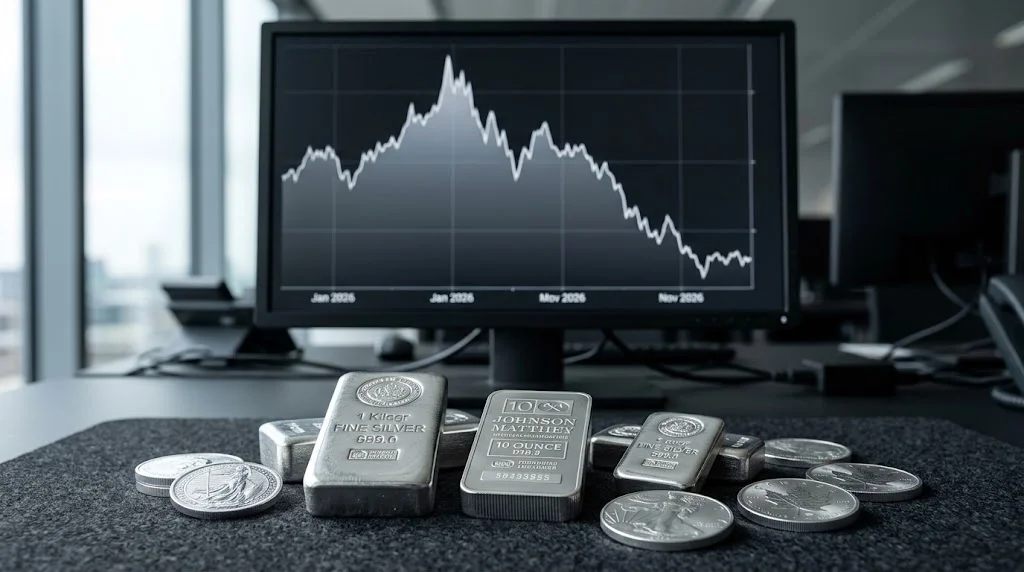
Silver closed 2025 at nearly $70 per ounce before climbing to a record high of approximately $121.60 in January. It now trades around $54 per ounce, marking its lowest level since November 2025. This represents a decline of roughly 55% from its peak and about 23% from the start of the year. However, silver remains approximately 14% to 15% higher than it was a year ago, leaving buyers divided over whether the Silver price drop 2026 presents a buying opportunity or a risky investment in a market that could fall further.
Whether this is an opportunity or a trap depends less on the headline number than on why silver is falling, what you plan to do with the metal, and how you buy it. Below are the drivers, the case on each side, what to watch next, and the physical-silver details, from premiums to old US coins, that decide whether a purchase actually works out.
What has silver actually done in 2026?
Silver finished 2025 after one of its strongest years in decades, at roughly $70 to $72 an ounce depending on the benchmark. The rally carried into January, when spot silver touched about $121.6. Since then the path has been jagged rather than a straight line down:
| Date | Approx. silver price | Context |
| Dec 31, 2025 | $70 – $72 | Year-end close; varies by benchmark |
| January 2026 | About $121.6 | Record high |
| Feb 24 | About $87.9 | Still far above the year-end level |
| Mar 26 | About $67.8 | Oil-driven inflation worries and a hawkish Fed |
| Sep 8 | About $66.3 | Rebound from roughly $58 at the end of July |
| Oct 14 | About $55.7 | Closed down 6.3% after hot US inflation data |
| Oct 26-27 | About $54 | Lowest level since November 2025 |
Approximate figures taken from published daily market quotes. Benchmarks differ slightly.
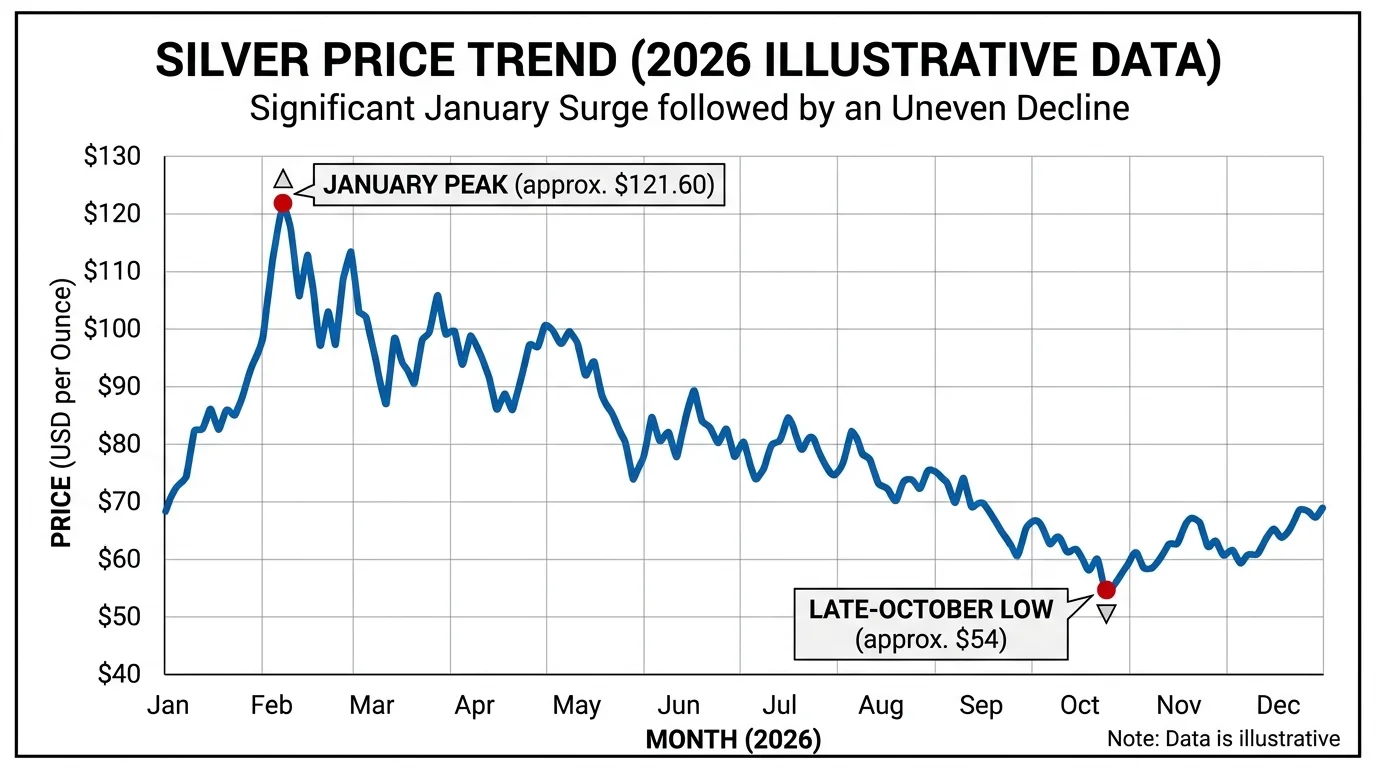
Gold followed a similar shape but fell less. It peaked near $5,600 in January and slipped below $4,100 on October 22, roughly 27 percent lower. Silver’s decline of more than 50 percent from its high shows why it is usually described as gold’s more volatile cousin.
Why is silver falling?
Rates, oil and the dollar
The most direct cause is a shift in interest-rate expectations. Middle East conflict and disruption around the Strait of Hormuz have pushed Brent crude above $110 a barrel at times, which feeds inflation worries. Markets have responded by pricing a Federal Reserve that may hold rates high or raise them again, with the 10-year Treasury yield above 5 percent and the dollar firm. Silver pays no interest, so when safer assets yield more, holding it costs more. Our guide to how global events and economic instability affect gold and silver prices walks through this chain in more detail.
Two sessions show it clearly. On October 14, hot US inflation data sent silver down about 6 percent in a single day while gold fell far less. On October 22, an oil spike knocked silver down roughly 5 percent. The Fed meets October 27-28, so the next move could come quickly.
Industrial demand is softer than the headlines suggest
The Silver Institute’s World Silver Survey 2026 put global silver demand at about 1.13 billion ounces in 2025. Industrial demand fell 3 percent to roughly 657 million ounces, partly because solar manufacturers are using less silver per cell and testing substitutes after the price surge. The survey still forecasts a sixth straight annual supply deficit for 2026, but the old assumption that solar growth automatically means more silver demand no longer holds cleanly.
Silver amplifies every move
After a record run, silver attracted fast-moving money, and fast money leaves quickly. The gold-silver ratio, the number of silver ounces needed to buy one ounce of gold, climbed from about 66 on September 23 to about 74 on October 26. In other words, silver has lagged even a falling gold market.
Is the silver price drop a buying opportunity or a trap?
Both descriptions can be true for different buyers, so it helps to weigh the evidence on each side.
The case for an opportunity
- Silver is still about 14 to 15 percent above its level a year ago, so this looks like a deep correction inside a longer uptrend, not a return to old lows.
- Physical investor demand has not vanished. The Silver Institute reported that coin and bar demand rose 14 percent in 2025, and the supply deficit is forecast to continue.
- A ratio near 74 is higher than the 66 to 70 readings seen from July through September, which means silver is cheaper against gold than it was a few months ago.
The case for a trap
- The pressure comes from rates, oil and the dollar. Until those turn, supply and demand data may not be enough to lift prices.
- Industrial demand is shrinking at the margin as manufacturers use less silver.
- There is no confirmed bottom. Traders are watching the $50 area, and a break below it could invite more selling.
- Forecasts have been unreliable. In late December 2025, analysts quoted in one survey saw silver ranging between $45 and $90 in 2026. It then overshot the top of that range by roughly $30 in January before falling back inside it.
- History urges patience. Silver peaked near $50 in January 1980 and again in April 2011, and each time it spent years, in the first case decades, below that level. It did not clear $50 again until October 2025. Past cycles do not dictate the future, but they show that a record high can be followed by a very long wait.
A better question than “buy or avoid”
Instead of guessing the bottom, a more useful approach is to answer five practical questions before spending anything:
- How long can you hold? Treat silver as money you will not need for years, not weeks.
- How much can you watch fall? Size the purchase so a further 20 to 30 percent decline would be uncomfortable but not damaging.
- Can you spread the buying?
- What is your all-in cost?
- What would change your mind? Write down in advance the facts, such as a rate pivot or a drop in oil, that would make you buy more or stop.
Here is a hypothetical example. Suppose you buy a one-ounce coin with spot at $54 and pay a 10 percent premium, so $59.40. If a dealer would buy it back at 98 percent of spot, silver must rise to roughly $60.60, about 12 percent higher, before you break even. That is why a falling spot price alone does not tell you whether a purchase makes sense. This is general information, not financial advice, so consider speaking with a licensed advisor about your own situation.
What to watch next
Any silver price forecast should be read as a set of scenarios, not a promise. These are the signals most likely to matter in the coming weeks:
- The Fed’s October 28 decision and its guidance on further increases.
- Oil prices and developments around the Strait of Hormuz.
- Inflation reports, the 10-year Treasury yield and the dollar.
- News on solar manufacturers’ silver use and the next Silver Institute data.
- Whether silver holds the $50 area.
If oil cools and rate-hike odds fade, silver has shown it can bounce quickly, as its move from about $58 in late July to about $66 in early September showed. If “higher for longer” persists, choppy trading and further tests of recent lows are plausible. A durable recovery probably needs both easing rate pressure and steadier industrial demand.
What the drop means for physical silver
Spot price is only the starting point. What you pay and what you can later sell for depend on premiums, dealer spreads and, for older US coins, whether a piece is worth more than its metal. For a quick sense of scale, here is the melt value of common 90 percent silver coins with silver at $54 an ounce, an illustration only, so check the live spot price before acting:
| Coin (90% silver, pre-1965) | Pure silver (troy oz) | Melt value at $54/oz |
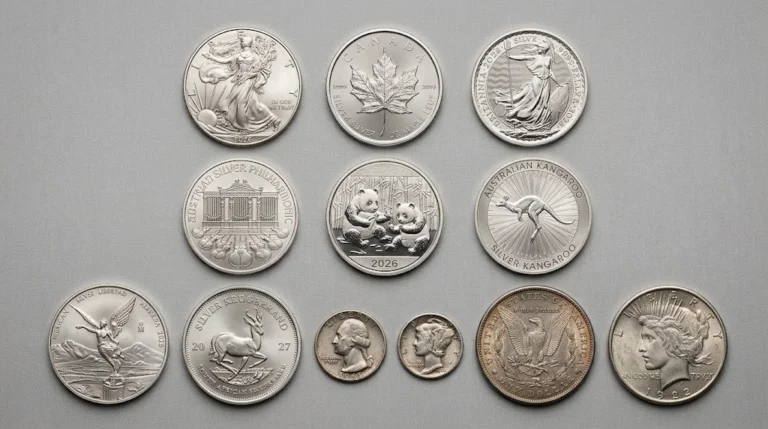
| Dime (Roosevelt or Mercury) | 0.0723 | $3.90 |
| Washington quarter | 0.1808 | $9.76 |
| Half dollar (pre-1965) | 0.3617 | $19.53 |
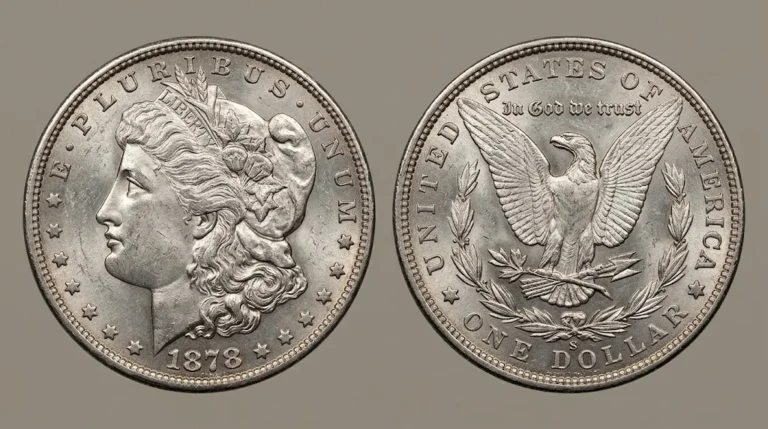
| Morgan or Peace dollar | 0.7734 | $41.76 |
| $1 face value of dimes, quarters or halves | 0.7234 | $39.06 |
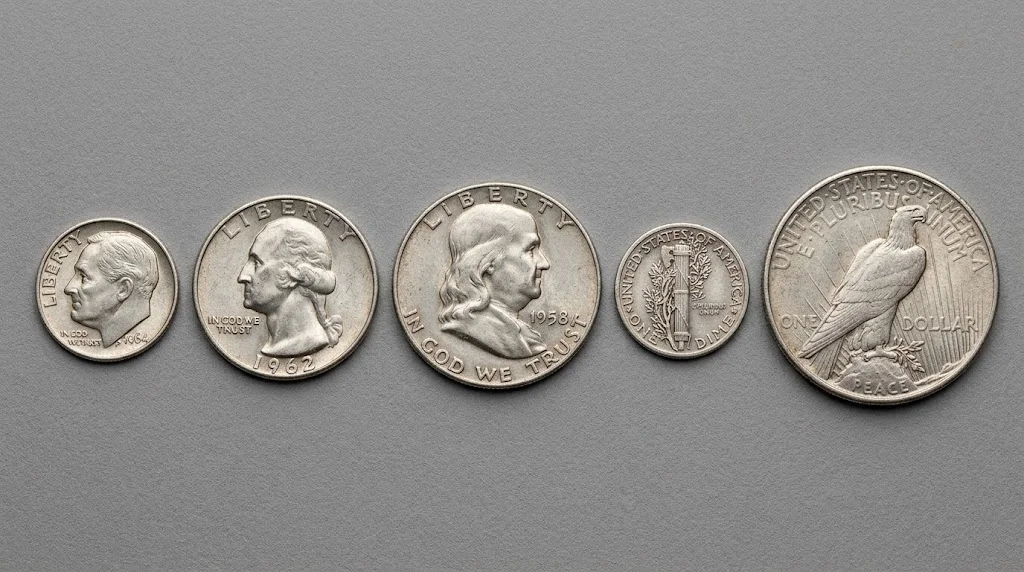
Melt value is a floor for common dates, not a ceiling for every coin. A 1916-D Mercury dime, a 1932-D or 1932-S Washington quarter or an 1893-S Morgan dollar is worth far more than its silver, and a well-preserved, certified example can be worth more still. Condition, strike, surface preservation and certification from services such as PCGS or NGC all affect what a collector will pay. Before you sell or melt old coins, check the date and mint mark. Our page on 90% junk silver coins explains how common-date coins are usually priced.
The same logic applies to household silver. Sterling is 92.5 percent silver, while silver-plated pieces carry almost none, so weight and markings need checking before assuming value.
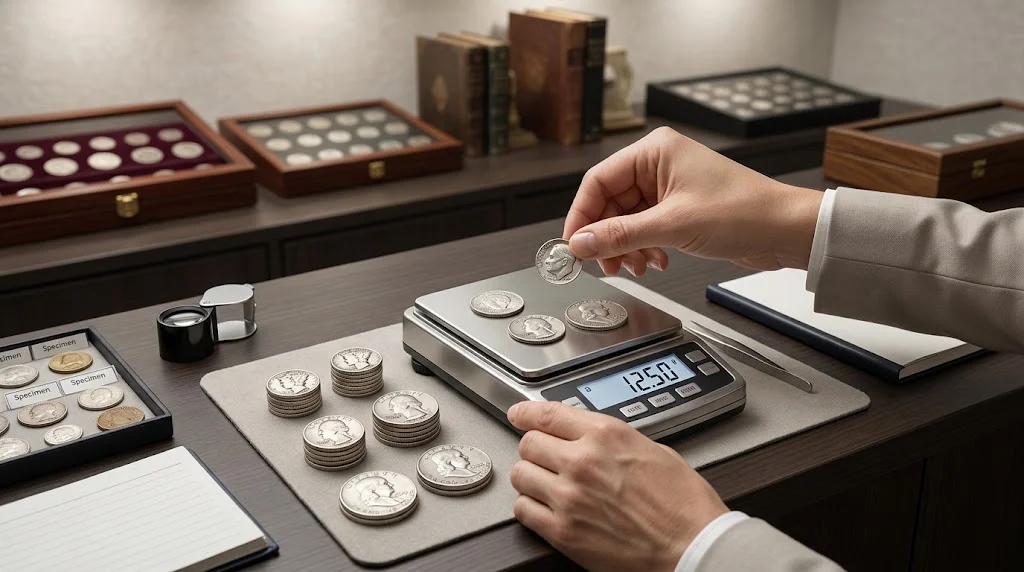
When prices swing this much, a few habits protect you. Ask any dealer for both the buy price and the sell price on the exact coin or bar. Compare quotes taken on the same day, since the spot can move between visits. Confirm whether a quoted price is tied to a live spot reference or locked for a set time. And ask whether the item is priced as bullion or carries a collector premium, because the two behave differently when silver falls
If you already own silver
A falling price is rarely a reason to sell in a hurry. If you bought for the long term and do not need the money, the lower price changes your paper gain, not your ounces. Review whether silver now makes up a smaller share of your holdings than you intended, keep your purchase records for tax purposes, and avoid borrowing to buy more. If you are weighing a sale or simply want to know what an inherited collection holds, DEI GOLD AND SILVER COINS, a Las Vegas coin dealer at 8985 S. Eastern Ave, Suite 160, offers a free silver appraisal in Las Vegas so you can separate melt value from collector value before deciding.
Conclusion
The silver price drop 2026 is steep, and it is driven mainly by rates, oil and the dollar rather than a collapse in demand. That makes the opportunity-or-trap question a matter of time horizon, position size and cost, not a verdict on the metal. Buy only what you could hold through further declines, spread purchases out, count premiums and spreads in your price, and check older coins before treating them as scrap. No one knows where the bottom is, and the sensible plan is one that works whether it comes next week or next year.
By DEI GOLD AND SILVER COINS | Articles by DEI GOLD AND SILVER COINS