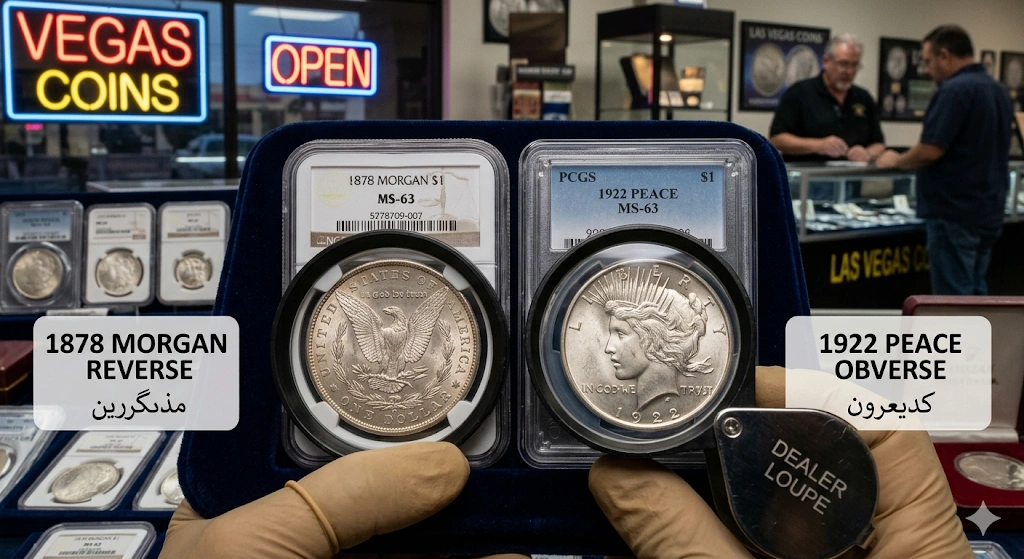
A common-date 1922 Peace dollar and a common-date 1921 Morgan dollar will both bring you roughly the same melt value — about $58–$62 at current silver spot near $32/oz, according to APMEX’s live silver pricing. But walk into our Las Vegas showroom with a 1893-S Morgan in XF-40 and the conversation changes entirely: that single coin is worth more than a full roll of common Peace dollars stacked end to end. The question “Morgan dollar vs Peace dollar value” is one our team at DEI answers dozens of times a month. The answer isn’t a simple dollar figure — it depends on date, grade, mint mark, and what you’re actually trying to accomplish as a buyer or seller. This guide gives you a dealer’s honest breakdown of both series so you can make a confident decision with your collection or your money.
Morgan Dollar vs Peace Dollar Value: The Core Difference
Morgan dollars hold higher average value than Peace dollars in today’s market, primarily because the Morgan series spans 1878–1921 across five mints, producing dozens of scarce dates and condition rarities that command strong collector premiums well above silver content. The Peace dollar series ran 1921–1935 from three mints — a shorter run with fewer key dates and lower population ceilings at top grades. Both coins contain the same 0.7734 oz of silver (.900 fine, 26.73 grams), so their melt floors are identical. The premium layered on top of that melt is where the real gap opens.
For common circulated examples, the spread is narrow. A VF-20 1922 Peace dollar typically brings $55–$70. A VF-20 common-date Morgan from the same era — say an 1881-S or 1884-O — trades at $65–$85, per the PCGS Price Guide. That’s a meaningful but modest difference.
Where Morgans genuinely pull away is in certified, high-grade, and key-date territory. The Morgan series has at least eight dates where even heavily circulated examples exceed $500 — including the 1893-S (mintage 100,000), the 1889-CC, and the 1895 Philadelphia proof-only issue. The Peace dollar series has three genuinely scarce dates: the 1921 high-relief, the 1928 Philadelphia (mintage 360,649), and the 1934-S in high grade. Strong coins, but a shorter list.
At DEI, our buying and selling prices reflect this reality: we offer more per coin on a mixed Morgan roll than an equivalent Peace dollar roll because the upside of finding a sleeper key date is statistically higher in the Morgan series.
Morgan Dollar History and Why It Still Attracts Collectors
The Morgan dollar was first struck in 1878 following the Bland-Allison Act, designed by George T. Morgan using a Philadelphia schoolteacher named Anna Willess Williams as his model for Liberty. It ran until 1904, was revived for a single year in 1921, and was officially commemorated again by the US Mint in 2021. More than 650 million Morgan dollars were struck across five mints — Philadelphia, New Orleans, San Francisco, Carson City, and Denver — creating one of the most complex and collectible series in American numismatics.
What drives Morgan dollar demand in 2026 is a combination of factors: the series is large enough that a collector can build a complete set at budget levels, yet rare enough at the top that serious investors find six-figure keys worth chasing. Carson City Morgans carry particular mystique — the CC mint mark connects directly to Nevada’s Comstock Lode silver boom, which makes them popular with collectors right here in Southern Nevada. At DEI, we see CC Morgans move faster than almost any other silver dollar type, regardless of grade.
The 1921 Morgan is the most common single date in the series — high mintages mean these trade near melt in circulated grades. But find a superb gem 1921 in MS-67, and you’re looking at a serious collector coin. Grade matters more in the Morgan series than almost any other US silver type.
Buy or Sell Gold & Silver Coins with Confidence
Work with a trusted Las Vegas coin dealer offering fair pricing, honest appraisals, and expert guidance every step of the way.
Peace Dollar History and Its Place in Today’s Silver Dollar Market
The Peace dollar — designed by sculptor Anthony de Francisci — replaced the Morgan dollar in 1921 as a deliberate artistic symbol of the peace following World War I. It ran from 1921 through 1935. The 1921 Peace dollar is notably different from the rest of the series: struck in high relief, it has a sculptural depth that was reduced in 1922 for easier production. That first-year design is a genuine collector coin in any grade.
Peace dollars are often preferred by investors who care primarily about silver content with a lower premium over melt. Common-date Philadelphia issues from 1922, 1923, 1924, and 1925 are plentiful in circulated condition and trade very close to spot. Per data from Bullion Sharks, a common-date Peace dollar in MS-63 brings around $80–$90, and MS-65 jumps to roughly $200.
The Peace dollar series is also the more affordable series to complete as a full date-and-mint set. Per Gainesville Coins’ collector data, a full set in AU-50 to MS-63 can be assembled for under $3,000 — an achievable goal for a serious beginner. The Morgan equivalent set costs far more, because the semi-key and key dates price out at multiples of the Peace dollar equivalents.
📌 DEI Market Observation: Since the US Mint relaunched modern Morgan and Peace dollars in 2021, we’ve noticed increased foot traffic from younger collectors (30s–45s) who started with the modern commemorative versions and are now back-filling original vintage examples. This has put quiet upward pressure on mid-grade Peace dollars from 1922–1927 — dates that were stagnant for years. If you’re buying Peace dollars for a long hold, these mid-series dates represent better relative value right now than they did five years ago.
Buy or Sell Gold & Silver Coins with Confidence
Work with a trusted Las Vegas coin dealer offering fair pricing, honest appraisals, and expert guidance every step of the way.
📊 Morgan Dollar vs Peace Dollar — DEI Quick Reference Comparison
| Attribute | Morgan Dollar (1878–1921) | Peace Dollar (1921–1935) |
|---|---|---|
| Silver content | 0.7734 oz (.900 fine) | 0.7734 oz (.900 fine) |
| Series length | 28 years, 5 mints | 15 years, 3 mints |
| Common circ. value (VF) | $65–$85 | $55–$75 |
| Common unc. value (MS-63) | $90–$150 | $80–$100 |
| Common gem value (MS-65) | $200–$400+ | $200–$250 |
| Top key-date value | $500,000+ (1893-S MS-65) | $135,000+ (1934-S MS-65) |
| Number of major key dates | 8+ | 3 |
| Best for: budget collector | Common dates, circulated | Common dates, circulated |
| Best for: serious investor | Key dates, high grade | 1921, 1928, 1934-S |
| Counterfeit risk | High (especially 1893-S) | Moderate |
| PCGS/NGC grading needed | Yes, above MS-62 or key dates | Yes, above MS-63 or 1928/1934-S |
Key Dates: Which Coins in Each Series Are Actually Worth Big Money?
The most valuable Morgan dollars are driven by extreme scarcity, not just age — the 1893-S Morgan dollar had a mintage of just 100,000 coins and circulated heavily, making uncirculated survivors genuinely rare. Per PCGS CoinFacts data and confirmed auction records, a circulated 1893-S in Good-4 starts around $3,700–$6,000; a certified MS-65 example has crossed $500,000 at auction. The 1889-CC — known as the “King of Carson City Morgans” — sold for $660,000 at Heritage Auctions in August 2023 in MS-65+ CAC. These are not theoretical numbers; they are documented, verified sales.
Peace dollar key dates are fewer but still significant. The 1928 Philadelphia (mintage 360,649) is the series key date, commanding $225+ even in heavily worn grades where collector demand overrides melt value. The 1934-S, per CoinWeek research, is a condition rarity — common in circulated grades but extraordinarily scarce above MS-64. A 1934-S in MS-65 has traded for over $135,000. The 1921 high-relief remains popular at every grade level and is the coin most likely to be undervalued when brought in from an estate.
The Most Important Key Dates at a Glance
Morgan Dollar Key Dates:
- 1893-S — Mintage 100,000; G-4 from ~$3,700; MS-65 $500,000+
- 1889-CC — G-4 from ~$1,000; MS-65+ CAC sold $660,000 (Heritage, Aug 2023)
- 1895-P — Proof only; ~880 struck; PR-65 runs $100,000–$130,000
- 1884-S — Condition rarity; MS-65 from $8,000+
- 1893-CC — Last Carson City Morgan ever struck; strong demand at all grades
Peace Dollar Key Dates:
- 1928-P — Mintage 360,649; $225+ even worn; MS-63 around $650+
- 1934-S — Condition rarity; MS-65 commands $100,000+
- 1921 — High relief only year; scarce in MS; MS-65 NGC ~$3,445 (recent eBay realized)
Grading: How a Single Point Changes the Morgan Dollar vs Peace Dollar Value Equation
One grade point on a Morgan or Peace dollar can mean the difference of hundreds — sometimes thousands — of dollars, which is why PCGS or NGC certification is essential before any significant transaction. For both series, the jump from MS-63 to MS-65 is where value increases most sharply. Common-date Morgans in MS-63 trade for $90–$150; in MS-65 they move to $200–$400. Better dates amplify this dramatically — a 1901-P Morgan in VF is an $88 coin, but the same date in MS-65 gem has reached over $500,000.
Peace dollars follow a similar pattern, but with an added complication: San Francisco (S) mint Peace dollars are frequently weakly struck, meaning even coins that grade MS-64 by technical wear standards can look disappointing compared to sharply struck Philadelphia issues at the same grade. At DEI, when we evaluate an S-mint Peace dollar, we weight strike quality and luster heavily — two MS-64 coins with identical PCGS labels can have very different eye appeal and very different market values. This is the kind of distinction that only shows up when you handle the coins in hand, not on a screen.
🪙 DEI Dealer Observation
After 50+ years of handling silver dollars, one pattern stands out: collectors consistently underestimate the value of originality and overestimate the appeal of “cleaned up” coins. We’ve watched sellers lose $150–$400 on Morgan dollars that were wiped with a polishing cloth by a well-meaning family member before being brought in — cleaning shows under a loupe as fine hairlines on the fields, dropping a potential MS-63 to a PCGS “Details” designation. That Details label is a red flag in our showroom and on every major coin exchange. An original, problem-free AU-55 Morgan is worth significantly more to us than a “shiny” MS-60 with hairlines. Never clean your coins.
Morgan Dollar Price in 2026: What the Current Market Is Telling Us
Morgan dollar prices in 2026 are tracking silver spot prices closely for common dates, but key dates and high-grade certified coins have maintained numismatic premiums well above melt. At current silver near $32/oz (per APMEX live data, early 2026), the melt floor for any original Morgan or Peace dollar sits around $24.75. Common circulated Morgans — your 1881-S, 1882-O, 1884-O, the bulk of 1921 issues — trade at $65–$85 retail in VF condition per the PCGS Price Guide, representing a modest but real premium above silver value.
The more interesting story is in the MS-63 to MS-65 range, where buyer competition from the NGC and PCGS Registry sets has kept premiums firm. Per JunkSilver.co’s 2026 market analysis, common-date Morgans in MS-63 bring $90–$200, while MS-64 to MS-65 examples range from $250 to $1,500 or more depending on date and mint. Third-party grading becomes non-negotiable above MS-62 — the grade-point premium difference in that range easily outweighs submission costs.
For Nevada-based sellers: DEI pays same-day on all Morgan and Peace dollar purchases, with pricing based on current PCGS Price Guide values and live spot — not a flat silver-weight formula. If you have a mixed bag of silver dollars from an estate, it’s worth a free appraisal at our Las Vegas showroom before you sell anywhere else.
Best Silver Dollar to Collect: Morgan or Peace, and Which Should You Buy in 2026?
The best silver dollar to collect in 2026 depends entirely on your goal — budget collection-building, key-date investment, silver bullion accumulation, or a combination. Here is how to think through it clearly.
Buy common-date Peace dollars if: You want silver content at the lowest premium over spot. Common-date Philadelphia Peace dollars (1922–1925) trade near melt and are widely available. For a bullion-minded buyer, this is the most efficient way to hold pre-1965 US silver.
Buy common-date Morgan dollars if: You want slightly more numismatic upside than Peace dollars, but still want accessible price points. Common Morgans carry a small premium over Peace dollars at equivalent grades, but the larger date-and-mint variety means more collector demand when it’s time to sell.
Buy key-date Morgan dollars if: You’re making a deliberate numismatic investment and can afford proper certification costs. Key-date Morgans are among the most liquid rare coins in the US market — Heritage Auctions, Stack’s Bowers, and GreatCollections maintain deep buyer pools for certified examples. Liquidity is a real advantage.
Buy 1921 or 1928 Peace dollars if: You want entry into key-date collecting at lower dollar amounts than Morgan keys. A problem-free 1928-P in AU-55 is accessible to most collectors at under $400 and represents genuine scarcity in a 15-coin date run.
Where to Buy and Sell Morgan Dollars and Peace Dollars: A Practical Guide for USA Collectors
The right venue for buying or selling Morgan or Peace dollars depends on the coin’s value tier. For common circulated examples worth $65–$150, a trusted local dealer like DEI in Las Vegas offers the best net result: no auction fees, no shipping risk, same-day payment. For certified key-date coins worth $500 or more, auction houses including Heritage Auctions (Dallas), Stack’s Bowers (New York), and GreatCollections (California) provide the broadest buyer base and competitive bidding that can maximize realized prices.
Avoid selling key-date coins — especially 1893-S, 1889-CC, or any Morgan in apparent MS-63 or higher condition — at “we buy gold by the ounce” events. These venues price by silver weight, not numismatic value, and will offer you melt value on coins worth multiples of that amount. We see this mistake regularly at DEI, often from heirs who didn’t realize what they were holding until after a low-ball sale elsewhere.
For buyers: counterfeit Morgan dollars flood online marketplaces, especially on the 1893-S, 1889-CC, and popular Carson City dates. Per JunkSilver.co’s 2026 collector guide, Chinese-made fakes circulate widely on general retail sites. Always buy certified (PCGS or NGC slabbed) for any Morgan or Peace dollar priced above $200, or buy from a dealer with NGC/PCGS/CAC credentials — like DEI — who can authenticate in person before you pay.
Nevada collectors have an additional advantage: Nevada has no state income tax, which means capital gains on coin sales are subject only to the federal rate. Long-term capital gains on collectibles (held more than one year) are taxed at a maximum 28% federal rate under current IRS rules. Consult a tax professional for your specific situation before making significant buy or sell decisions.
Conclusion
Your next move is clear: know what you have before you sell, and know what you’re buying before you spend. If you’re holding Morgan or Peace dollars from an estate or old collection, a free in-person appraisal gives you a real number based on current PCGS Price Guide values and live silver spot — not a guess. If you’re buying, the choice between Morgan dollar vs Peace dollar value comes down to this: common-date Peace dollars offer the lowest premium over silver for bullion-minded buyers; common-date Morgans offer slightly more numismatic liquidity; and key-date Morgans offer the deepest collector market and the highest documented price ceilings in the series. Whatever your goal, certified coins from PCGS or NGC are the standard — raw, uncertified key dates are a risk not worth taking.
Ready to evaluate your Morgan or Peace dollar collection? Visit DEI Gold & Silver Coins at 8985 S. Eastern Ave, Suite 160, Las Vegas, NV 89123, or call (702) 460-5188 for a free, same-day appraisal — no pressure, no obligation. You can also schedule online at /appraisals/ or reach our team at /contact-us/.
For your next read, explore DEI’s guides on junk silver (90% constitutional silver coins) and how certified silver coins differ from raw examples — two topics that come up constantly alongside Morgan and Peace dollar questions.
FAQ SECTION
1. Which is worth more, a Morgan dollar or a Peace dollar?
Morgan dollars are generally worth more than Peace dollars in today’s market. Common circulated Morgans trade at $65–$85, versus $55–$75 for Peace dollars. Key-date Morgans like the 1893-S reach six figures in top grades — a ceiling no Peace dollar date currently matches. For common coins, the gap is modest; for certified high-grade and key-date examples, Morgan dollars win decisively.
2. What is the Morgan dollar price in 2026 for common dates?
Common-date Morgan dollars in circulated condition (VF to XF) trade at approximately $65–$85 in 2026, based on current PCGS Price Guide values with silver near $32/oz. Common-date Morgans in MS-63 uncirculated condition run $90–$150. Key dates start at $3,700 (1893-S in Good-4) and reach $500,000+ for top-certified examples. Always verify against current PCGS or NGC pricing before buying or selling.
3. What are the key dates in the Peace dollar series?
The three major Peace dollar key dates are the 1921 high-relief (first year, scarce in mint state), the 1928 Philadelphia (lowest mintage at 360,649 coins, worth $225+ even worn), and the 1934-S (a condition rarity that reaches $100,000+ in MS-65). The 1927-D and 1927-S are semi-key dates that regularly get sold as common coins by sellers who haven’t checked. PCGS or NGC certification is essential for any of these.
4. Is it worth getting a Morgan dollar graded by PCGS or NGC?
Grading by PCGS or NGC is worth the cost if your Morgan dollar is a key date in any grade, a common date that appears to be MS-63 or higher, or a Carson City (CC) mint example in uncirculated condition. Certification typically increases realized sale prices by more than the submission fee on coins at these levels. For common circulated Morgans worth $65–$85, grading fees generally exceed the value uplift — leave those raw.
5. What is the best silver dollar to collect for a beginner?
For beginners, common-date Peace dollars from 1922–1925 are the best starting point — they’re affordable (near silver melt), widely available, and historically significant. Once comfortable with grading basics, moving into common-date Morgan dollars adds numismatic depth without dramatic cost increases. Both series are a smart foundation. DEI’s free appraisal service is a practical first step for anyone starting a silver dollar collection in Las Vegas or Henderson, NV.
6. How do I store Morgan and Peace dollars to protect their value?
Store Morgan and Peace dollars individually in non-PVC flips or PCGS/NGC slabs — never in soft plastic sleeves that contain PVC, which causes irreversible toning damage over time. Keep them in a cool, dry environment away from humidity and sulfur compounds (avoid rubber bands and newspaper). For certified coins already in PCGS or NGC holders, no additional handling is needed. At DEI, we see more value destroyed by improper storage than by circulation wear — it’s a preventable loss.