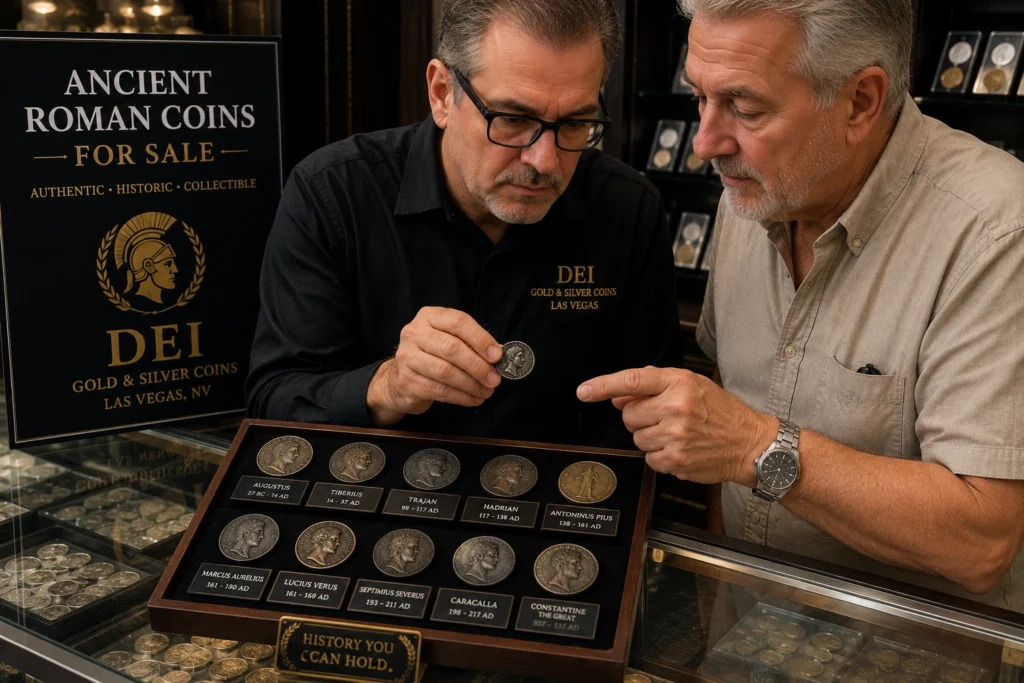
A retired schoolteacher came into our showroom last spring holding a small silver coin she’d bought decades ago on a trip to Rome — worn, dark with age, and stamped with a profile she thought might be an emperor. She wanted to know two things: was it real, and was it worth anything. It’s one of the most common questions we get, and it points to something bigger — search interest in ancient Roman coins for sale has grown steadily as more investors and collectors discover that a 1,800-year-old piece of silver can sometimes cost less than a modern bullion coin.
Ancient coins are genuinely different from the U.S. and world coins most collectors start with — different denominations, different grading conventions, and a much higher risk of counterfeits. This guide covers what you need to know before you buy your first one.
How to Start Collecting Ancient Coins: The Basics
How to start collecting ancient coins begins with understanding that you’re not just buying metal — you’re buying an artifact that was struck, circulated, and buried or hoarded for close to two thousand years. That history is exactly what makes the hobby compelling, and exactly why beginners need a bit of foundational knowledge first.
Denarius, Sestertius, and Other Roman Denominations to Know
Roman coinage spans several denominations, and most collectors start with one of these:
Denarius — a small silver coin, roughly the size of a dime, and the workhorse denomination of the early-to-mid Roman Empire.
Sestertius — a larger bronze coin, closer to a half-dollar in size, prized for detailed portraiture and inscriptions.
AE3 bronze coins — smaller, later-Empire bronzes, especially those of Constantine the Great and his family, which are widely available and often the most affordable entry point.
Why Greek Coins Are a Different (and Often Harder) Starting Point
Greek coinage predates Roman coinage by centuries and tends to be harder for English-speaking beginners to research, since inscriptions use Greek lettering and the political landscape (dozens of independent city-states, each minting its own coins) is more fragmented than Rome’s. Many collectors start with Roman coins first, since Latin inscriptions and a single, well-documented imperial timeline make attribution easier, then move into Greek coins once they’re comfortable with the basics.
Authenticity: The Single Biggest Risk for New Collectors
Why Ancient Coins Attract More Counterfeits Than Modern Ones
Counterfeiting ancient coins isn’t new — it’s been happening since antiquity — but the market has seen a real surge in high-quality fakes since the 1970s, and cast or die-struck reproductions continue to circulate today, sometimes with artificial “ancient” toning designed to fool casual buyers. Unlike a modern coin, an ancient coin has no mint records, no serial number, and often no clear paper trail, which is exactly what makes authentication so important.
Third-Party Grading for Ancient Coins
The same certification principle that protects buyers of U.S. coins applies here: buy from a dealer who guarantees authenticity, and where possible, look for coins independently graded and encapsulated by a recognized service such as NGC Ancients, much like you would look for certified gold coins. Slabbed authentication doesn’t just confirm a coin is genuine — it also gives you a documented, third-party opinion you can rely on if you ever decide to resell.
Is It Legal to Own Ancient Coins? Provenance Matters
Yes — owning ancient coins is legal in the United States, but where and how you buy matters more than most beginners realize. The U.S. has entered cultural property agreements (MOUs) with several countries — including Italy, Greece, Cyprus, China, and Bulgaria — that restrict importing certain coin types without documentation showing they were legally out of the country of origin before a specific cutoff date.
For a beginning collector, the practical takeaway is simple: buy from an established, reputable dealer who can provide provenance documentation — a record of a coin’s prior ownership and export history — rather than an anonymous online seller with no paper trail. This protects you from both counterfeits and coins with murky import history.
Grading Ancient Coins: Why VF and XF Mean Something Different Here
If you’re used to the modern coin grading scale, ancient coin grading will look unfamiliar. Rather than the 70-point numeric scale used for U.S. coins, ancient coins are typically graded on a descriptive scale, including terms like:
Fine (F) — clearly worn, but major details still visible
Very Fine (VF) — moderate wear, most details sharp
Extremely Fine (XF/EF) — light wear, strong detail retention
About Uncirculated / Mint State — rare for ancients, minimal to no wear
Because ancient coins were hand-struck with dies that wore down over time, strike quality and centering matter just as much as wear — a well-centered, sharply struck coin in VF condition can be more desirable (and valuable) than a poorly struck coin technically graded higher.
Where to Buy — and Sell — Ancient Roman Coins in Las Vegas
Whether you’re buying your first ancient coin or you’ve inherited a small collection and want to know what it’s actually worth, the same rule applies: work with a dealer who can authenticate what you have before money changes hands. Reference works like David R. Sear’s Roman Coins and Their Values are useful for building your own knowledge, but they’re not a substitute for professional authentication, especially for a first purchase.
DEI Gold and Silver Coins evaluates ancient and world coins as part of our broader numismatic services in Las Vegas, backed by more than 50 years of experience and certifications from CAC, NGC, PCGS, GIA, and AGL — so whether you’re starting a collection or found an old coin from a family estate, you can get a straight answer on authenticity and value in one visit.
Buy or Sell Gold & Silver Coins with Confidence
Work with a trusted Las Vegas coin dealer offering fair pricing, honest appraisals, and expert guidance every step of the way.
Start (or Verify) Your Ancient Coin Collection the Right Way
Ancient Roman and Greek coins offer something modern bullion can’t — a direct, physical link to history — but that same age is what makes authentication and provenance so important before you buy or sell.
Call or text DEI Gold and Silver Coins at (702) 460-5188 to schedule a same-day, private consultation. Whether you’re evaluating your first purchase, verifying an inherited coin, or looking to sell your coin collection, our numismatists can give you a clear, honest assessment before you make a decision.
Frequently Asked Questions
Yes, owning ancient coins is legal. However, importing certain coin types from countries with active U.S. cultural property agreements — including Italy, Greece, Cyprus, China, and Bulgaria — may require documentation proving the coin left its country of origin before a specific date.
Beginners can start surprisingly affordably. Common late Roman bronze coins, such as AE3 pieces from the era of Constantine the Great, are often available for modest prices, making them a popular entry point before moving into rarer silver or gold issues.
Weight, diameter, strike characteristics, and metal composition are all things a trained numismatist checks, along with signs of casting versus die-striking. Because counterfeits have circulated for decades, the safest approach for a beginner is to buy only from a dealer who guarantees authenticity, or to have a suspected purchase authenticated before paying for it.
Roman coins generally use Latin inscriptions and follow a single, well-documented imperial timeline, making them easier to research. Greek coins predate Rome’s coinage, were minted by dozens of independent city-states, and use Greek lettering — genuinely fascinating, but often a steeper learning curve for a first collection.
For anything beyond a low-value common bronze, third-party grading from a recognized service like NGC Ancients is worth the cost. It confirms authenticity, documents condition, and makes the coin significantly easier to resell later.