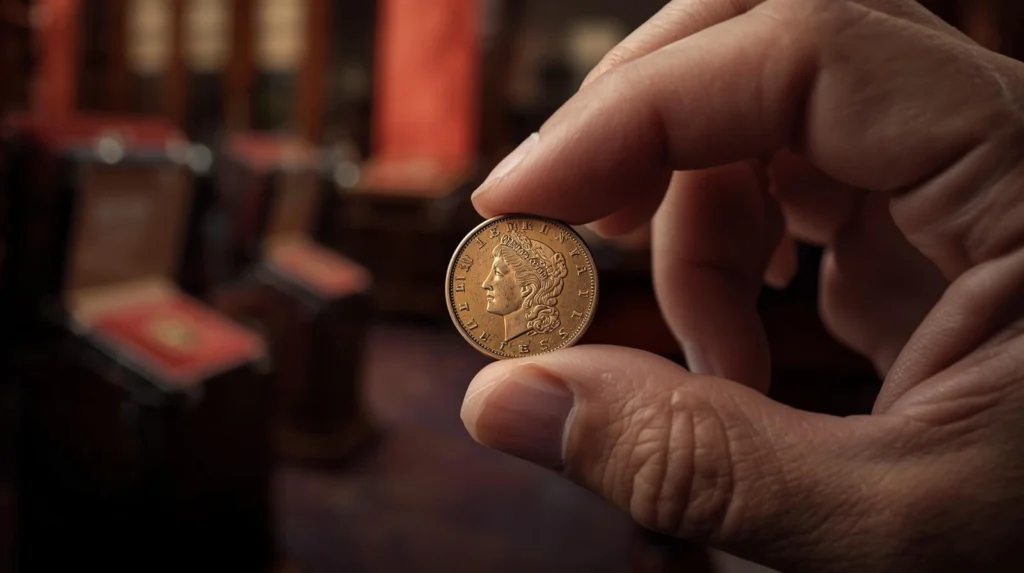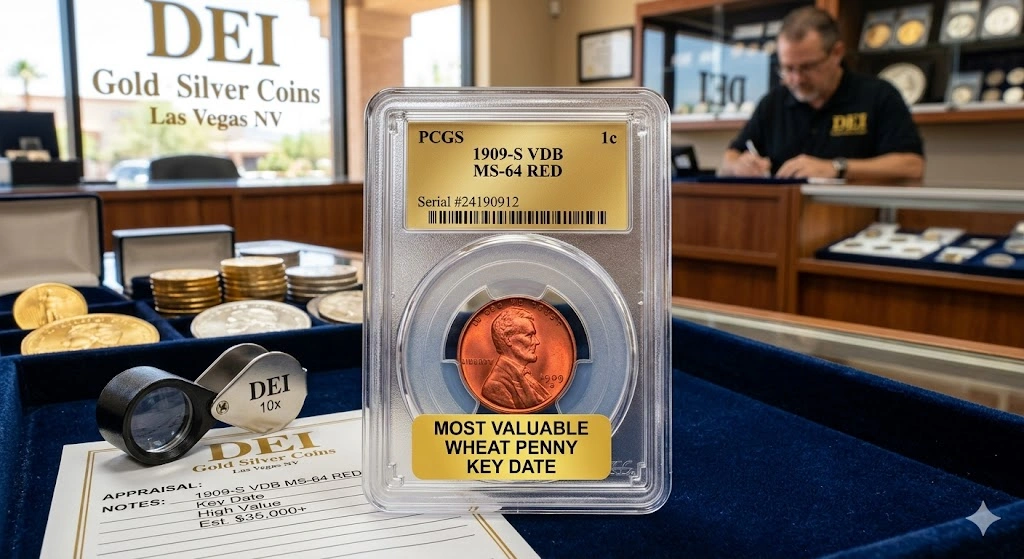
A worn 1909-S VDB Lincoln cent sold at Heritage Auctions in early 2025 for $1,680 in VG-8 condition — a coin that could theoretically still be found in a grandparent’s coffee can. According to PCGS CoinFacts, fewer than 484,000 of these were minted at the San Francisco Mint before the design was pulled, making it one of the most sought-after coins in American numismatic history. Yet every week in our Las Vegas showroom, we see customers walk in with wheat pennies they’ve pulled from old jars and drawers — sometimes not knowing what they have, sometimes hoping they’ve struck gold, and occasionally, they actually have.
This post gives you the exact dates, mint marks, and condition benchmarks that separate a wheat penny worth face value from one worth hundreds or thousands. You’ll also learn where these coins actually turn up in 2026 and how to avoid the two biggest mistakes that destroy a coin’s value before it ever reaches a dealer’s counter.
Which Wheat Pennies Are Worth the Most Money in 2026?
The most valuable wheat pennies are defined by low mintage, high surviving population in collectible grades, and ongoing collector demand — with the 1909-S VDB, 1914-D, and 1922 plain leading the pack in 2026 market values. The Lincoln wheat cent series ran from 1909 to 1958, and while the vast majority of those 150+ billion coins are worth a cent or two in circulated grades, roughly a dozen key and semi-key dates carry real money.
Here’s how the top tier breaks down by current PCGS Price Guide estimates for circulated grades (Good-4 to Fine-12), which represent realistic finds in the wild:
1909-S VDB — The crown jewel. Victor David Brenner’s initials on the reverse caused a public uproar in 1909, and the Philadelphia Mint pulled the design after just 484,000 San Francisco strikes. In Good-4, expect $700–$900. In VF-20, you’re looking at $1,200–$1,500. A gem MS-65 Red has crossed $30,000 at Stack’s Bowers.
1914-D — Low mintage of 1,193,000 from Denver, combined with heavy circulation wear, makes survivors in Fine or better genuinely scarce. Good-4 values run $150–$200; VF-20 pushes $450–$550. Watch for alterations — unscrupulous sellers have been known to add a “D” mintmark to common 1914-P cents.
1922 Plain (No D) — In 1922, the Denver Mint was the only mint striking Lincoln cents. Some coins came out with an extremely weak or missing “D” mintmark due to a worn die. These “No D” strong reverse examples are worth $500–$700 in Good-4. Be cautious: the “weak D” variety is far less valuable, and a removed “D” is worthless.
1931-S — Only 866,000 minted in San Francisco. This is the coin we most often acquire in our showroom without the seller realizing its value. Good-4 fetches $80–$110; Fine-12 reaches $130–$160. It looks like a common coin to the untrained eye.
1943 Copper — The wartime cent was supposed to be steel, but a small number of 1943 copper planchets accidentally made it through the Philadelphia, Denver, and San Francisco mints. Genuine examples are worth $100,000+. A magnet test is your first screen: if it sticks, it’s steel (common). If it doesn’t stick, get it to a PCGS or NGC-certified dealer immediately.
Lincoln Wheat Penny Key Dates: The Full Tier List
Key date wheat pennies are ranked by three factors — original mintage, survival rate in collectible grades, and current auction demand — with the 1909-S VDB, 1914-D, and 1922 Plain consistently at the top of every serious collector’s want list. Understanding the difference between a true key date and a semi-key helps you prioritize your search.
Buy or Sell Gold & Silver Coins with Confidence
Work with a trusted Las Vegas coin dealer offering fair pricing, honest appraisals, and expert guidance every step of the way.
📊 Wheat Penny Key Date Tier Reference — DEI Quick Reference
| Coin | Mintage | Grade | Est. Value (PCGS 2025–26) | Tier |
|---|---|---|---|---|
| 1909-S VDB | 484,000 | G-4 | $700–$900 | Key |
| 1914-D | 1,193,000 | G-4 | $150–$200 | Key |
| 1922 Plain No D | Est. <10,000 | G-4 | $500–$700 | Key |
| 1931-S | 866,000 | G-4 | $80–$110 | Key |
| 1943 Copper (All Mints) | Est. <50 known | Any | $100,000+ | Key/Rarity |
| 1909-S (no VDB) | 1,825,000 | G-4 | $90–$130 | Semi-Key |
| 1924-D | 2,520,000 | G-4 | $45–$65 | Semi-Key |
| 1926-S | 4,550,000 | G-4 | $30–$45 | Semi-Key |
| 1955 Doubled Die | ~20,000–24,000 | F-12 | $1,200–$1,800 | Error/Key |
| Common dates (most) | 100M–500M | Any | $0.05–$2.00 | Common |
Values based on PCGS Price Guide and recent Heritage Auctions/GreatCollections sales data.
The 1955 Doubled Die deserves special mention. It’s not a low-mintage coin by key date standards, but the dramatic doubling of the date and lettering is visible to the naked eye and makes it one of the most recognizable — and counterfeited — error coins in the Lincoln series. At DEI, we always recommend submitting any 1955 cent with visible doubling to PCGS or NGC before buying or selling.
How to Identify Wheat Pennies Worth Money: Dates, Mint Marks, and Grades
A wheat penny is worth serious money when three things align: it’s a recognized key or semi-key date, it carries the right mint mark (or the right absence of one), and it grades at least Good-4 with no cleaning or environmental damage. Let’s walk through how to check each factor.
Dates and Mint Marks
The date appears on the obverse (front), directly below Lincoln’s portrait. The mint mark — a small letter — sits on the obverse as well, just below the date, slightly to the right. The key marks to know:
- No mint mark = Philadelphia (most common)
- D = Denver
- S = San Francisco (most semi-keys and keys come from here)
Use a 5x–10x loupe, not your phone camera, when checking mint marks. The lens on a loupe eliminates the distortion that makes “VDB” or a faint “S” look like nothing on a phone screen.
Grades That Matter
For wheat pennies, the grades that cross meaningful value thresholds are Good-4 (G-4), Very Good-8 (VG-8), Fine-12 (F-12), and Very Fine-20 (VF-20). In G-4, the date and mint mark are clear, the wheat stalks show, and Lincoln’s outline is visible but flat. In VF-20, all major features are sharp, with light wear on the cheekbone and wheat heads.
Any wheat penny that might be a key date should be professionally graded. PCGS and NGC slabs protect the coin, authenticate it, and tell you exactly what the market will pay. At DEI, we can guide you through the CAC submission process as well — coins that earn a CAC sticker (indicating the grade is solid for its tier) consistently command 10–25% premiums in our experience.
Where to Actually Find Valuable Wheat Pennies in 2026
Valuable wheat pennies are still found in the real world through estate sales, inherited coin collections, bank rolls, and flea markets — not usually in active circulation, but in stored collections from the mid-20th century that are just now being dispersed. The key is knowing where accumulations survive.
Estate Sales and Inherited Collections
This is where we find the most significant coins at DEI. When someone passes away who was born before 1960, their coin collection often reflects a lifetime of casual accumulation — no formal collecting, just coins saved in jars, envelopes, and dresser drawers. These collections frequently contain 1930s and 1940s wheat cents in original, untouched condition. The Las Vegas and Henderson area sees a steady flow of estate dispersals given the retirement population — we purchase these collections regularly through our free appraisal service.
Coin Roll Hunting
Banks still distribute rolled pennies, and penny rolls from credit unions and small community banks occasionally contain older coins. It’s low-yield in 2026, but the cost is zero if you return the common dates. Focus on rolls from banks in older neighborhoods or rural areas.
Flea Markets and Coin Shows
The ANA (American Numismatic Association) hosts regional shows throughout the USA, and local coin shows in Nevada regularly feature dealer tables with bulk wheat cent lots. Buying a $20 mixed lot is often cheaper than cherry-picking — and more fun.
📌 DEI Market Observation: Over the last 18 months, we’ve noticed a measurable uptick in customers bringing in 1930s Lincoln cents found in Southern Nevada estate lots — particularly from estates settled in Henderson and North Las Vegas. The desert climate means storage conditions are often favorable, and coins that sat in a drawer since the 1950s sometimes present in AU-50 or better without ever being formally collected.
Wheat Pennies Worth Money: Errors and Varieties Beyond the Key Dates
Beyond the key dates, certain error and variety wheat pennies are worth substantial money regardless of mintage — particularly the 1955 Doubled Die, 1943-D Bronze, 1944 Steel, and any RPM (repunched mint mark) on a semi-key date. Error coins are the wheat penny market’s hidden upside.
The 1944 Steel cent is the mirror image of the 1943 Copper situation: 1944 cents should be copper, but a handful of steel planchets from 1943 made it through. Genuine 1944 Steels are worth $75,000–$100,000. The same magnet test applies: 1944 steel cents will stick to a magnet.
Repunched mint marks (RPMs) — where the mintmark was stamped more than once at a slight angle — add 20–300% premiums over standard values on key and semi-key dates. The 1909-S RPM and 1944-D/S (D over S) are among the most valuable. These require magnification to identify and a reference guide like A Guide Book of United States Coins (the Red Book) or PCGS CoinFacts to confirm.
🪙 DEI Dealer Observation Of all the wheat penny mistakes we see at our counter on Eastern Avenue, the most costly is cleaning. A customer recently brought in a 1909-S in what turned out to be AU-55 condition — extraordinary for this date. Unfortunately, someone had lightly polished it decades ago, visible under a loupe as fine hairlines. That coin went from an estimated $3,500+ in genuine AU-55 to a Details-grade coin worth roughly $900 — a loss of over $2,500 from one bad decision made by a previous owner. Never clean a coin. Not with soap, not with a soft cloth, not with anything. An original surface, even a dark one, is worth more than a bright, damaged one every single time.
How PCGS and NGC Certification Affects Wheat Penny Values
A PCGS- or NGC-certified wheat penny commands 30–100% more than a raw (uncertified) example of the same coin, because the slab guarantees authenticity and a standardized grade that the entire market can rely on. For key date wheat pennies, certification is not optional — it’s essential.
The certification process involves submitting your coin to PCGS (Professional Coin Grading Service) or NGC (Numismatic Guaranty Company), where expert graders assign a numerical grade from 1 to 70 using the Sheldon scale. The coin is then sealed in a tamper-evident holder (the “slab”) with the grade printed on it.
Why it matters for wheat pennies specifically: the 1914-D, 1922 Plain, and 1909-S VDB are three of the most counterfeited and altered coins in American numismatics. A raw coin claiming to be any of these is a red flag. At DEI, we will not purchase unslabbed examples of these key dates without first running them through our in-house authentication check, and we strongly advise any buyer to do the same.
For coins you’re considering submitting, DEI’s free appraisal service can give you a realistic sense of whether the submission cost (typically $30–$65 per coin at standard PCGS/NGC tiers) is worth it given the coin’s likely grade. We also provide CAC submission guidance — a CAC verification sticker on a PCGS or NGC slab adds another layer of third-party confidence and typically produces a price premium at auction.
Buying and Selling Wheat Pennies in Las Vegas: What DEI Sees at the Counter
Las Vegas coin buyers and sellers get the best outcomes when they arrive with realistic expectations, original storage, and a willingness to learn — and our 50 years of combined numismatic experience at DEI means we can usually give you an honest assessment in minutes. Here’s what we see most often and what it means for you.
Most common scenario: A jar of mixed wheat cents from a grandparent’s home. These typically grade Good-4 to Fine-12 on the common dates and fetch $0.05–$0.15 each in bulk. Occasionally a 1931-S or 1926-S shows up, which moves the needle. We always look through every coin before making an offer, and we explain what we find.
Second most common: A single key date the seller found in a roll or purchase lot. These are taken seriously immediately. We check date, mint mark, surface condition, and any signs of alteration under magnification before discussing value.
Tax note for sellers: If you sell coins at a profit, the IRS classifies coins as collectibles, subject to a maximum long-term capital gains rate of 28% — higher than standard capital gains rates for most assets — provided you’ve held them longer than one year. Short-term gains are taxed as ordinary income. Nevada has no state income tax, which benefits Las Vegas-area sellers. Always consult a tax professional for your specific situation.
CONCLUSION
Start by checking any wheat pennies in your possession against the key date list above — dates like 1909-S VDB, 1914-D, 1931-S, and 1922 plain — before assuming they’re worth face value. Second, never clean them. Third, if you find a likely key date, get it authenticated by PCGS or NGC before selling or buying at any price.
The most valuable wheat pennies still show up in estate lots, inherited collections, and bulk purchases every year. They’re out there. The difference between finding one and profiting from one is knowing what you’re looking at — and having a dealer you trust verify it.
If you’ve got wheat pennies you’d like evaluated, or you’re looking to buy a certified key date for your collection, visit DEI Gold & Silver Coins at 8985 S. Eastern Ave, Suite 160, in Las Vegas, or call us at (702) 460-5188. We offer free, same-day appraisals — no pressure, no obligation. We also purchase coins outright and can walk you through the PCGS or NGC submission process if you’d like to certify before selling.
For your next reads, explore our related posts on how to grade Morgan Silver Dollars at home and what junk silver coins are worth in today’s market — both tied directly to the kind of mixed-metal collections that often accompany wheat penny finds.
FAQ SECTION
1. What wheat pennies are worth money in 2026?
The wheat pennies worth the most money in 2026 are the 1909-S VDB ($700+ in Good-4), 1914-D ($150+), 1922 Plain No D ($500+), 1931-S ($80+), 1943 Copper (potentially $100,000+), and the 1955 Doubled Die ($1,200+ in Fine-12). Values are based on current PCGS Price Guide data and recent Heritage Auctions results.
2. How do I know if my wheat penny is valuable?
Check the date and mint mark first — the small letter below the date on the front of the coin. Key dates include 1909-S, 1909-S VDB, 1914-D, 1922 (no D), 1931-S, and 1943 (copper). A 5x–10x loupe helps read faint mint marks. If the date matches a key date, bring it to a PCGS- or NGC-certified dealer for authentication before assuming its value.
3. What is the most valuable wheat penny ever sold?
The most valuable wheat penny ever sold was a 1943-D Bronze Lincoln cent, which fetched $840,000 at Heritage Auctions. Among more attainable coins, a 1909-S VDB in MS-66 Red grade sold for over $117,500. For most valuable wheat pennies still circulating in average grades, the 1909-S VDB in Good-4 trades for $700–$900 based on recent auction data.
4. How can I tell if a 1943 penny is copper or steel?
Use a magnet. Steel 1943 cents — the common variety — will stick to a magnet. If your 1943 penny does not stick to a magnet, it may be a rare copper example worth $100,000 or more. Do not clean it, and take it immediately to a PCGS- or NGC-certified dealer or submit it directly to PCGS for authentication. DEI Gold & Silver Coins in Las Vegas offers free same-day appraisals.
5. Does cleaning a wheat penny increase its value?
No — cleaning a wheat penny destroys its value. Even light cleaning creates microscopic hairlines on the surface that professional graders at PCGS and NGC identify as “cleaned” or “Details grade,” which can reduce a coin’s market value by 50–70% compared to an original-surface example. An original dark or brown patina is always preferable to a bright, polished surface. Never use soap, cloths, or any cleaning product on a coin.
6. Where can I sell valuable wheat pennies in Las Vegas?
DEI Gold & Silver Coins, located at 8985 S. Eastern Ave, Suite 160, Las Vegas, NV 89123, buys wheat pennies and rare coins with free same-day appraisals and same-day payment. As a PCGS- and NGC-certified dealer with 50+ years of combined numismatic experience, DEI provides transparent valuations with no pressure. Call (702) 460-5188 or visit in person. Sellers should note that coin sale profits may be subject to IRS collectibles capital gains tax — consult a tax professional.