If you’ve narrowed your first (or next) gold purchase down to these two coins, you’ve picked two of the most respected bullion products the US Mint produces — and the Gold Eagle vs Gold Buffalo decision comes down to fewer factors than you might think. Both are backed by the US government, both are widely recognized by dealers nationwide, and both are legitimate long-term holdings. The real differences are in purity, durability, available sizes, and how each fits into specific goals like a Gold IRA. This guide breaks down exactly how they compare, so you can decide on the best gold coin to buy for your situation.
American Gold Eagle vs Gold Buffalo at a Glance
Here’s how the two coins stack up on the factors that actually matter for buyers:
Feature | American Gold Eagle | American Gold Buffalo |
First Minted | 1986 | 2006 |
Purity | 22-karat (91.67% gold, alloyed with silver and copper) | 24-karat (.9999 fine gold) |
Sizes (Bullion) | 1 oz, 1/2 oz, 1/4 oz, 1/10 oz | 1 oz (fractional sizes mainly issued as proofs) |
Design | Lady Liberty (obverse); eagles (reverse) | Native American profile and American bison, based on the 1913 Buffalo Nickel |
Durability | Harder, more scratch-resistant due to alloy | Softer, shows marks more easily due to higher purity |
Face Value (1 oz) | $50 (legal tender, backed by the US government) | $50 (legal tender, backed by the US government) |
Gold IRA Eligible | Yes — specifically named as an exception in IRS rules | Yes — meets the standard .995 minimum fineness requirement |
Purity and Composition: 22-Karat vs 24-Karat Gold
This is the single biggest technical difference between the two coins. The American Gold Eagle is struck in 22-karat gold — 91.67% pure — with the remainder made up of silver and copper added for hardness. The American Gold Buffalo, introduced in 2006 as the first-ever 24-karat gold coin from the US Mint, is struck in .9999 fine gold, making it nearly pure.
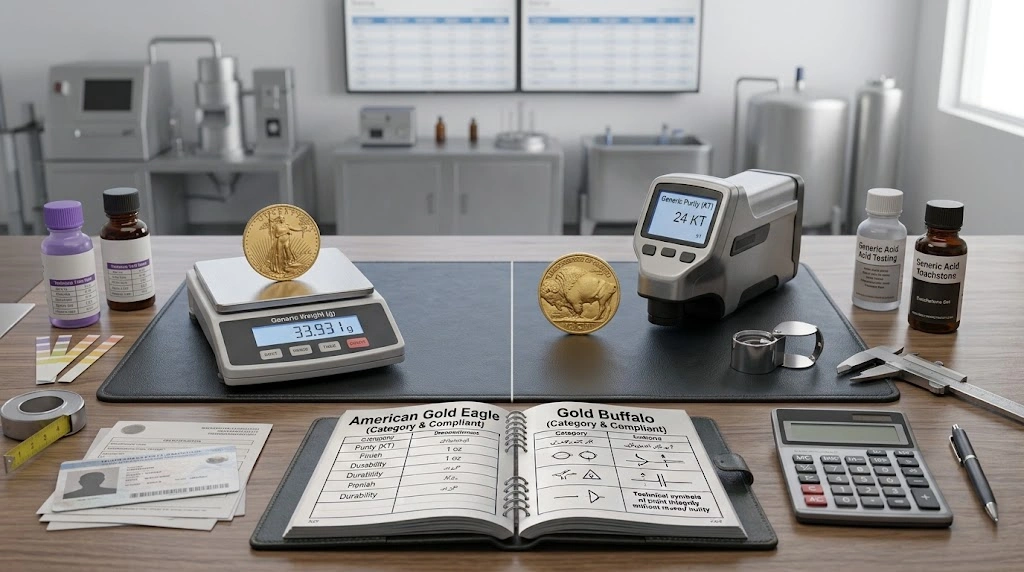
A concrete example of what this means in practice: a 1 oz Gold Eagle has a total gross weight of about 33.93 grams, but because of the alloy content, it still contains exactly one troy ounce (31.1035 grams) of pure gold — no more, no less. A 1 oz Gold Buffalo weighs almost exactly 31.108 grams total, with virtually all of that weight being pure gold. Both coins deliver the same amount of actual gold; the Eagle simply carries extra alloy weight to reach that same content.
Design and History
The American Gold Eagle has been the US Mint’s flagship gold bullion coin since 1986, featuring Augustus Saint-Gaudens’ Lady Liberty on the obverse and a design of eagles on the reverse. The American Gold Buffalo, launched two decades later in 2006, revives James Earle Fraser’s iconic 1913 Buffalo Nickel design — a Native American profile on the obverse and an American bison on the reverse. Both designs are widely recognized among US collectors, though the Buffalo’s design has a particular following among those drawn to classic Americana motifs.
Available Sizes and Denominations
The Gold Eagle offers more flexibility for smaller budgets, available in four bullion sizes: 1 oz, 1/2 oz, 1/4 oz, and 1/10 oz, each with its own $50, $25, $10, or $5 face value. The Gold Buffalo is primarily issued as a 1 oz bullion coin; fractional sizes exist but are mainly struck as limited proof versions rather than widely available bullion products. If you’re looking to start small or buy in smaller increments over time, the Eagle’s size range gives you more entry points.
Premiums, Liquidity, and Resale Value
Both coins are highly liquid and accepted by dealers across the country, including here at DEIGSC. In practice, premiums for both tend to move within a similar range over spot price, though the exact gap can shift with mint production levels and demand in a given month. The Gold Eagle’s longer track record and four-decade circulation history generally make it the more universally recognized coin at a glance, which can be a small edge when reselling to a buyer unfamiliar with less common bullion products. The Gold Buffalo’s 24-karat purity appeals to buyers who prioritize gold content over alloy composition, and it holds strong resale demand in its own right.
Gold IRA Eligibility: Do Both Qualify?
Yes — both coins are eligible for a Gold IRA. The IRS generally requires bullion held in a precious metals IRA to meet a minimum fineness of .995, which the Gold Buffalo satisfies directly at .9999 purity. The Gold Eagle is technically below that threshold at .9167 purity, but it’s specifically named as an exception under IRS rules and has been eligible since Gold IRAs were first permitted. For more on how these accounts work day to day, see our guide on how Gold IRAs work.
So, Which Is the Best Gold Coin to Buy for You?
Neither coin is objectively better — the right choice depends on what you’re prioritizing:
- Choose the Gold Eagle if you want the widest range of sizes, a coin with the longest US resale track record, or extra durability for a coin you may handle more often.
- Choose the Gold Buffalo if you specifically want 24-karat purity, prefer the classic Buffalo Nickel design, or are building a Gold IRA and want a coin that meets the standard fineness requirement without relying on the IRS exception.
- Consider holding both if you’re building a diversified bullion position — many long-term stackers own a mix of each rather than choosing exclusively.
Conclusion
The Gold Eagle vs Gold Buffalo decision isn’t about one coin being objectively superior — it’s about matching the coin’s strengths to your goals, whether that’s purity, size flexibility, design preference, or Gold IRA eligibility. Both are government-backed, widely traded, and solid additions to a precious metals holding. DEI Gold and Silver Coins, backed by certifications from CAC, NGC, PCGS, GIA, and AGL and more than 50 years of combined numismatic experience, carries both American Gold Eagle and Gold Buffalo coins and can walk you through which fits your specific goals. Either way, you’re buying a coin backed by the full faith and credit of the US government.
Frequently Asked Questions
Neither is inherently more valuable — a 1 oz coin of either type contains one troy ounce of gold content, so their underlying value tracks the same spot price. Small differences in dealer premiums can shift day to day based on demand and available supply, but neither coin holds a consistent value edge over the other.
Yes, both are IRA-eligible. The Gold Buffalo meets the IRS’s standard .995 minimum fineness requirement directly at .9999 purity. The Gold Eagle, at .9167 purity, is specifically named as an approved exception under IRS rules, so it qualifies despite falling below the general purity threshold.
The Gold Eagle is alloyed with silver and copper to improve hardness and scratch resistance, since pure 24-karat gold is quite soft. This design choice, dating back to the coin’s 1986 introduction, trades a small amount of purity for a coin that holds up better to repeated handling.
Yes, generally. Because the Gold Buffalo is nearly pure 24-karat gold, it’s softer than the alloyed Gold Eagle and can show handling marks more easily. Careful storage in a capsule or protective holder helps minimize this for either coin, but it matters more for the Buffalo.
Both are highly liquid and readily bought by dealers nationwide. The Gold Eagle’s longer history and higher overall mintage volume can make it marginally faster to sell to a buyer less familiar with bullion products, but a Gold Buffalo is not considered a hard-to-sell coin by any reasonable standard