Gold is trading near $4,000 an ounce this week. That is roughly 28 percent below its January record near $5,600 and about 7 to 8 percent below where the year began. Yet the three popular ways to own gold have told very different stories. Gold ETFs took in a record $31 billion in the third quarter and ended September holding more metal than ever. A leading miners fund, GDX, is still up about 6 percent for the year, though it sits roughly 30 percent below its high and dropped more than twice as fast as gold last week.
If you are weighing physical gold vs gold ETF ownership, or wondering where mining stocks fit, that gap is the useful part of the 2026 story. It shows what each choice actually exposes you to, and why the cheapest-looking option on a given day is not always the right one.
What has gold actually done in 2026?
Gold ended 2025 near $4,330 to $4,370 an ounce, depending on the benchmark, after one of its strongest years in decades. It kept climbing into January and then reversed. Here is the path in brief:
| Date | Approx. gold price | Context |
| Dec 31, 2025 | $4,330 – $4,370 | Year-end close; varies by benchmark |
| January 2026 | About $5,600 | Record high |
| Jul 13 | About $4,040 | Fed rate-hike expectations weighing on the metal |
| Sep 8 | About $4,410 | Rebound before the autumn slide |
| Oct 26 | About $4,000 | Briefly below $3,980 on Oct 23-26 |
Approximate figures from published market quotes. Benchmarks differ slightly.
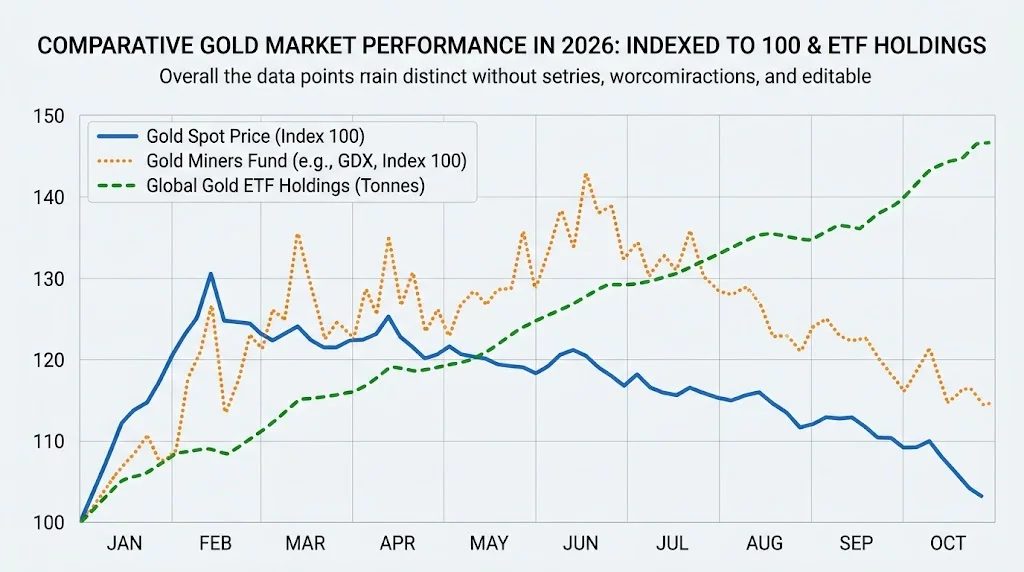
The main pressure has come from interest rates rather than from a loss of interest in gold. Higher oil prices, linked to Middle East conflict, have fed inflation worries and pushed markets to price a Federal Reserve that may hold rates high or raise them again. Gold pays no interest, so higher yields raise the cost of holding it. We cover that chain in our explainer on how global events and economic instability affect gold and silver prices.
Why did gold ETF investors keep buying while the price fell?
This is the sharpest gap of the year. According to the World Gold Council, global physically backed gold ETFs attracted about $10 billion in September, which lifted third-quarter inflows to a record $31 billion. Collective holdings rose by 67 tonnes in September to a record 4,256 tonnes, even though the lower gold price cut total fund assets by 7 percent to about $574 billion.
That does not mean there were no gold ETF outflows. Funds saw about $8.9 billion leave in June, and North America was the only region with net outflows in the first half, at roughly $7.7 billion. In mid-September, the largest fund, GLD, saw about $603 million redeemed in a single week, according to ETF Action data. The pattern is one of rotation between regions and funds rather than a single verdict on gold.
Flows and prices measure different things. Flows show what long-term allocators are doing. Price reflects the marginal seller on a given day, including futures traders reacting to rates and the dollar. State Street’s October gold monitor read the third-quarter inflows as evidence of strategic allocations rather than short-term trading. When buyers of the fund and sellers of the metal are different groups with different time horizons, a gap like this is possible.
It is also worth knowing what this gap does not tell you. A record in ETF holdings is not a price forecast, and inflows can reverse, as June showed. When you read fund data, look at tonnes and dollars separately. Tonnes show whether investors are actually buying or selling metal, while total assets in dollars move with the gold price, which is why assets fell in September even as holdings rose.
Gold mining stocks 2026: why miners and metal have diverged
Mining shares are companies, not gold. Their costs, such as labor, energy and equipment, are largely fixed in the short run, so a change in the gold price moves profit margins by much more than it moves the metal. That is why miners often run ahead of gold on the way up and fall faster on the way down.
Both sides of that leverage have shown up in 2026. The GDX fund is up about 6.5 percent for the year as of October 23, while gold is lower, because high prices fattened margins for much of the year. But GDX trades near $81, about 30 percent below its January high of roughly $117. In the week ended October 23, the junior miners fund GDXJ fell 9.6 percent while gold fell 4.1 percent. Higher oil hits miners twice: through their fuel and operating costs, and through the rate channel that weighs on gold.
Analysts value miners on production, reserves and cost, especially all-in sustaining costs, the full per-ounce cost of keeping a mine running, along with debt and management quality. A miners ETF spreads single-company risk across a basket, but it still moves with the stock market as well as with gold.
Miners also carry risks that bullion does not: operational problems, political and permitting risk, and the swings of the wider stock market. Their dividends are small, around 0.7 to 0.8 percent for GDX, so they are not an income substitute for holding the metal.
Physical gold vs gold ETF vs miners: what do you actually own?
| Physical coins and bars | Gold ETF (physically backed) | Mining stocks or ETF | |
| What you own | The metal itself | Shares in a trust that holds gold | Shares in operating companies |
| Cost to hold | Dealer premium, resale spread, storage and insurance | Annual fee, for example 0.40% for GLD | Annual fee, for example 0.51% for GDX |
| Delivery | In your hands or a vault of your choice | Most individuals cannot exchange shares for metal | Not applicable |
| Main risk | Premiums, theft, loss, resale spread | Fund and custody structure, market hours | Company, cost and stock-market risk |
| Federal tax (long-term) | Collectibles rate, up to 28% | Typically the collectibles rate for bullion trusts | Usually taxed like stocks |
| Best fit | Direct ownership you control | Convenient, liquid exposure | A small, higher-risk satellite position |
General information only. Fees and rules change, so check each fund’s current documents and confirm tax treatment with a CPA.
Cost is where the two main choices differ in shape. A physical coin charges you mostly up front, through a premium over spot and the spread when you sell. A fund charges a little every year. As a hypothetical example, a 4 percent premium paid once is roughly equal to ten years of a 0.40 percent annual fee. Premiums vary by product and dealer, and physical gold adds storage and insurance, so treat this as a way to think about the trade-off rather than a verdict. Our precious metals tax guide explains why bullion trusts and physical gold are usually taxed alike, while miners are not.
Owning physical gold: what a coin professional looks at
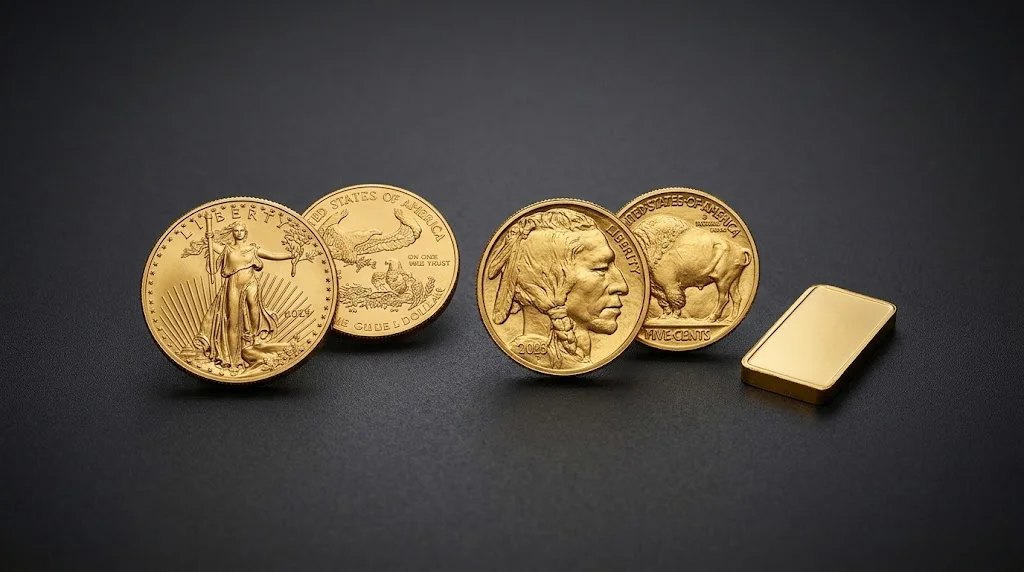
Owning physical gold works best when you know what you are holding. A one-ounce American Gold Eagle is struck by the U.S. Mint in 22-karat (.9167) gold and contains exactly one troy ounce of pure gold, with the rest being alloy for durability. The Gold Buffalo, introduced in 2006 as the U.S. Mint’s first 24-karat gold coin, is .9999 fine. Both usually trade close to the gold price plus a premium, and that premium is the cost of recognition, mint backing and easy resale.
Within physical gold there is a further choice. Bars usually carry lower premiums per ounce, while recognizable government coins are easier to sell in small pieces. Whichever you choose, ask a dealer for both the buy price and the sell price on the exact item, because the gap between them, called the spread, is part of your real cost. Items kept with their original packaging and paperwork are generally easier to resell.
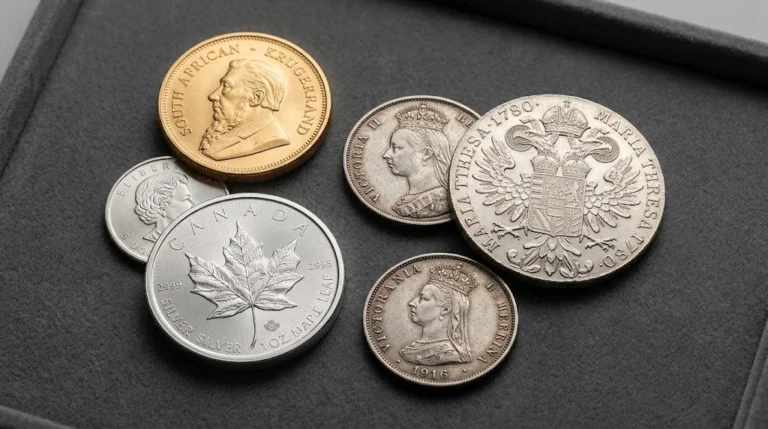
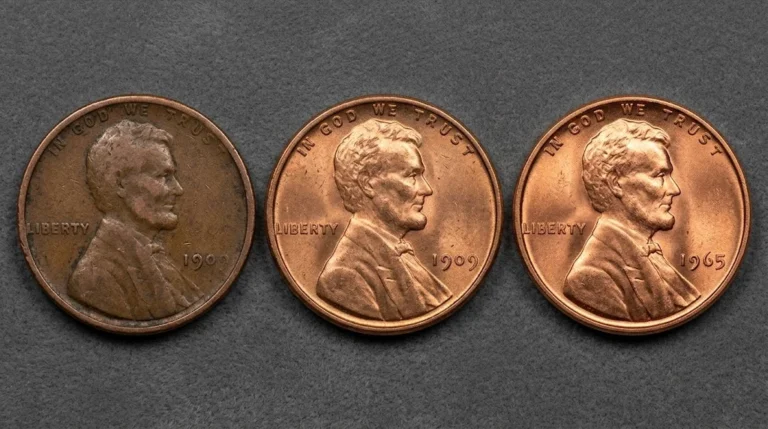
It also helps to separate bullion from numismatic value. A common-date bullion coin is priced mainly by its gold content. An older or scarce coin can carry a collector premium that depends on date, mint mark, strike, surface preservation and certification from services such as PCGS or NGC, none of which tracks spot. If you inherit gold coins, check the dates before assuming melt value is the whole story.
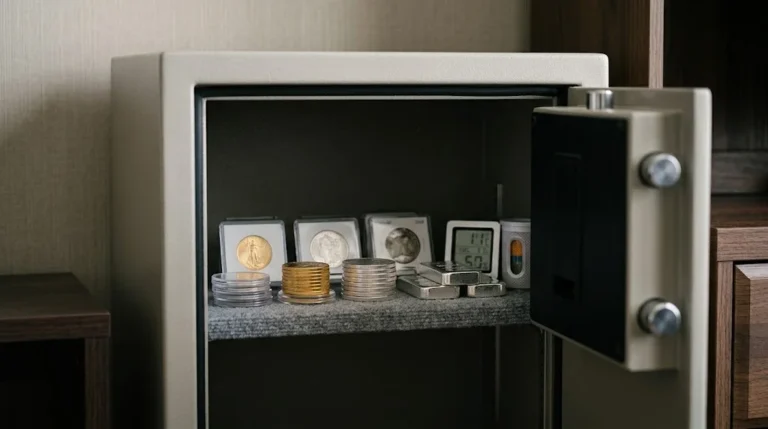
Before you buy, a dealer should be able to show the exact weight and, where relevant, test for purity. Keep coins in their original tubes or capsules, keep invoices for your cost basis, and decide where they will be stored. Nevada’s sales-tax treatment of precious metals depends on how an item is classified and published interpretations differ, so ask for the tax treatment to be shown on your invoice.
How should you choose?
The 2026 gap suggests starting with your purpose rather than the price. These are general guidelines, not financial advice:
- Convenience and liquidity:
- Direct ownership: physical coins and bars give you the metal itself, with no fund structure between you and it, in exchange for premiums, storage and record keeping.
- Leverage to gold: miners can reward you when margins widen, but they can also fall faster than the metal, so size the position accordingly.
- A blend: many investors combine more than one, so a forced sale in one place does not undermine the rest.
Picture two hypothetical investors. One wants gold inside a brokerage account and values being able to sell in seconds, so a physically backed ETF fits. The other wants coins she can hold and is comfortable paying a premium and arranging storage, so physical gold fits. Neither is wrong. They are paying for different things.
Rate expectations will keep driving short-term moves. The Federal Reserve meets October 27-28, and oil prices and inflation data will matter after that. Whatever you choose, decide in advance how you would act if gold fell another 10 or 20 percent.
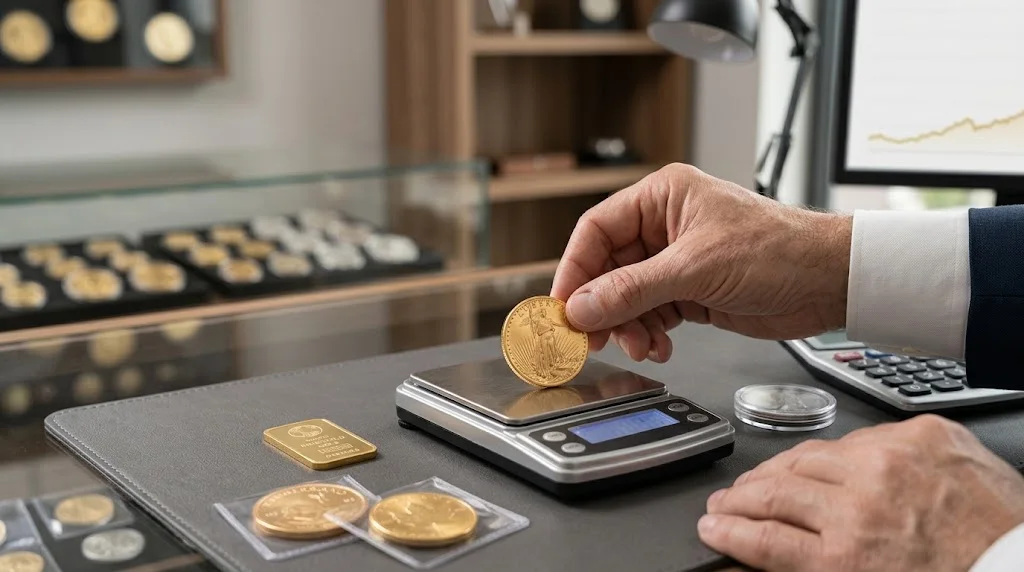
DEI GOLD AND SILVER COINS, a Las Vegas coin dealer at 8985 S. Eastern Ave, Suite 160, evaluates gold coins, bars and jewelry and can explain how a sale of physical gold is priced before you commit.
Conclusion
The gap in 2026 is really three different stories. ETF investors kept adding to holdings while the price fell. Miners amplified the move, rewarding holders earlier in the year and punishing them in recent weeks. Physical gold tracked the metal, with its cost paid up front in premiums. None of these is the right choice for everyone. Match the vehicle to your purpose, count every cost, and check any coin before you assume what it is worth. If you already hold or inherit physical gold and are unsure what it is worth, a professional evaluation separates melt value from collector value before you decide anything.
By DEI GOLD AND SILVER COINS | Articles by DEI GOLD AND SILVER COINS