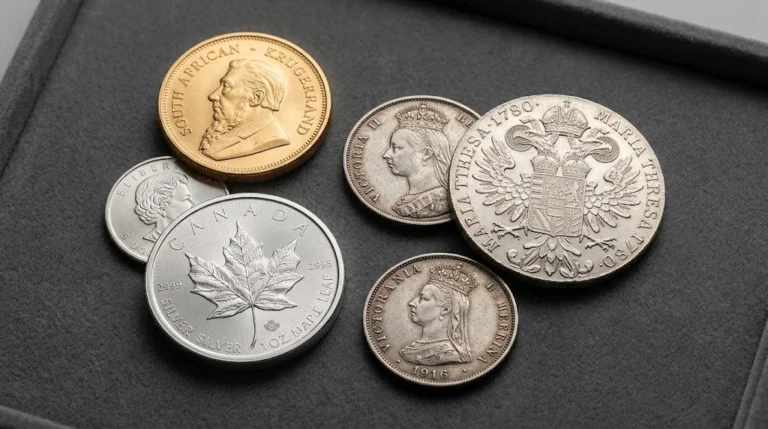
Gold is trading at around $4,000 per ounce this week, approximately 28 percent below its January record high. Silver, currently near $54, is about 55 percent below its own peak. Both metals have also experienced sharp rebounds along the way, leaving many buyers uncertain whether to buy now or wait for prices to fall further. Dollar-cost averaging gold and silver offers a more structured approach by replacing this uncertainty with a consistent routine of investing a fixed dollar amount at regular intervals.
It does not guarantee a better result, and it does not remove the risk of prices falling after you buy. What it does is reduce the damage from mistiming a single purchase and fit your buying to your cash flow. Below are a worked example, what research says about spreading purchases, the costs that make small physical purchases tricky, and a practical silver stacking strategy.
Why choppy prices make timing so hard
This year shows why. Gold ended 2025 near $4,330 to $4,370, climbed to about $5,600 in January, dipped to about $4,040 in July, recovered to about $4,410 in early September, and is back near $4,000. Silver went from roughly $70 to $72 at the start of the year to about $121.6 in January, fell to about $58 by late July, rebounded to about $66 in early September, and now sits near $54. Anyone who tried to wait for the bottom has had several apparent bottoms to second-guess, and several rallies that looked like the start of a recovery.
In a market like that, the real problem is rarely the price you pay. It is the decision you keep postponing.
How does dollar-cost averaging work with gold and silver?
Each period you spend the same number of dollars, so you receive more ounces when the price is low and fewer when it is high. Your average cost per ounce is total dollars divided by total ounces. Because low-price periods deliver more ounces, that average always lands at or below the plain average of the prices you paid.
Physical metal adds one layer. What you pay is spot plus a premium, so the number you are really averaging is your all-in cost per ounce, not the spot price alone.
A worked example with choppy prices
Here is a hypothetical six-month plan: $500 a month into silver, ignoring premiums for simplicity. The prices are invented to resemble this year’s swings, not actual purchase dates.
| Scenario | Monthly prices | Monthly plan: avg cost | Monthly plan: ounces | Value at month 6 | All at once on day 1: ounces | Value at month 6 |
| Choppy, ends lower | $58, $66, $61, $56, $54, $50 | $57.05 | 52.58 | $2,629 (-12.4%) | 51.72 | $2,586 (-13.8%) |
| Steady rise | $50, $52, $54, $56, $58, $60 | $54.79 | 54.76 | $3,285 (+9.5%) | 60.00 | $3,600 (+20.0%) |
Hypothetical numbers for illustration only. Total invested in each case: $3,000.
[IMAGE: Suggested image of a simple chart showing the six monthly purchases of the choppy scenario as dots on the price line, with the average cost drawn as a horizontal line.]
Image purpose: Shows visually how buying more ounces at lower prices pulls the average cost down, which a table cannot do.
Suggested alt text: Chart of six monthly silver purchases at varying prices with a horizontal line marking the average cost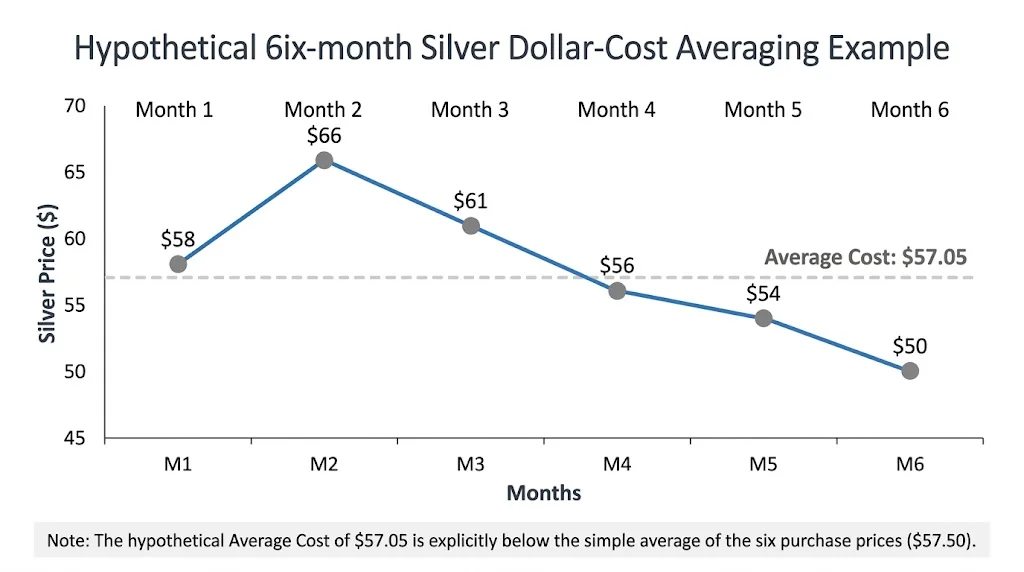
Two lessons stand out. In the choppy, falling path, spreading purchases cost less per ounce than buying everything on day one, yet both approaches ended below the $3,000 invested. In the steady rise, buying everything at the start won, because the money was working before prices climbed. Dollar-cost averaging manages timing risk. It does not beat a market that is simply rising.
What does the research say about spreading purchases?
The best-known study comes from Vanguard. Looking at stock-and-bond portfolios in the U.S., U.K. and Australia, it found that investing a lump sum immediately beat spreading it over 12 months about two-thirds of the time, mostly because markets tend to rise and cash sits idle while you wait. In the remaining third, when prices fell, spreading came out ahead. The longer the averaging period, the more it lagged, so a short, finite schedule suits a windfall, while an ongoing plan suits regular income.
Two caveats matter for gold and silver buyers. First, the study covered stocks and bonds, which earn returns while you hold them. Gold and silver pay nothing, and both have endured long stretches without gains. Gold fell roughly 70 percent from its 1980 peak to its 1999 low. Second, the study addresses what to do with a windfall you already hold. If you are buying from monthly income, you are averaging by necessity. Where the research does support a schedule is behavior: it keeps you from buying only after rallies and freezing after drops. Our market timing guide looks at the same question from the timing side.
Why small purchases cost more with physical metal
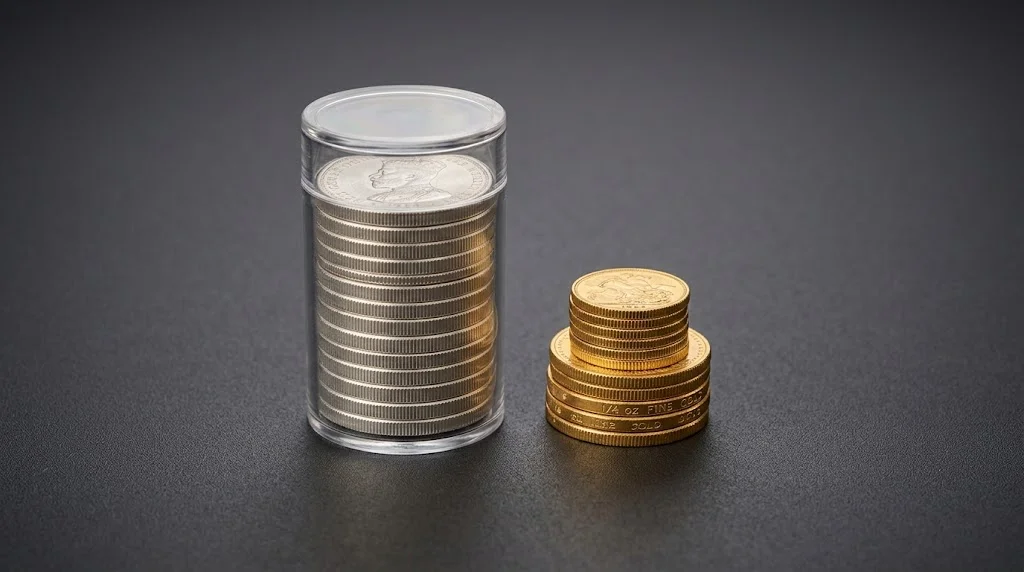
Dealers’ costs for minting, handling and shipping do not shrink with the size of the item, so smaller products usually carry higher premiums per ounce. Our explanation of bullion premiums covers what drives them.
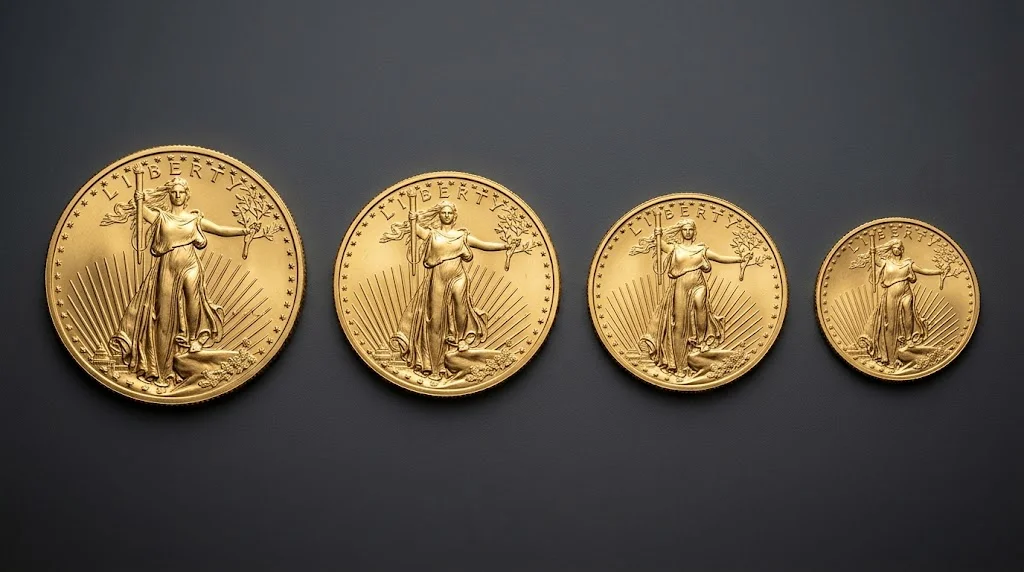
Gold makes the point clearly. At roughly $4,000 an ounce, a $500 monthly budget buys about one-eighth of an ounce before premium, so a one-ounce coin is out of reach each month. You have three practical options:
- Fractional coins.
- Quarterly purchases. Saving three months of budget and buying a larger coin keeps the discipline while lowering the premium.
- A blend. Some buyers use small monthly purchases for silver and quarterly buys for gold.
Fixed costs matter too. If shipping and insurance add $25 to each $500 order, that is a 5 percent cost on top of the premium. The same $25 on a $1,500 quarterly order is under 2 percent. Choose an interval where those fixed costs stay small relative to what you spend, and remember that the spread between a dealer’s buying and selling price is part of your cost when you eventually sell.
A silver stacking strategy built on dollar-cost averaging
Silver suits small, regular purchases because the price per ounce is low. At about $54, $500 buys roughly 9.3 ounces before premium, or about 8.4 ounces with a hypothetical 10 percent premium. Here is what common monthly budgets buy before any premium, at about $54 for silver and $4,000 for gold:
| Monthly budget | Silver (ounces) | Gold (ounces) |
| $250 | 4.63 | 0.0625 |
| $500 | 9.26 | 0.125 |
| $1,000 | 18.52 | 0.25 |
Approximate, before premium. Actual quantities depend on the product and the day’s price.
A workable silver stacking strategy comes down to a few decisions made once, in advance:
- Fix the amount. Use money you will not need for years, set at a level that survives another 20 to 30 percent drop without forcing a sale.
- Choose the interval. Monthly lines up with income. Less frequent buying lowers per-order costs.
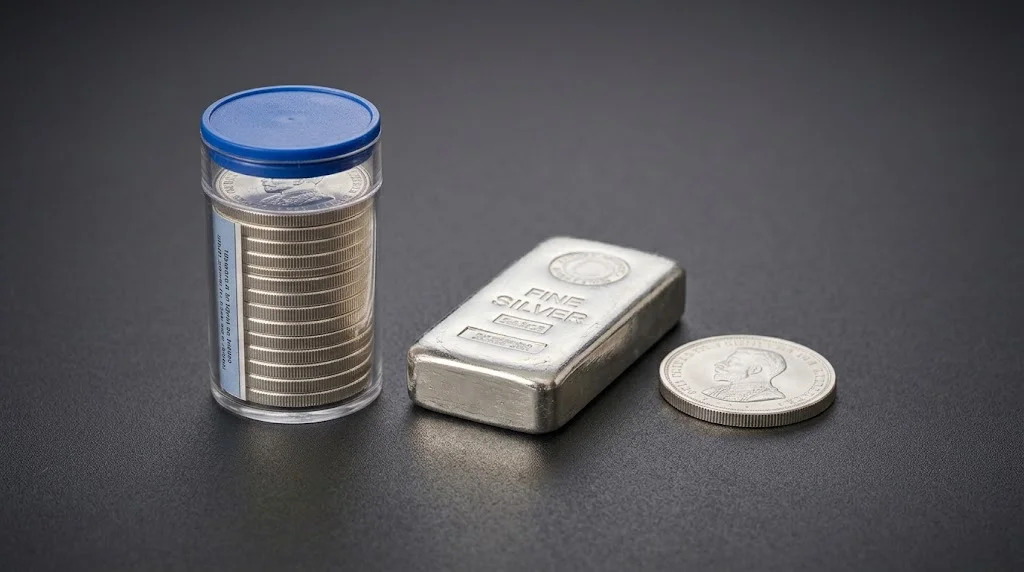
- Pick a core product.
- Keep buying through drops. The schedule only works if you do not pause after a fall. Skip a purchase only if you need the cash.
- Decide any tilt in advance. Some stackers shift part of the budget toward the metal that looks cheaper by the gold-silver ratio, which was about 74 on October 26, up from about 66 in late September. That adds judgment and can be wrong, so write the rule down and keep it small.
- Review twice a year. Check allocation and storage, not the daily price.
Records, tax and storage when you buy often
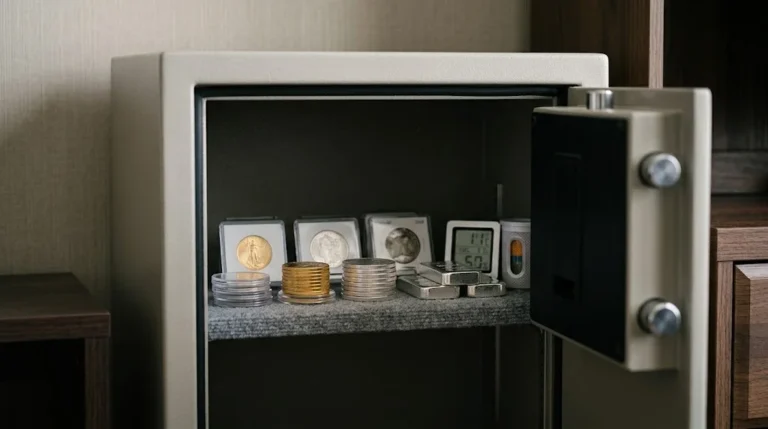
Many small purchases mean many cost-basis entries. Keep each invoice, with the date, price and premium. Federal tax treats physical gold and silver as collectibles, so long-term gains can be taxed at up to 28 percent, and your records are what establish the gain. Our precious metals tax guide covers the details, and a CPA can confirm what applies to you. As the stack grows, plan storage and check whether your insurance covers it.
DEI GOLD AND SILVER COINS, a Las Vegas coin dealer, sells silver coins, bars and rounds and can quote the price it would pay to buy an item back alongside the selling price, which is worth asking any dealer before you commit to a schedule.
Common mistakes to avoid
- Quietly turning the plan into market timing. Buying extra after every dip and skipping after every rally brings back the guesswork the schedule was meant to remove.
- Ignoring premiums. A low spot price does not help if the product you chose carries a high premium.
- Changing products constantly. A mix of unfamiliar items can be hard to value and resell. Stay with widely recognized coins and bars.
- Letting headlines rewrite the plan. Decide the rules when you are calm, and change them only at your scheduled review.
When dollar-cost averaging is not the right tool
- You hold a large windfall, have a long horizon and can tolerate volatility. The research above favors investing sooner in that situation, at least for stocks and bonds.
- Per-order costs would eat a large share of each purchase. Fewer, larger purchases may serve you better.
- You know you would stop buying during a crash. A rule you will not follow has no value.
- You expect it to protect you from a lasting decline. It lowers your average cost but does not stop losses.
This article is general information, not financial advice, so consider speaking with a licensed advisor about your own situation.
Conclusion
When gold and silver swing this widely, a fixed schedule is less about beating the market and more about staying in the game without agonizing over each purchase. Spread buying when it fits your cash flow, match the interval to your costs, keep records, and decide your rules in advance. Treat the worked example as a reminder that averaging lowers the cost of mistiming, not the risk of falling prices.
By DEI GOLD AND SILVER COINS | Articles by DEI GOLD AND SILVER COINS