What is coin toning?
Toning is a surface discoloration caused by a slow chemical reaction with the coin’s environment. It differs from corrosion, which eats into the metal. Toning mostly changes how the surface looks.
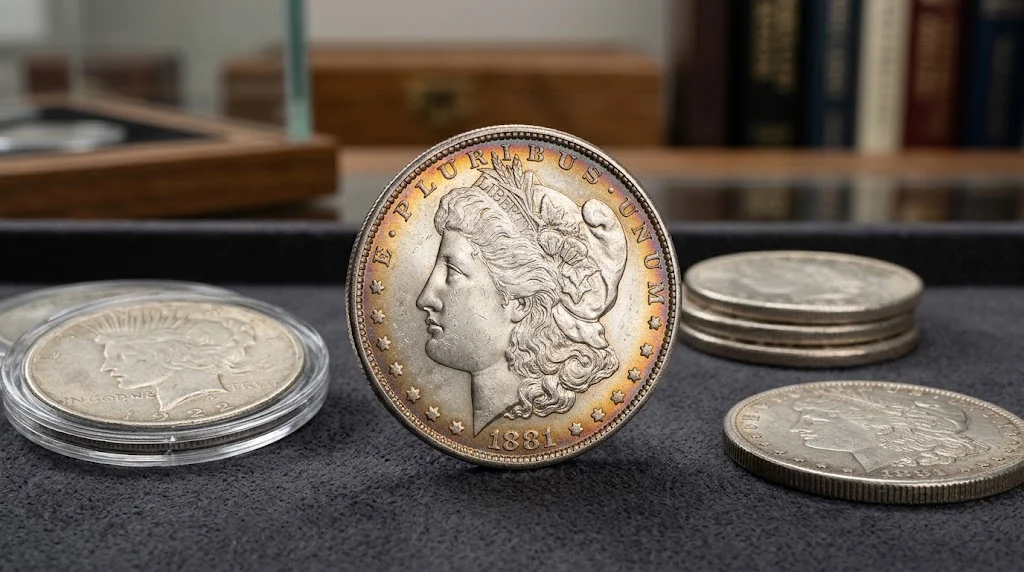
On silver, the main cause is sulfur. Sulfur compounds in the air, in paper and cardboard, and in some storage materials react with the silver and form a thin film of silver sulfide. The thickness of the film decides the color. A very thin film looks light gold or yellow. As it thickens the colors move through orange, red, blue and purple, and finally to gray or black. The rainbow on a toned silver dollar is light passing through those layers. This takes years, sometimes decades.
[PHOTO: a real naturally toned coin from your shop, with a caption saying what the coin is. Suggested alt text: “Naturally toned silver dollar with blue and gold color near the rim”.]
What causes toning?
- Sulfur and other reactive compounds in air, paper envelopes, cardboard albums, rubber bands, wool, felt, some paints and adhesives. Coins often tone where they touched the material.
- Humidity and temperature swings. Damp rooms and basements speed up the reaction and make it uneven.
- Handling. Fingerprints leave oils, salts and acids that can spot or etch the surface.
- The metal. Silver tones easily. Copper turns from red to brown to dark brown. Copper-nickel can tone or spot. Gold resists toning, although gold-copper alloys can develop spots or a reddish cast.
Common types of toning
| Type | What it looks like | How it usually forms | How collectors tend to see it |
|---|---|---|---|
| Rainbow | Bands or swirls of several colors | Slow, even reaction over many years | Often the most sought after when natural and attractive |
| Crescent | A curved band of color along the rim | Part of the coin was covered, for example by a holder or another coin | Popular when vivid and the coin is otherwise clean |
| Bullseye | A ring of color around a lighter center | Contact with a ring-shaped holder or material | Valued by many when the colors are appealing |
| Album | Color that follows the shape of an album slot | Long storage in a cardboard or paper album | Can be beautiful but is hard to predict |
| End-roll | Color on the edge or on one face | Stored in a roll or wrapper | Similar to crescent toning; value depends on eye appeal |
| Dark or uneven | Brown, gray or black patches | Heavy tarnish, often with spotting | Usually lowers appeal and value |
No label guarantees a premium. A toned coin with a weak strike, scratches or cleaning marks can still sell for little.
How toning affects value
Toning can raise a coin’s price, lower it, or change nothing. It depends on the coin and the buyer.
When toning can add value
- The coin is collectible, not a bullion piece, and the color is original.
- The colors are vivid, evenly spread and improve the coin’s overall appearance.
- The coin underneath is already desirable: a better date, a higher grade, or a series collectors chase, such as Morgan silver dollars.
When toning can lower value
- The color is dark or blotchy and hides attractive luster.
- The toning is artificial (see below).
- The coin was cleaned to remove the toning, which leaves its own damage.
What toning does not change
A silver coin’s silver content. Tarnish does not reduce the weight of metal, so melt value stays the same. Heavy spotting on a modern bullion coin can still reduce the premium a dealer will pay above melt. For more on this, see melt value vs. collector value.
Toning is also a matter of taste. Some collectors pay up for color and others want a bright, untouched coin, which is why two experienced dealers can value the same toned coin differently.
Natural vs. artificial toning
Artificial toning, sometimes called “doctoring,” is color added on purpose to make a coin look more valuable.
Natural toning usually
- Develops over years with colors that blend smoothly.
- Follows how the coin was stored, with patterns that match a holder, album or roll.
- Sits within the luster, not on top of it.
Artificial toning often
- Looks too bright, with “crayon” colors that seem too vivid.
- Seems to float on the surface instead of being part of it.
- Covers hairlines or scratches instead of following the coin’s surface.
- Looks too uniform or too perfect for the coin’s age.
The major grading services may decline to give a toned coin a numeric grade if they believe the color is artificial, and may mark it as questionable color. If you are buying a toned coin and are unsure, choose a certified coin or have a dealer examine it first. See our guides to spotting fake or counterfeit coins and how to read a grading certificate.
Should you clean a toned coin?
No. Cleaning, dipping or polishing removes the toning, but it also strips part of the original surface and leaves tiny scratches. A cleaned coin is usually worth less to collectors than the same coin with natural toning, and a grading service may return it with a “details” grade instead of a numeric one. Our guide on why cleaned coins lose value explains it in detail. If the coin is ordinary bullion with no collector value, cleaning does not change the metal, but when in doubt, do not clean it. Get it looked at first.
Can you tone a coin on purpose?
Online guides explain how to tone silver with heat, chemicals or sulfur sources. A coin toned on purpose is artificially toned. Collectors and graders will not treat it as natural, and it will rarely be worth more. If you enjoy the look for your own display, that is your choice, but do not do it to a coin that has collector value.
How to store coins to avoid unwanted toning
- Use inert holders. Choose PVC-free holders such as Mylar flips, hard plastic capsules and certified slabs. Old soft vinyl flips can leave a green, sticky film that is hard to reverse.
- Keep coins away from sulfur sources: cardboard, rubber bands, wool, felt and unsealed paper.
- Control humidity. A cool, dry place with a steady temperature, ideally with silica gel in a closed container.
- Handle by the edges over a soft surface. Nitrile gloves are a good choice. Cotton can snag.
- Check any album or holder before use. The rainbow effect from albums is unpredictable and can ruin a coin as easily as improve it.
For bullion, storage is mostly about security. See our guide on storing gold and silver safely at home.
What to do if you have toned coins
- Do not clean them.
- Store them in inert holders until you decide.
- Take clear photos of both sides in natural light, plus a close-up of any unusual color.
- Get a hands-on opinion. Toning is hard to judge from a photo. Contact us for a free appraisal at 8985 S. Eastern Ave, Suite 160, Las Vegas, or call (702) 460-5188. Thinking of selling? See how we buy silver in Las Vegas.
- Consider grading if the coin is valuable. Our grading scale guide explains what the numbers mean.
Frequently asked questions
Q1. What causes coin toning?
A chemical reaction between the coin’s metal and its surroundings. On silver, sulfur compounds in air, paper or storage materials are the usual cause. Humidity, handling and heat can speed it up.
Q2. Does toning always change a coin’s value?
No. Attractive natural toning can add a premium on collectible coins. Dark, uneven or artificial toning can reduce value. On bullion, it does not change the silver content.
Q3. How can you tell if toning is artificial?
Look for color that seems too bright, sits on top of the surface, covers hairlines or looks unnaturally uniform. If unsure, ask a dealer or buy a certified coin.
Q4.Is it okay to clean a toned coin?
Generally no. Cleaning removes the original surface and usually lowers a collectible coin’s value. Have it looked at before touching it.
Q5. Can I tone a silver coin myself?
You can, but it will be artificially toned and not treated as natural by collectors or graders. Do not do it to a coin with collector value.
Q6.What is the best way to store toned coins?
In PVC-free holders, in a cool, dry place, away from cardboard, rubber and other sulfur sources. Handle by the edges only.