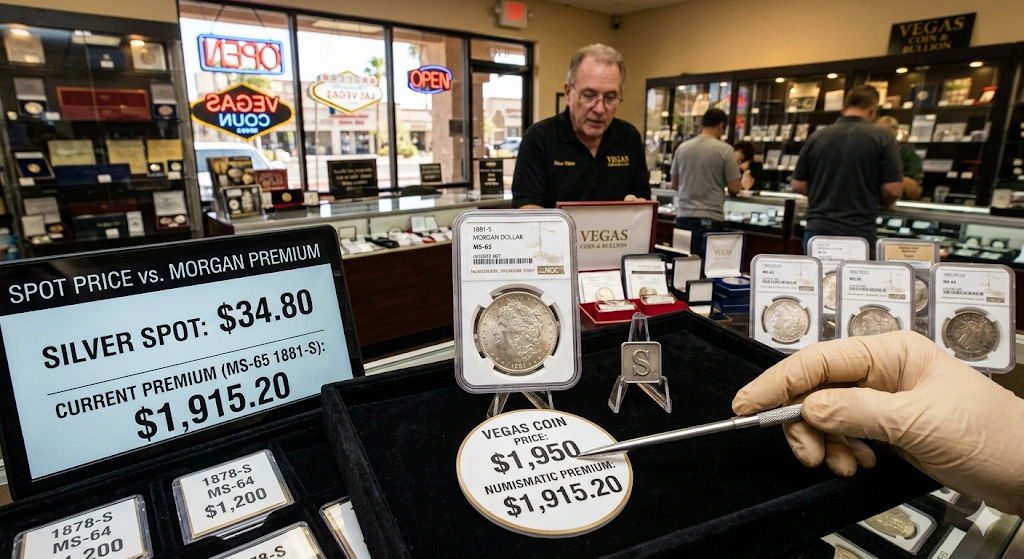
A retiree walked into DEI’s showroom on Eastern Ave last spring carrying a PCGS-graded 1881-S Morgan dollar in MS-65. She’d seen silver spot price at roughly $30 per ounce that week and assumed her coin was worth about $25 — the approximate melt value of 0.7734 troy ounces of silver. The PCGS Price Guide value for that coin in MS-65 was $750. She’d been undervaluing a numismatic premium of more than $700 because she didn’t know the difference between spot price and collectible value.
That gap — between what metal markets say a coin is worth and what coin markets say a coin is worth — is the central concept every buyer and seller of US coins needs to understand. According to Heritage Auctions, numismatically graded coins in MS-64 and above have historically outperformed bullion-grade coins on a per-ounce basis during periods of flat or declining precious metals prices, precisely because their value is driven by two independent variables rather than one. The challenge for most people is knowing which of their coins carry meaningful numismatic premiums, and how stable those premiums are over time.
This post explains exactly how numismatic premium vs spot price works, which coins carry the strongest premiums, and how to think about coin value above spot price when buying, selling, or evaluating an inherited collection.
What Is Numismatic Value and How Does It Differ from Spot Price?
Numismatic value is the market price a coin commands based on its rarity, condition, historical significance, and collector demand — a figure that can be anywhere from a few percent above spot price to hundreds of times the melt value, depending entirely on the coin.
Spot price (also called melt value) is simpler: it’s the current commodity market price for the precious metal content of the coin. For a 1 oz American Silver Eagle, spot is essentially one ounce of silver at today’s Kitco or APMEX price, plus a small dealer premium for the coin’s production cost and distribution. That relationship is direct and transparent.
Numismatic value adds layers on top of that foundation. A coin’s numismatic premium reflects:
Rarity — How many examples were minted, and how many survive in collectible condition today? An 1893-S Morgan dollar had a mintage of only 100,000 and extremely few survivors in problem-free condition. Its numismatic premium is enormous relative to melt.
Grade — The same coin in VF-20 versus MS-65 can differ in value by a factor of 10 or more. PCGS and NGC provide the standardized 70-point Sheldon scale that creates a verifiable, tradeable grade attached to the coin permanently.
Collector Demand — Some series attract intense collector competition; others are collected primarily for metal content. Morgan dollars, Walking Liberty halves, and Saint-Gaudens Double Eagles all have deep collector bases that support sustained premiums. Generic silver bars have none.
Historical Significance — Key dates, scarce mint marks, and coins with documented provenance (like the Tilawa Shipwreck silver at DEI) carry premiums that reflect their story as much as their metal.
What is numismatic value in practice? It’s the price a coin achieves at Heritage Auctions, GreatCollections, or Stack’s Bowers after a competitive bidding process — a market-determined number that incorporates all of these factors simultaneously.
How Numismatic Premium vs Spot Price Actually Works: A Real Example
The numismatic premium vs spot price gap is most visible when you compare two coins with identical metal content but different collector standing — like a common-date American Silver Eagle and an 1881-S Morgan dollar in MS-65, both containing approximately 0.77 troy ounces of silver.
With silver spot at $30/oz, both coins have a melt value of roughly $23. Here is where they diverge:
A 2024 American Silver Eagle in MS-70 (PCGS or NGC) sells for approximately $80–$100 on GreatCollections — a numismatic premium of $57–$77 over melt, driven by its status as the official US bullion coin, high collector demand for perfect-grade examples, and its Gold IRA eligibility.
An 1881-S Morgan dollar in MS-65 (PCGS) sells for approximately $700–$900 at Heritage Auctions — a numismatic premium of $677–$877 over the same melt value, driven by its age, original surfaces, specific mint mark desirability (San Francisco issues in high grades are consistently valued), and the enormous Morgan dollar collector base.
Same metal content. Same melt value. Premium difference: roughly $800.
This is why the numismatic premium vs spot price calculation matters so much when you’re evaluating what to buy, what to sell, and what you actually own. A coin collection isn’t a pile of metal — it’s a portfolio of individual items where each piece’s value is determined by a separate market with its own supply, demand, and pricing dynamics.
📌 DEI Market Observation: In 50+ years of combined experience buying coins at our Las Vegas showroom, we’ve consistently observed that inherited coin collections contain a mix of bullion-level coins and numismatically significant coins, and sellers almost never know which is which until a PCGS- or NGC-affiliated dealer evaluates them. On average, roughly one in four coins in a typical estate collection carries a numismatic premium that makes professional grading and certification worth pursuing before sale.
Which Coins Have the Highest Coin Value Above Spot Price?
Coins with the highest numismatic value above spot price are key-date US rarities in certified high grades, specifically scarce-mintage Morgan and Peace dollars, pre-33 US gold coins in original condition, and early American copper coins — where collector demand consistently outpaces supply of problem-free examples.
Here’s how the major categories rank for premium potential:
Pre-33 US Gold Coins carry some of the strongest sustained premiums in American numismatics. A Saint-Gaudens Double Eagle ($20 face) in MS-63 with original surfaces sells for $2,400–$2,800 at Heritage Auctions — a premium of 20–35% above the coin’s approximately $2,000–$2,100 gold melt value (depending on gold spot). The premium reflects both collector demand and the coin’s historical irreproducibility: no new pre-33 Double Eagles will ever be minted. DEI’s pre-33 US gold coin inventory includes both circulated and certified examples across multiple grades.
Morgan Silver Dollars (key dates) represent the widest range of any single US coin type. A common 1921 Morgan in MS-63 trades near melt with a small premium. An 1893-S Morgan in VF-30 — one of the key dates with a mintage of 100,000 — sells for $5,000–$8,000 at major auction houses, a premium of more than 200x melt value at current silver prices.
American Silver Eagles (high grades) occupy a middle position: strong premiums for MS-70 and PR-70 examples, modest premiums for MS-69, and near-spot pricing for ungraded examples. Their consistent US Mint production creates a large supply that limits extreme premium growth, but their Gold IRA eligibility and official status maintain steady collector and investor demand.
Junk silver coins (90% pre-1965 US coins) trade at or very near spot with minimal numismatic premium — they are primarily metal plays. DEI carries junk silver by the face value bag for buyers whose interest is in silver content rather than collectibility.
Buy or Sell Gold & Silver Coins with Confidence
Work with a trusted Las Vegas coin dealer offering fair pricing, honest appraisals, and expert guidance every step of the way.
📊 Coin Value Above Spot Price by Type — DEI Quick Reference
| Coin Type | Typical Numismatic Premium Over Melt | Driver | Grading Required? |
|---|---|---|---|
| Common-date Morgan dollar (circulated) | 5–15% | Metal + collector baseline | No, but helps resale |
| Key-date Morgan dollar (MS-63+) | 50x–200x+ melt | Rarity + grade + demand | Yes — PCGS/NGC |
| American Silver Eagle (MS-70) | 3x–4x melt | Official bullion + IRA eligibility | Yes for premium |
| Pre-33 Double Eagle (MS-63) | 20–35% over melt | Historical rarity + collector demand | Yes — PCGS/NGC |
| Gold Buffalo (1 oz, recent) | 4–7% over spot | Bullion premium only | Optional |
| 1881-S Morgan dollar (MS-65) | 30x melt | Grade rarity + San Francisco demand | Yes — PCGS/NGC |
| 90% junk silver (pre-1965) | 0–5% over melt | Metal content only | No |
| Walking Liberty Half (MS-65) | 8x–15x melt | Classic design + grade scarcity | Yes — PCGS/NGC |
🪙 DEI Dealer Observation
The premium conversation we have most often at DEI’s Eastern Ave showroom isn’t about rare key dates — it’s about mid-range Morgan dollars in MS-63 to MS-65 that sellers have been holding for years without realizing that the grade differential in that two-point range is enormous. An 1881-S Morgan in MS-63 might bring $90–$110. The same coin in MS-65 brings $700–$900. That’s not a 2-point improvement in condition — it’s an $800 difference driven almost entirely by how uncommon pristine original-surface examples of that issue are at the MS-65 level. The practical implication: if you have a coin that looks exceptional to you, spend the $30–$50 on a PCGS or NGC submission before you sell it at a flat price. We’ve had clients leave our showroom and come back three months later with a PCGS MS-65 holder on a coin we evaluated as raw, and that submission turned a $120 coin into a $700 coin. That return on a $35 submission fee isn’t unusual for the right coin.
When Does Coin Value Above Spot Price Justify Paying a Premium to Buy?
Paying a numismatic premium above spot price is justified when the coin has documented rarity in the requested grade, a deep and active collector market, PCGS or NGC certification confirming its condition, and a resale history showing that comparable examples have maintained or grown their premium over time.
Not every premium is worth paying. Here’s how to evaluate:
Justified premiums: Certified key-date coins in PCGS or NGC holders where grade population reports (available free on PCGS CoinFacts) show that fewer than 50–100 examples exist in that grade and above. When supply is genuinely constrained and collector demand is proven by auction history, premiums are durable.
Pre-33 US gold coins in original, problem-free condition — where the supply is permanently fixed and demand grows alongside wealth preservation interest.
High-grade American Silver Eagles for Gold IRA portfolios — where IRS fineness requirements (.999+ silver) and official US Mint status make them specifically suitable for retirement account structures that other silver coins don’t meet.
Premiums to approach with caution: Modern commemorative coins and limited-edition private mint products marketed with “collector premium” language but without a deep secondary market. If Heritage Auctions or Stack’s Bowers don’t have a meaningful transaction history for the coin, the premium may not hold.
Graded coins where the grade is assigned by a third-party service other than PCGS or NGC — some smaller grading companies assign more generous grades, creating an apparent premium coin that the mainstream market doesn’t recognize at that value.
At DEI, when clients ask whether a specific coin’s premium is worth paying, we pull the Heritage Auctions sold listing history and the PCGS population report together. Those two data sources tell you whether the premium is supported by real market evidence or by marketing language.
Numismatic Premium and Tax Considerations for USA Coin Investors
Coins sold at a profit are taxed as collectibles under IRS rules, with a maximum long-term capital gains rate of 28% after a holding period of more than one year — a higher rate than the 15–20% that applies to most stock investments, which is a critical factor in calculating net return on numismatic premium coins.
The IRS classifies coins, including numismatically graded coins, as collectibles under IRC Section 408(m). Gains realized on coin sales held for more than one year qualify for the long-term collectibles rate, which is capped at 28% for taxpayers in the highest brackets — compared to the 20% maximum long-term rate on stocks and bonds. For lower-income taxpayers, the rate may be lower. Consult a tax professional for your specific situation.
This tax structure has a real impact on premium coin ROI calculations. If you buy a coin with a $700 numismatic premium and sell it for $1,400 two years later, your $700 gain faces up to 28% tax rather than the 20% rate you might pay on a stock gain of the same size. Net after-tax return narrows. Factor this into your holding period and return expectations when buying numismatic premium coins as investments rather than collectibles.
Gold IRA investors face separate rules: coins held in an IRA avoid annual capital gains taxes, with distributions taxed as ordinary income at withdrawal. Gold coins eligible for IRA inclusion must meet IRS fineness requirements (.9950+ for gold) and must be held by an approved custodian — not personally stored. American Gold Eagles are specifically exempted from the fineness requirement by statute. Nevada has no state income tax, which provides an additional after-tax advantage for Las Vegas and Henderson residents selling coins compared to residents of California or New York.
How DEI Evaluates Numismatic Premium Coins: The Las Vegas Process
At DEI Gold & Silver Coins in Las Vegas, evaluating a coin’s numismatic premium vs spot price takes five minutes and uses PCGS CoinFacts population data, current Heritage Auctions sold listings, and physical examination — a process we apply to every coin we consider buying or certifying.
When you bring a coin to our showroom for appraisal, here’s what actually happens:
First, we examine the coin physically — surfaces, luster, strike quality, and the presence of any cleaning, tooling, or damage. A coin’s grade range is established by eye before any database is consulted.
Second, we pull the PCGS CoinFacts or NGC price guide entry for that specific coin, date, and mint mark at the grade range we’ve identified. This gives us the certified market value at each grade level.
Third, we check recent Heritage Auctions and GreatCollections sold listings for the specific date and grade to see where actual transactions have cleared versus published price guides. Price guides lag the market; recent auction results reflect what buyers are paying today.
Fourth, if the coin appears to have significant numismatic premium potential, we discuss PCGS or NGC submission with the owner — providing a realistic submission cost, turnaround estimate, and grade probability range based on what we’re seeing physically.
The result is an honest, documented assessment of whether your coin’s value above spot price is $20 or $2,000 — based on real market data, not speculation. DEI offers this evaluation free of charge, with same-day results for most coins. Call (702) 460-5188 or visit our appraisals page to arrange a visit.
CONCLUSION
Know what you own before you price it. That’s the single most valuable action you can take with any coin collection — and the difference between a $25 melt-value sale and a $750 numismatic premium sale on the same coin comes down entirely to that knowledge.
Four things to carry from this post: (1) Spot price and numismatic value are driven by separate markets — knowing both is the baseline for any informed coin transaction. (2) Grade makes an outsized difference; a two-point grade improvement on the right coin can multiply value by 5–10x. (3) PCGS and NGC certification is how numismatic premium becomes verifiable, liquid, and tradeable. (4) IRS collectibles tax treatment at up to 28% long-term is a real factor in net ROI calculations for premium coin investors.
Understanding numismatic premium vs spot price is the foundation of every good coin buying and selling decision — and it’s knowledge that protects you from leaving money on the table or overpaying for coins whose premiums aren’t supported by real market data.
Visit DEI Gold & Silver Coins at 8985 S. Eastern Ave, Suite 160, in Las Vegas, or call (702) 460-5188 for a free, same-day appraisal — no pressure, no obligation. We’ll tell you exactly what your coins are worth above spot, and why.
Two related topics worth reading next: how PCGS and NGC population reports work and how to use them to evaluate grade scarcity before buying, and how to evaluate pre-33 US gold coins for numismatic versus bullion value in your portfolio.
FAQ SECTION
1. What is the difference between numismatic value and spot price?
Spot price is the current commodity market value of a coin’s precious metal content — roughly $23 for a silver coin with 0.77 oz of silver at $30/oz silver. Numismatic value adds rarity, condition, and collector demand on top of that metal value. A common Morgan dollar may be worth $25 in silver; a key-date Morgan in MS-65 may be worth $5,000 or more, with numismatic premium accounting for nearly all of that value.
2. Which coins have the highest numismatic premium above spot price?
The highest numismatic premiums above spot price belong to key-date Morgan and Peace silver dollars in certified MS-63 and above, pre-33 US gold coins in original problem-free condition, and early American copper coins like the 1793 Chain Cent. At current silver prices, a rare Morgan dollar in MS-65 can trade at 30–200 times its melt value, depending on date and mint mark. PCGS CoinFacts and Heritage Auctions sold listings show current premium ranges by coin and grade.
3. Does a coin’s numismatic premium go down when gold or silver prices rise?
Not necessarily — numismatic premium vs spot price often compresses during sharp metal price increases, meaning the premium as a percentage of total value shrinks, but the coin’s absolute dollar value usually rises. A coin worth $700 at $30 silver (with $23 melt and $677 numismatic premium) might be worth $750 at $40 silver — the premium compressed slightly but the coin gained value. Rare coins with deep collector bases tend to maintain their premium over time regardless of metal price movement.
4. Are numismatic coins eligible for a Gold IRA?
Most numismatic coins are not eligible for Gold IRA accounts because IRS rules require gold coins to meet .9950+ fineness and be produced by a national government mint. Pre-33 US gold coins do not meet the fineness requirement. American Gold Eagles are a statutory exception. American Silver Eagles meet the .999+ silver fineness requirement for Silver IRAs. Consult a tax professional and your IRA custodian to confirm eligibility for specific coins before purchasing for retirement accounts.
5. How do I find out what numismatic premium my coin carries?
Check the PCGS Price Guide or NGC Price Guide online for your coin’s date, mint mark, and estimated grade — both are free to access. Then confirm against recent Heritage Auctions or GreatCollections sold listings to see what comparable coins actually cleared at auction. For a physical coin in your hand, DEI Gold & Silver Coins at 8985 S. Eastern Ave in Las Vegas offers free same-day appraisals that include an assessment of numismatic premium value and whether PCGS or NGC certification makes sense.
6. Is it worth paying a high numismatic premium when buying coins to resell?
Paying a high numismatic premium above spot price is worth it only when PCGS CoinFacts population data shows genuine grade scarcity, recent auction results confirm the premium is sustained by real buyer competition, and the coin is certified by PCGS or NGC — creating a liquid, verifiable resale market. Premiums on uncertified coins, modern commemoratives, or coins graded by non-PCGS/NGC services are harder to recover at resale and should be treated with caution.