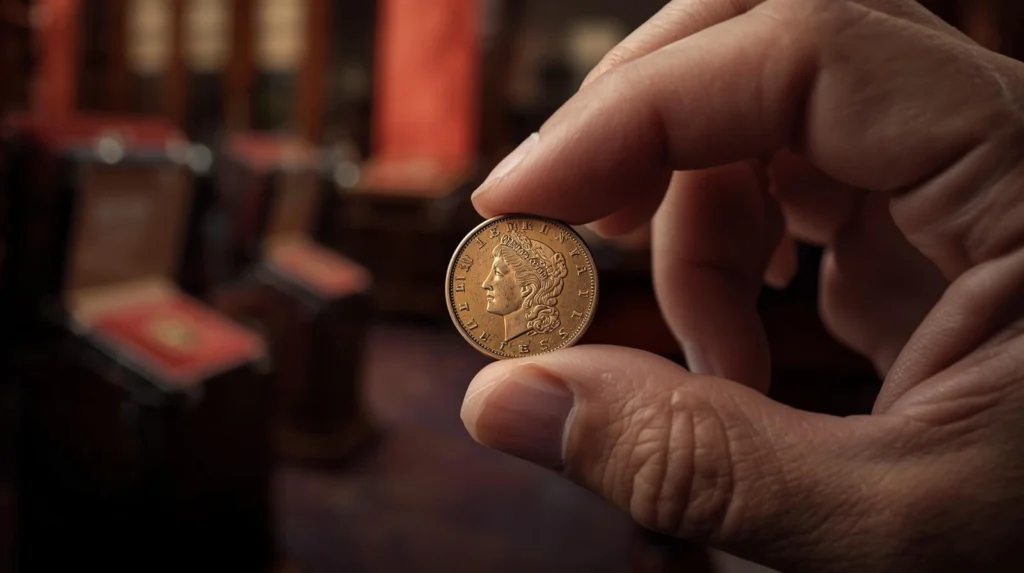
Two months ago, a Henderson, Nevada resident walked into our showroom on Eastern Ave carrying five American Gold Eagle coins purchased from an online seller for what seemed like a modest discount off spot price. Four were genuine. One was a gold-plated copper replica so well-executed that it passed a visual inspection by an experienced eye. What gave it away was a Sigma Metalytics conductivity test — a tool that reads the electromagnetic signature of the metal underneath any plating — which showed copper where .9167 fine gold should have been. The customer had paid $2,100 for a coin worth roughly $8 in copper and plating.
According to the Numismatic Guaranty Company (NGC), counterfeit coin submissions have increased steadily alongside rising gold and silver spot prices, with fake American Gold Eagles and Morgan silver dollars consistently among the most commonly submitted counterfeits. At PCGS, the authentication department flags and confiscates thousands of counterfeit coins annually. For anyone buying coins outside of a certified dealer — at flea markets, estate sales, private online transactions, or pawn shops — knowing how to detect counterfeit coins before money changes hands is not optional. It’s table stakes.
This guide walks you through seven dealer-tested detection methods, tells you which fakes are hardest to catch at home, and explains when a professional authentication service is worth the cost.
How to Detect Counterfeit Coins at Home: The 7-Method Framework
Reliable counterfeit coin detection at home uses seven layered tests — weight, diameter, magnet, ping, visual, edge, and conductivity — because no single test catches every type of fake, and genuine coins will pass all seven.
No one test is definitive on its own. Counterfeiters have become sophisticated enough that a fake passing three or four individual tests is not unusual. The goal of layered testing is to eliminate explanations: a coin that passes the magnet test and the weight test and the ping test and the diameter test has cleared four independent lines of evidence. That convergence is meaningful. One that fails any single test is worth setting aside immediately for professional evaluation.
Here is the complete framework, in the order a dealer would apply it:
Test 1 — Weight Every US Mint coin has a published, official weight. A genuine American Gold Eagle (1 oz) weighs exactly 33.93 grams. A genuine American Silver Eagle weighs 31.10 grams. A genuine Morgan silver dollar weighs 26.73 grams. Use a digital scale accurate to 0.01 grams — available for $15–$25 online — and compare your reading against the official US Mint specification. Counterfeit coins frequently fail here because matching weight precisely while substituting metals requires exact engineering that most counterfeiters don’t achieve.
Test 2 — Diameter and Thickness Pair weight verification with caliper measurement. An American Gold Eagle is 32.70mm in diameter. A Morgan silver dollar is 38.10mm. Inexpensive digital calipers (under $20) measure both diameter and thickness. A coin that matches weight but is slightly too thick or too thin in a key dimension indicates a different alloy density — the signature of a counterfeit substituting tungsten (for gold coins) or zinc (for silver coins).
Test 3 — Magnet Test Gold and silver are non-magnetic. Hold a strong neodymium magnet near your coin — if the coin is attracted to it, it fails immediately. This test eliminates iron and steel fakes with certainty. Note that some counterfeits use non-magnetic metals like copper, brass, or tungsten, so passing the magnet test does not confirm authenticity by itself. It only eliminates the most basic category of fake.
Test 4 — Ping (Ring) Test for Silver Genuine silver produces a distinctive, clear, bell-like ring when struck lightly. Drop a silver coin onto a hard surface or tap it with another coin and listen. A real Morgan dollar or American Silver Eagle rings with a sustained, musical tone for 1–2 seconds. A base metal fake produces a dull, short thud with no resonance. You can find reference audio comparisons on the APMEX and JM Bullion websites. This test does not work reliably for gold coins, which ring differently by thickness.
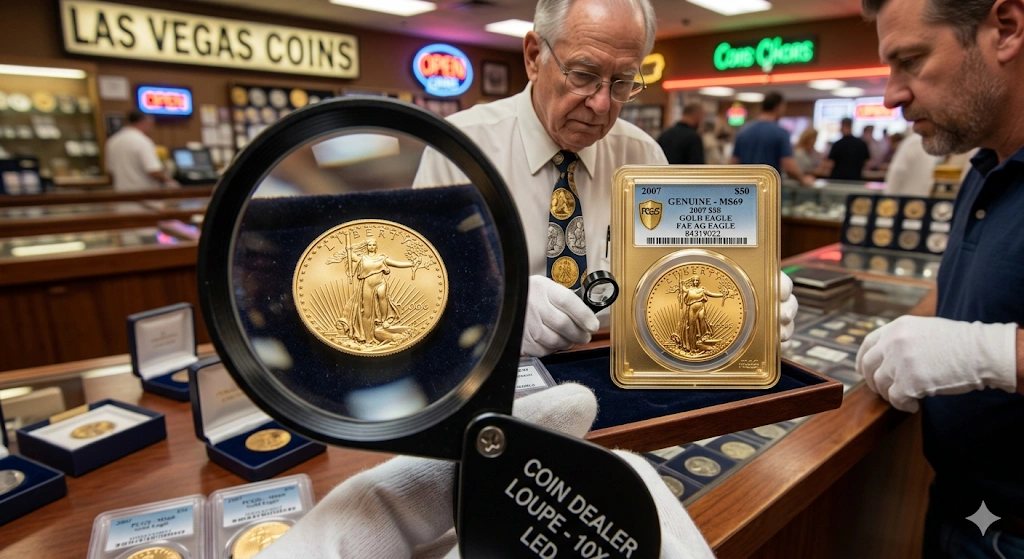
Test 5 — Visual Inspection Under Magnification Use a 10x loupe or jeweler’s magnifier and examine design details against a known reference image from PCGS CoinFacts or NGC’s catalog. Genuine US Mint coins have sharply struck, well-defined design elements. Common counterfeit tells under magnification: slightly blurred lettering, granular or porous fields (caused by casting rather than die striking), seam lines around the rim from two-piece mold fakes, and design elements that don’t match published mint specifications in depth or proportion.
Test 6 — Edge Examination US Mint coins have specific edge characteristics. Morgan silver dollars have a reeded (ridged) edge with 150 reeds. American Gold Eagles have a reeded edge. Examine the edge under magnification for inconsistent reeding spacing, seam lines, or a raised line running along the circumference — the latter indicates a cast fake produced by pouring metal into a two-piece mold rather than die-striking.
Test 7 — Sigma Metalytics or XRF Conductivity Test This is the dealer-level test that catches gold-plated counterfeits that pass all visual and dimensional checks. Sigma Metalytics devices (starting around $600 for basic models) read the electromagnetic conductivity of the metal through any plating, identifying the actual alloy composition. XRF (X-ray fluorescence) analyzers used by professional dealers provide full elemental composition in seconds. If you’re buying gold coins regularly outside a certified dealer, the Sigma investment pays for itself quickly. If you’re bringing coins to DEI for evaluation, this is one of the tools we use on-site.
Buy or Sell Gold & Silver Coins with Confidence
Work with a trusted Las Vegas coin dealer offering fair pricing, honest appraisals, and expert guidance every step of the way.
The Fake Gold Coin Detection Problem: Why Gold Is the Priority
Fake gold coin detection is more critical than silver authentication because the counterfeit profit margin on gold is far higher — a convincing gold-plated tungsten fake costs under $50 to produce and can be sold for $2,000+ if the buyer relies only on visual inspection.
Tungsten is the primary material used in sophisticated gold coin counterfeits because its density (19.3 g/cm³) is almost identical to gold’s (19.32 g/cm³), meaning a tungsten core with gold plating passes both the weight test and the diameter test nearly perfectly. These coins have been documented by NGC and PCGS in American Gold Eagles, South African Krugerrands, Chinese Pandas, and Canadian Gold Maple Leafs — the four most commonly counterfeited gold bullion coins globally.
At DEI’s showroom, when a customer brings in gold coins for appraisal or sale, our evaluation always includes conductivity testing alongside weight and visual inspection. Gold-plated tungsten fails conductivity immediately — tungsten’s electromagnetic signature is completely distinct from gold’s — but it would fool most buyers relying on scale and caliper alone.
📌 DEI Market Observation: In our Las Vegas showroom over the past several years, the counterfeit gold coins that have required conductivity testing to identify have been almost exclusively purchased from private sellers or online marketplaces rather than from established dealers. Coins purchased from PCGS or NGC certified dealers in original graded holders have not, in our experience, presented authentication concerns — the certification process is specifically designed to catch these fakes before the coin ever reaches a consumer.
Coin Authentication Guide: When to Use PCGS, NGC, or a Local Certified Dealer
The most reliable coin authentication method is submission to PCGS or NGC for encapsulation, but for quick decisions or pre-sale evaluations, a PCGS- or NGC-affiliated dealer with in-store testing equipment provides same-day authentication at no cost.
PCGS and NGC are the two dominant third-party coin grading services in the USA, and both maintain dedicated authentication departments that examine coins for counterfeits before assigning any grade. A coin that returns in a genuine PCGS or NGC holder with a matching certification number verifiable on their websites is authenticated against all known counterfeit types at the time of grading. For coins valued above $500, professional certification is almost always worth the submission cost because it simultaneously authenticates, grades, and creates a liquid resale market for the coin.
For coins you’re evaluating before purchase, or for an inherited collection you need assessed quickly, an in-person consultation at a PCGS-affiliated dealer provides the same testing tools without the submission timeline. At DEI, free appraisals include on-site weight, dimension, magnet, and conductivity testing for any coin you bring in — the same process we use when buying coins for our own inventory.
The American Numismatic Association (ANA) also maintains a list of member dealers with authentication capabilities. For Las Vegas and Henderson residents, DEI’s Eastern Ave location is a direct resource. For nationwide buyers, PCGS’s dealer locator and NGC’s dealer network pages list verified affiliated dealers by state.
📊 Counterfeit Coin Detection Methods — DEI Quick Reference
| Test Method | Equipment Needed | Cost | Detects | Limitation |
|---|---|---|---|---|
| Weight | Digital scale (0.01g) | $15–$25 | Wrong alloy density | Won’t catch precise-weight fakes |
| Diameter/Thickness | Digital calipers | $15–$20 | Wrong dimensions | Tungsten may match closely |
| Magnet | Neodymium magnet | $5–$10 | Iron/steel fakes | Non-magnetic fakes pass |
| Ping / Ring test | None | Free | Base metal silver fakes | Unreliable for gold |
| Visual / Loupe | 10x loupe | $10–$30 | Cast fakes, seams, blurring | Misses plated fakes |
| Edge inspection | 10x loupe | $10–$30 | Mold seams, wrong reeding | Requires reference knowledge |
| Sigma / XRF | Sigma Metalytics or XRF | $600+ / dealer tool | Plated tungsten, plated copper | Requires device access |
🪙 DEI Dealer Observation
The counterfeit coins we see most often at DEI’s Las Vegas showroom are not crude fakes — they’re coins that clearly had real money invested in their production. The gold-plated tungsten American Gold Eagles and the silver-plated zinc Morgan dollar replicas look, feel, and weigh close enough to genuine coins that customers who purchased them weren’t being careless — they were buying from sellers who presented them convincingly. The critical detail that distinguishes our buying process from a private transaction is the conductivity test, which reads through the plating to the base metal in seconds. Our practical advice: never buy a raw, ungraded gold or silver bullion coin above $200 in value from any source without either a certified dealer verification or access to a Sigma Metalytics device. The cost of the test is negligible compared to the loss if the coin is fake.
What Las Vegas Coin Buyers Need to Know About Fake Gold Coins
Las Vegas’s high tourist volume and active private resale market — from estate sales to pawn shops to convention-floor transactions — makes fake gold coin detection a specific, local concern that buyers in Southern Nevada face more frequently than in smaller markets.
Las Vegas sees a consistent flow of inherited collections, tourist impulse purchases, and pawn shop liquidations — all transaction types that carry higher counterfeit exposure than purchases from established certified dealers. Tourists purchasing coins at Las Vegas gift shops, flea markets, or non-specialist retailers face the highest risk. Estate sales in Henderson, Summerlin, and the greater Clark County area regularly surface coin collections where authenticity has never been formally verified.
Nevada has no state income tax, which makes Las Vegas an attractive location for precious metals transactions — but that same volume of transactions means counterfeits circulate more actively here than in smaller markets. The Las Vegas Metropolitan area is served by Heritage Auctions’ regional sales network and Stack’s Bowers’ Las Vegas-based operations, both of which employ professional authentication before accepting coins for sale. Buying from established auction house channels or certified local dealers like DEI substantially reduces counterfeit exposure compared to private transactions.
If you’re visiting Las Vegas and considering a coin purchase from any non-certified source, the 15-minute drive to DEI’s showroom on Eastern Ave for a free authentication check before completing the transaction is worth every minute.
Fake Coins vs. Replicas: The Legal Line and What It Means for Sellers
Counterfeit coins intended to defraud are federal crimes under the Hobby Protection Act and US Code Title 18, but legal “replica” coins marked “COPY” are sold commercially — and removing or obscuring that marking to sell replicas as genuine is a separate federal offense.
The Hobby Protection Act of 1973 requires that any imitation numismatic item manufactured or imported into the USA be plainly and permanently marked “COPY.” A coin marked “COPY” is legal to own and sell as a replica. The same coin with that marking removed, or sold as genuine to a buyer who doesn’t know it’s a replica, becomes federal fraud. US Code Title 18, Section 485 makes counterfeiting US coins a crime punishable by up to five years in federal prison.
At DEI, when we encounter a coin in an estate or appraisal that turns out to be a replica — often a Franklin Mint commemorative or a replica Morgan dollar sold as a collector item decades ago — we identify it clearly for the seller and explain the legal distinction. The most common scenario: a grandparent purchased a “collector’s replica” in the 1970s or 1980s, it sat in a coin folder for 40 years, and an heir brings it in believing it’s genuine. No fraud occurred in the original purchase. The issue arises only if the heir then attempts to sell it as a genuine coin.
For sellers: if you’re unsure whether any coin in your collection is genuine, a free DEI appraisal before any attempted sale protects you from inadvertently participating in a fraudulent transaction — even if the fake coin was sold to you or inherited by you in good faith.
CONCLUSION
If there’s one action worth taking before you buy or sell any gold or silver coin outside a certified dealer, it’s this: get it tested first. The methods in this guide — weight, diameter, magnet, ping, visual inspection, edge check, and conductivity — take less than five minutes combined and can prevent losses that range from hundreds to thousands of dollars on a single transaction.
Three things to carry with you from this guide: (1) No single test is definitive — counterfeit coin detection requires layered verification. (2) Tungsten-core gold fakes pass weight and diameter tests and require conductivity testing to catch — the most important test most buyers skip. (3) PCGS and NGC certification is the permanent solution — a coin in a genuine, number-verified certified holder has been professionally authenticated against all known fake types.
Bring any coin you’re unsure about to DEI Gold & Silver Coins at 8985 S. Eastern Ave, Suite 160, in Las Vegas, or call (702) 460-5188 for a free, same-day appraisal — no pressure, no obligation. Our team uses professional-grade conductivity testing alongside visual and dimensional verification on every coin we evaluate.
Two related topics that pair directly with this guide: how PCGS and NGC grading works and what a certified coin holder tells you about authenticity, and how to spot artificially cleaned or altered coins before they cost you a significant downgrade in value.
FAQ SECTION
1. How do I detect counterfeit coins without expensive equipment?
You can detect counterfeit coins at home using four free or low-cost methods: weigh the coin against official US Mint specifications (a $20 digital scale works), measure diameter with $15 digital calipers, test with a neodymium magnet (gold and silver are non-magnetic), and perform a ping test on silver coins — genuine silver rings clearly for 1–2 seconds while base metal fakes produce a dull thud.
2. What are the most commonly counterfeited coins in the USA?
The most commonly counterfeited coins in the USA are American Gold Eagles, Morgan silver dollars, Saint-Gaudens Double Eagles, South African Krugerrands, and Canadian Gold Maple Leafs. PCGS and NGC authentication departments flag these types most frequently. American Gold Eagles attract the most sophisticated tungsten-core fakes because their $2,000+ value makes high-cost counterfeiting profitable.
3. Can a fake gold coin pass a weight test?
Yes. Tungsten-core gold coin counterfeits are specifically engineered to match genuine gold’s weight because tungsten has nearly identical density to gold (19.3 g/cm³ vs. gold’s 19.32 g/cm³). A tungsten core with gold plating can pass weight, diameter, and magnet tests simultaneously. Only a Sigma Metalytics conductivity test or XRF analyzer reliably catches tungsten-core fakes by reading the metal composition through the plating.
4. Is it illegal to own a counterfeit coin in the USA?
Owning a counterfeit coin is not automatically illegal in the USA — it depends on intent. Possessing a coin that was sold to you as genuine without your knowledge is not a crime. Attempting to sell or pass a counterfeit coin as genuine violates US Code Title 18 and the Hobby Protection Act, and carries federal penalties. If you discover a coin you own may be counterfeit, a PCGS or NGC certified dealer can evaluate it and advise on your options.
5. Does PCGS or NGC catch all counterfeit coins submitted?
PCGS and NGC catch the vast majority of counterfeits submitted, and both maintain databases of known fake types that are updated as new counterfeits are identified. Neither service guarantees 100% detection of every possible fake, but coins returned in genuine PCGS or NGC holders with matching certification numbers verifiable on their websites represent the highest available standard of authentication for USA collectors and investors.
6. Where can I get a coin authenticated for free in Las Vegas?
DEI Gold & Silver Coins at 8985 S. Eastern Ave, Suite 160, in Las Vegas offers free same-day coin appraisals that include weight, dimensional, and conductivity testing for authentication. Call (702) 460-5188 to confirm availability. For formal PCGS or NGC certification, DEI handles submissions on behalf of clients and guides the process from evaluation through return of the graded, authenticated coin.