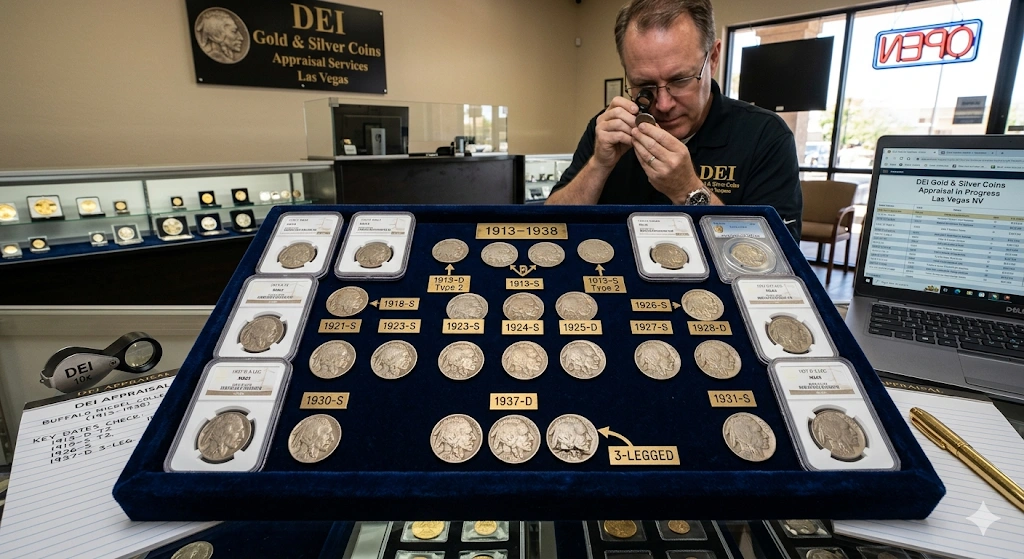
Somebody walked into the DEI showroom on Eastern Ave last spring with a small envelope of Buffalo nickels from a grandparent’s collection. Fifteen coins total — most worn flat, worth a dollar or two each. Then she flipped one over, and there it was: a 1926-S, circulated but problem-free, date fully readable. That one coin was worth more than everything else in the envelope combined, and then some. Per PCGS CoinFacts data, a problem-free 1926-S in Good-4 condition trades at roughly $30–$50 today; in Fine it jumps to $200–$500; and a fully struck MS-65 example sold for $115,500 at Heritage Auctions in 2021.
This is the story of the Buffalo nickel series. Most of these coins — minted by the US Mint from 1913 to 1938 across three mints — trade for pocket change. A handful are among the most coveted coins in all of American numismatics. Knowing the difference between a $2 coin and a $2,000 coin comes down to date, mint mark, condition, and one critical rule about what NOT to do before you bring it in.
This guide covers every major key date and error variety in the Buffalo nickel series, explains what the most valuable Buffalo nickels are actually worth in the 2026 market, and gives you a practical roadmap for evaluating what you have.
What Are the Most Valuable Buffalo Nickels, and What Makes Them Rare?
The most valuable Buffalo nickels are coins whose rarity comes from three distinct sources: low mintage (1926-S, 1921-S), dramatic die errors (1937-D Three-Legged, 1918/17-D Overdate), or extreme condition scarcity where even common-date coins become rare in top grades. Buffalo nickels were struck in 75% copper and 25% nickel — no silver content — so all of their value is numismatic, driven entirely by collector demand rather than metal content.
The series ran from 1913 to 1938 and was designed by sculptor James Earle Fraser, whose portrait of a Native American on the obverse drew from three real subjects — Iron Tail, Two Moons, and John Big Tree. The reverse bison was modeled on Black Diamond, a resident of the Central Park Zoo. What makes the design numismatically challenging is that the date was placed on a high point of the design relief, which meant it wore away faster than almost any other US coin type. Dates that are flat or partially readable dramatically reduce a coin’s value — a readable date on a Buffalo nickel is itself a premium feature, not a baseline.
Strike quality is the other defining factor. Denver (D) and San Francisco (S) mint issues from the 1920s and early 1930s are notorious for weak strikes, where even uncirculated coins come out of the holder looking like they’ve been circulated. Per Coins-Value.com’s 2026 analysis, well-struck examples of these dates can command premiums of 300–500% over weakly struck coins at the same grade. This is not an exaggeration — it fundamentally changes the value of many S-mint Buffalo nickels.
Buffalo Nickel Key Dates Prices: The Definitive List for 2026
Buffalo nickel key dates prices in 2026 range from $30 for a worn 1926-S in About Good condition to over $300,000 for top-certified gem examples, with error varieties like the 1916 Doubled Die and 1918/17-D Overdate capable of eclipsing $280,000 in high Mint State grades. Here is the complete picture of the dates worth knowing.
Low-Mintage Key Dates
1926-S — With a mintage of just 970,000, the 1926-S is the key date of the entire regular-issue Buffalo nickel series. Per Greysheet and coinvaluechecker.com, the MS-66 auction record stands at $322,000, set at a Bowers & Merena auction in April 2008. A PCGS MS-65 realized $115,500 at Heritage Auctions in 2021. Even an MS-64, of which PCGS has certified just 187 examples, has traded between $7,200 and $18,600 in recent sales. The 1926-S is the only Buffalo nickel that commands a premium in AG-3 condition — a grade where most other dates are worth face value.
1921-S — Mintage of 1,557,000 with a low survival rate in Mint State condition. PCGS estimates roughly 8,500 survivors across all grades, with only 700 grading above MS-60. In VF condition, expect $200–$500; MS-65 examples have reached $51,750 at auction.
1924-S — Another S-mint condition rarity. Common in lower circulated grades, genuinely scarce above MS-63. Per Coins-Value.com, values range from $35 in Good to $5,500+ in Gem Uncirculated.
Buy or Sell Gold & Silver Coins with Confidence
Work with a trusted Las Vegas coin dealer offering fair pricing, honest appraisals, and expert guidance every step of the way.
Error Varieties and Overdates
1916 Doubled Die Obverse (1916/1916) — The single most valuable regular-series Buffalo nickel variety, with strong doubling visible on the date and the word LIBERTY. Per the PCGS Price Guide, Mint State examples sell for $25,000 to over $40,000, and top-certified gems have reached $280,000+ at auction. Even a well-worn example in VG grades as a $1,000+ coin.
1918/17-D Overdate — A faint “7” from a 1917 die is visible beneath the “8” in the date on this Denver Mint issue. One of the most dramatic overdates in US coin history, per PCGS CoinFacts. Values run from $1,100 in heavily circulated condition to $350,000+ for gem Mint State examples.
1937-D Three-Legged Buffalo — The most famous error coin in the Buffalo nickel series. A Denver Mint employee over-polished a die, removing the bison’s front right leg. Stack’s Bowers sold a PCGS MS-66+ CAC example for $84,000 in August 2023. Legend Rare Coin Auctions sold the same coin earlier for $99,875 in October 2021. A certified AU-58 with good eye appeal trades in the $2,100–$2,300 range per CoinWeek’s 2024 market data.
📊 Most Valuable Buffalo Nickels — DEI Quick Reference
| Date / Variety | Mintage | VF Value | MS-63 Value | MS-65 Value | Notable Auction Record |
|---|---|---|---|---|---|
| 1926-S | 970,000 | $200–$500 | $2,000–$5,000 | $115,500+ | $322,000 MS-66 (Bowers, 2008) |
| 1916 DDO | Unknown | $3,000+ | $15,000–$25,000 | $40,000–$280,000+ | $280,000+ (auction) |
| 1918/17-D Overdate | Unknown | $1,500–$3,000 | $20,000+ | $100,000+ | $350,000+ (auction) |
| 1937-D 3-Legged | ~10,000 est. | $1,500–$2,500 | $5,000–$10,000 | $15,000–$30,000 | $99,875 MS-66+ (Legend, 2021) |
| 1921-S | 1,557,000 | $200–$500 | $700–$1,500 | $20,000–$51,750 | $51,750 MS-66 (auction) |
| 1924-S | 1,437,000 | $100–$300 | $500–$1,000 | $5,500–$14,250 | $14,250 MS-65+ (auction, 2020) |
| 1913-S Type 2 | 1,209,000 | $150–$400 | $400–$800 | $8,225+ | $49,938 MS-67 (auction, 2013) |
| Common date (1923-P) | 35,715,000 | $5–$10 | $25–$50 | $200–$500 | N/A |
Values based on PCGS Price Guide, Coins-Value.com 2026 data, and verified Heritage/Stack’s Bowers auction results. Problem-free, certified examples only. Weak strikes trade below these figures.
The 1913 Nickel Value: What Type 1 and Type 2 Mean for Collectors
The 1913 nickel value depends entirely on which of the two distinct types you have — Type 1 shows the buffalo standing on a raised mound, while Type 2 shows the buffalo on a flat recessed ground, and the difference matters for both identification and pricing. The US Mint switched from Type 1 to Type 2 partway through 1913 to address rapid die wear caused by the raised mound design.
Both types were struck at Philadelphia (no mint mark), Denver (D), and San Francisco (S) — giving collectors six distinct 1913 varieties to chase. The most scarce among the regular issues is the 1913-S Type 2, with a mintage of only 1,209,000, per the US Mint records. Per IndianHeadNickels.com’s May 2026 PCGS Price Guide data, the 1913-S Type 2 in XF-40 fetches around $5,250; Heritage sold an NGC AU-55 example for $24,000 in May 2024 and a PCGS XF-40 for $20,740 in April 2026.
Quick 1913 Type Identification
Checking your 1913 nickel’s type takes seconds: look at the reverse and find where the buffalo is standing. If the ground reads “FIVE CENTS” on a raised mound with “FIVE CENTS” incuse (sunken), that’s Type 1. If “FIVE CENTS” sits on a flat, recessed ground with no mound, that’s Type 2. Type 2 is generally more valuable across all mints and grades.
At DEI, we see 1913 Type 1 coins undervalued by sellers and over-valued by buyers in about equal measure — the type designation is not always obvious to someone unfamiliar with the series, and a Type 1 Denver or Philadelphia example in circulated grades is a much more common coin than its Type 2 counterpart. If you’re unsure which you have, bring it in for a free appraisal before making any decision.
How Grading Determines Buffalo Nickel Value More Than Almost Any Other US Coin
On a Buffalo nickel, a single grade point can separate a $50 coin from a $5,000 coin — more dramatically than almost any other US series — because weak strikes, date wear, and the high-relief design mean that top-grade survivors are genuinely rare even for common dates. This is not marketing language; it is a documented market reality.
The Sheldon scale runs from Poor-1 to Mint State-70. For Buffalo nickels, the practical grading checkpoints are:
Good-4 (G-4): Date partially readable, major devices visible. Lowest practical grade for most key dates. Fine-12 (F-12): Date sharp, most details visible with some wear. Mid-tier circulated value. Extremely Fine-40 (XF-40): Light wear on high points only. Buffalo’s horn mostly visible. Strong numismatic premium on key dates at this level. Mint State-63 (MS-63): No wear, some bag marks. The standard “uncirculated” benchmark. Mint State-65 (MS-65): Gem quality. Rare for most S-mint and D-mint issues. Top collector prices start here.
One critical note: the buffalo’s horn is the first place experienced graders look on any Buffalo nickel. A fully visible horn indicates minimal wear and significantly raises the grade — and the price. Per our experience at DEI, buyers and sellers who overlook horn visibility are consistently mispricing their coins in both directions.
🪙 DEI Dealer Observation
Buffalo nickels are the series we see most frequently misrepresented at our Las Vegas counter — not by sellers trying to deceive, but by sellers who genuinely don’t know what they have. The two most common scenarios: a 1926-S that’s been acid-treated to read the date (chemical restoration drops the coin to “Genuine” details status, worth a fraction of a problem-free example), and a 1937-D that looks like it “might” be three-legged but is actually a worn four-legged coin with a soft strike. Genuine three-legged coins show a very specific “iceberg” effect under the belly of the bison — a shelf of polished metal where the leg was removed. If you can’t see that shelf clearly, you don’t have the variety. We examine both details on every Buffalo nickel brought in before giving any valuation, and we recommend PCGS or NGC certification for any coin you believe may be a key date.
Buying and Selling the Most Valuable Buffalo Nickels: A Las Vegas Dealer’s Practical Guide
The smartest place to buy or sell the most valuable Buffalo nickels depends on the coin’s value tier — local certified dealers for coins under $500, and major auction houses like Heritage Auctions in Dallas or Stack’s Bowers in New York for certified key dates above $1,000. This isn’t a rule of thumb; it’s a structural reality of how liquidity works in the nickel market.
For common circulated Buffalo nickels worth $2–$25, any reputable coin dealer will give you a fair market offer. For mid-range coins — a problem-free 1921-S in Fine, or a 1924-S in XF — it pays to get at least two dealer quotes and check recent eBay sold listings as a price sanity check. For genuine key dates above $500, always get the coin certified by PCGS or NGC before selling. Per Coins-Value.com 2026 data, a certified 1926-S can sell for 2–3× what a raw (uncertified) example brings, because buyers trust the authentication and grade.
Counterfeits are a real concern on the highest-value Buffalo nickels. The 1916 Doubled Die, the 1937-D Three-Legged, and the 1926-S are all faked. On the Three-Legged variety, a genuine coin will show the distinctive polished shelf under the buffalo’s belly where the leg was removed — a feature counterfeiters rarely replicate convincingly. On the 1926-S, added or altered mint marks from common Philadelphia coins are the primary fraud type.
📌 DEI Market Observation: Over the past two years at our Eastern Ave showroom, we’ve noticed a steady increase in Buffalo nickels coming in from estate sales where the heirs have already done initial research online, but systematically overestimate the grade of their coins. A coin that looks MS-63 to an untrained eye typically grades F-15 to VF-30 after professional evaluation — because the design’s high points are the first to show wear, and that wear is subtle until you know exactly where to look. Grading calibration is one of the most valuable things a free DEI appraisal gives you before you make any selling decision.
Nevada collectors benefit from the state’s lack of a personal income tax, which means gains from Buffalo nickel sales are subject only to the federal rate. Long-term capital gains on collectibles held more than one year are taxed at a maximum 28% federal rate under current IRS rules. Consult a tax professional for your specific situation.
How to Spot Fakes and Problems: Protecting Yourself on High-Value Buffalo Nickel Purchases
The two biggest threats to Buffalo nickel value are chemical date restoration (Nic-A-Date acid treatment) and altered mint marks — and both are undetectable to the naked eye without the right tools or expertise. Per Coins-Value.com’s 2026 guide, chemically restored dates reduce a Buffalo nickel’s value to 10–20% of a graded coin’s price, even on key dates.
Nic-A-Date treated coins show a rough, granular surface in the date area when examined under a loupe (a small magnifying lens). The acid that reveals the date destroys the metal’s original luster and leaves an unmistakable texture that PCGS and NGC flag immediately. Sellers sometimes don’t know the treatment was applied — it was a commonly sold product marketed to collectors for decades. If you’re buying a raw 1926-S or 1921-S, insist on authentication, not just grading.
Altered mint marks — specifically adding a “D” or “S” punch to a common Philadelphia (no mint mark) Buffalo nickel — are the other major fraud vector. The tell is usually displaced metal around the mint mark area, or a mint mark that appears lighter or differently toned than the surrounding coin surface. These are difficult to detect without experience, which is exactly why third-party grading from PCGS or NGC is non-negotiable for any Buffalo nickel priced above $200.
Conclusion
If you have Buffalo nickels sitting in a drawer, a jar, or an inherited collection, take one practical step before anything else: separate out any coin that shows a date from the 1920s, and look for a “D” or “S” mint mark on the reverse just below “FIVE CENTS.” Those are the coins most likely to hold real numismatic value. Don’t clean them, don’t apply anything to the surfaces, and don’t sell them in bulk with common coins.
The most valuable Buffalo nickels — the 1926-S, the 1937-D Three-Legged, the 1916 Doubled Die — can turn a handful of old nickels into a meaningful find, but only if they arrive problem-free and properly authenticated. PCGS or NGC certification is the standard for any key date above $200. And a free appraisal at DEI gives you a real market value, not a guess.
FAQ SECTION
1. What are the most valuable Buffalo nickels I should look for?
The most valuable Buffalo nickels are the 1926-S (key date, mintage 970,000), the 1916 Doubled Die Obverse, the 1937-D Three-Legged error, and the 1918/17-D Overdate. In top certified grades, these coins range from $15,000 to over $300,000. Even in circulated condition, the 1926-S and 1916 DDO are worth hundreds to thousands of dollars over common dates.
2. How do I know if my Buffalo nickel is worth anything?
Check the date and mint mark first — the date is on the obverse, the mint mark is on the reverse below “FIVE CENTS.” Key dates like the 1926-S, 1921-S, and 1924-S are worth significant premiums even worn. Then check condition: a readable date, visible horn on the buffalo, and no cleaning or chemical treatment all increase value. For any Buffalo nickel you think may be a key date, a free appraisal at DEI in Las Vegas gives you an accurate current market value.
3. What is the 1937-D Three-Legged Buffalo nickel worth in 2026?
The 1937-D Three-Legged Buffalo nickel is worth $600–$2,500 in circulated grades and $5,000–$30,000 in Mint State, with gem MS-66+ CAC examples reaching $84,000–$99,875 at Stack’s Bowers and Legend Rare Coin Auctions. Authentication by PCGS or NGC is essential — altered coins and coins with soft strikes are sometimes mistaken for this variety. A genuine example shows a polished “shelf” under the buffalo’s belly where the front right leg was removed.
4. Are Buffalo nickels made of silver?
No. Buffalo nickels contain no silver. They are struck in 75% copper and 25% nickel — the same composition as modern nickels. All Buffalo nickel value is numismatic, meaning it comes from collector demand based on date, mint mark, and condition, not from metal content. Do not confuse Buffalo nickels with modern American Gold Buffalo bullion coins, which are gold, or wartime Jefferson nickels (1942–1945), which contain 35% silver.
5. How do I tell if my Buffalo nickel date has been chemically restored?
Chemically restored Buffalo nickel dates (“Nic-A-Date” treatment) show a rough, granular texture in the date area when viewed under a loupe. The acid that reveals the date permanently damages the metal’s surface. PCGS and NGC will designate these coins as “Genuine” details-grade, which reduces their value to roughly 10–20% of a problem-free example. Never apply any product to a Buffalo nickel before getting it appraised — chemical treatment is irreversible.
6. What is a 1913 nickel value for the two different types?
A 1913 Type 1 Buffalo nickel (buffalo on raised mound) in circulated VF condition is worth roughly $30–$100 depending on mint mark. A 1913 Type 2 (buffalo on flat ground) runs higher — the 1913-S Type 2 in XF-40 trades around $5,250, and a PCGS XF-40 example sold for $20,740 at Heritage Auctions in April 2026. Type 2 is generally more valuable than Type 1 across all mint marks and grades. Check the reverse: the ground under the buffalo tells you which type you have.