Two Walking Liberty halves in a flat plastic sleeve sat on our counter last spring — a 1916-D and a 1917-D Obverse, brought in by an heir who had no idea which was which. The 1916-D, per PCGS CoinFacts, had a mintage of just 1,014,400 and in the VF-20 grade the seller’s example appeared to be, was worth roughly $650–$800. The 1917-D Obverse, nearly identical to the untrained eye, was worth $35 in the same grade. That difference — nearly $700 — came down to a single letter and a one-year gap in striking date.
That kind of scenario is exactly why knowing your Walking Liberty half dollar value, and how it compares to the Franklin half dollar series that followed it, matters before you buy, sell, or inherit either coin. Both series ran on 90% silver planchets. Both produced low-mintage key dates that are worth serious money. And both are misunderstood in different ways — the Walking Liberty for its wide value spread between common and key dates, the Franklin for the “Full Bell Lines” designation that turns an ordinary uncirculated coin into a prize.
This post maps the full picture: mintage data, current PCGS values by grade, the key dates that move the needle, and a straight answer on which series makes more sense for your specific goal in 2026 — whether that’s collecting, stacking silver, or selling an inherited set.
Walking Liberty Half Dollar Value: What the Series Is Actually Worth in 2026
Walking Liberty half dollar value spans from roughly $12 in circulated grades for common dates to well over $100,000 for the 1916-D in gem uncirculated — making it one of the most range-bound series in American coinage. The series ran from 1916 to 1947 across Philadelphia, Denver, and San Francisco mints, totaling 485 distinct date-mint-mark combinations.
Adolph Weinman’s design — Lady Liberty striding toward the sunrise on the obverse, a perched eagle on the reverse — is widely considered the most beautiful in American coin history, and that aesthetic premium drives collector demand at every grade level. But beauty alone doesn’t make a coin valuable. What drives Walking Liberty prices is mintage and survival rate in collectible condition.
Key Dates That Define the Series
The 1916-D (mintage: 1,014,400) and 1916-S Obverse mintmark (mintage: 508,000) anchor the top of the value ladder. In Good-4, the 1916-D trades for $275–$350. In VF-20, $650–$800. In MS-64, you’re looking at $5,000–$7,000 based on recent Heritage Auctions results.
The 1921 and 1921-D are the other major keys. The 1921 Philadelphia issue (mintage: 246,000) and the Denver version (mintage: 208,000) are among the lowest-mintage issues in the series. In Good-4, the 1921-D trades around $500–$650. Finding either in circulated problem-free condition in an inherited lot is a genuine score.
Semi-keys to watch: 1919-D, 1919-S, 1923-S, and 1938-D. The 1938-D (mintage: 491,600) regularly surfaces in 50-state or type collections and brings $150–$250 in Fine grades.
For bullion stackers, the common-date Walking Liberty halves — anything from 1941–1947 in circulated condition — trade at or near spot silver price (each contains 0.3617 troy ounces of silver). At a silver spot price around $32–$34 per ounce (Kitco, mid-2025), that puts melt value at roughly $11.60–$12.30 per coin.
Franklin Half Dollar Price Guide: What Makes a Franklin Worth Real Money
A Franklin half dollar is worth $10–$15 in circulated condition for common dates, but a 1955 Full Bell Lines (FBL) in MS-65 trades for $1,500–$2,500, making the Franklin series one of the most underestimated in the 20th-century silver coin market. The series ran from 1948 to 1963 — 47 date-mint combinations — and is minted on the same 90% silver planchets as the Walking Liberty.
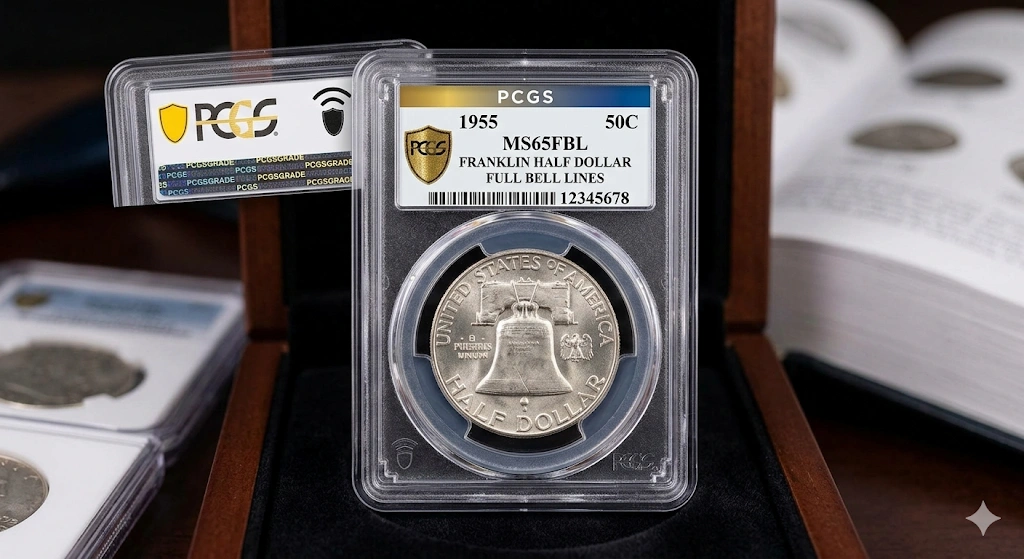
The Franklin’s defining premium is the “Full Bell Lines” designation, abbreviated FBL on PCGS slabs and FB on NGC slabs. The Liberty Bell on the reverse has two sets of horizontal lines running across the lower portion. When these lines are sharp and fully struck, the coin qualifies for the FBL designation. Most Franklins — even in uncirculated grades — do not make FBL because the hub dies wore quickly during production. A coin that grades MS-65 FBL is categorically rarer, and more valuable, than the same coin in MS-65 without FBL.
Franklin Half Dollar Key Dates and FBL Premium Dates
The true key date is the 1955 Philadelphia issue, with a mintage of just 2,498,181 — modest by modern standards but low for this series. In MS-65 with FBL, it can bring $2,500+. The 1955 without FBL in MS-65 runs $350–$500 — still a premium, but dramatically less.
Other high-value FBL dates: 1950 (Philadelphia), 1953 (Philadelphia), and 1955-D. These don’t command the 1955 premium, but FBL examples regularly outperform non-FBL counterparts by 200–400% at GreatCollections and Stack’s Bowers auctions.
For the bullion buyer, the Franklin math is identical to the Walking Liberty: 0.3617 oz of silver per coin, same melt calculation at current spot.
Buy or Sell Gold & Silver Coins with Confidence
Work with a trusted Las Vegas coin dealer offering fair pricing, honest appraisals, and expert guidance every step of the way.
Head-to-Head Comparison: Walking Liberty vs Franklin Half Dollar
📊 Walking Liberty vs Franklin Half Dollar — DEI Quick Reference
| Attribute | Walking Liberty (1916–1947) | Franklin Half Dollar (1948–1963) |
|---|---|---|
| Silver Content | 90% silver, 0.3617 oz troy | 90% silver, 0.3617 oz troy |
| Melt Value (at $33/oz spot) | ~$11.90 per coin | ~$11.90 per coin |
| Common Date Circulated Value | $12–$18 | $10–$15 |
| Top Key Date Value (any grade) | 1916-D MS-65: $100,000+ | 1955 FBL MS-65: $2,500+ |
| Primary Value Driver | Low mintage key dates | Full Bell Lines (FBL/FB) strike quality |
| Number of Date-Mint Combos | 65 (plus varieties) | 47 |
| Most Accessible Entry Point | Common 1940s dates, ~$12 | Common dates, ~$10–$12 |
| Collector Demand | Very high — “most beautiful” US coin | High — strong 20th-century type demand |
| Best Grade for Collecting | AU-55 to MS-63 for mid-tier | MS-63 FBL to MS-65 FBL |
| PCGS/NGC Registry Competition | Intense for key dates | Intense for FBL coins |
Silver spot price used: ~$33/oz (Kitco, reference range mid-2025). Coin values based on PCGS Price Guide.
Both series contain identical silver content per coin, so the bullion decision is a wash. The numismatic decision separates them sharply. Walking Liberty has a broader range of key dates requiring more study; Franklin rewards buyers who understand the single FBL variable.
Which Half Dollar Should You Buy: Investor vs. Collector vs. Stacker
The right half dollar to buy depends entirely on your goal — silver bullion stackers get equal value from either series, collectors seeking long-term appreciation should focus on Walking Liberty key dates or Franklin FBL grades, and beginners building type sets are better served by common Walking Liberties in AU condition. There is no universal answer, but the decision tree is short once you know your purpose.
If You’re Stacking Silver
Buy whichever circulated 90% silver halves you can source closest to spot price. Common Walking Liberties and common Franklins are interchangeable for this purpose — both deliver 0.3617 oz of silver per coin. DEI’s junk silver inventory (link: /silver/junk-silver-coin/) carries both series in bulk at competitive premiums over spot. Shop by the roll or bag, not by individual coin.
If You’re Collecting for Numismatic Value
Walking Liberty offers more upside on key dates but requires more research investment. The 1916-D, 1921, and 1921-D are genuine rarities that have appreciated consistently over 20+ years according to PCGS auction records. If your budget is under $500 per coin, semi-keys like the 1938-D or 1919-S in AU-50 to MS-62 offer solid collector value without the key date premium.
Franklin rewards collectors who study strike quality. Learning to identify FBL candidates before submission is a genuine edge. At DEI, we’ve seen collectors buy raw MS-64 Franklin lots, submit them to PCGS, and pull FBL coins worth 3–5x what they paid — because the previous owner didn’t know what to look for.
If You’re Selling an Inherited Collection
Don’t sell in bulk without checking individual dates and grades. The difference between a common 1944 Walking Liberty and a 1921-D in VF condition is $500+ in the same album page. DEI offers free appraisals (link: /appraisals/) and same-day payment. We look at every coin before making an offer — no bulk-lot pricing without full inspection.
PCGS and NGC Grading: How Certification Changes the Value Equation
A PCGS- or NGC-certified Walking Liberty or Franklin half dollar commands a 25–150% premium over a raw example of the same coin in the same grade, because the slab removes authentication risk and provides a standardized grade the entire market trusts. For any coin you’re considering buying or selling above $100 in numismatic value, certification is the right move.
For Walking Liberty halves: the 1916-D, 1921, and 1921-D are frequently counterfeited or have altered mintmarks (adding an “S” or “D” to a Philadelphia issue). Never buy a raw example of these key dates without dealer authentication. DEI’s certified silver coin inventory (link: /silver/silver-coins/certified-silver-coins/) includes slabbed examples when available, and we can walk you through the submission process for coins you already own.
For Franklin halves: grading without the FBL designation on a coin that might qualify is leaving money on the table. PCGS and NGC charge the same fee for a standard submission regardless of whether FBL is awarded — it’s assigned based on the coin’s strike quality. Submit your best-looking uncirculated Franklins.
A CAC (Certified Acceptance Corporation) sticker on a PCGS or NGC slab indicates the coin is solid for its assigned grade — not just technically correct, but above average for the tier. At DEI, we’ve consistently observed that CAC-stickered Walking Liberty and Franklin halves sell faster and at 10–20% premiums over non-CAC slabs at the same grade. If you plan to sell into the auction market, CAC verification is worth considering before consignment.
🪙 DEI Dealer Observation The most consistent pricing mistake we see in our Las Vegas showroom involves Franklin halves in MS-63 to MS-64 — sellers price them at PCGS generic value without checking whether they might qualify for FBL. We’ve examined raw Franklins on our counter that appeared to have full bell lines under a 10x loupe, submitted them to PCGS, and had them come back FBL — doubling or tripling the realized value on the spot. The strike quality difference is visible with magnification before you ever spend a submission fee. Learn to look at the lower bell lines first; if they’re sharp and unbroken, the coin is worth submitting. If they’re mushy or partially struck, it won’t make FBL regardless of overall grade.
Buying Walking Liberty and Franklin Half Dollars at DEI: What to Expect in Las Vegas
DEI Gold & Silver Coins purchases and sells both Walking Liberty and Franklin half dollars at our Las Vegas showroom on Eastern Ave, with pricing based on current PCGS market data, live silver spot, and the specific coin in hand — not generic dealer-sheet estimates. Here’s what the transaction looks like from both sides of the counter.
Buying from DEI: We carry both series in bulk junk silver form and as individual numismatic examples. For certified pieces, we source PCGS and NGC slabs from auction and direct submissions. For bullion-grade halves, we price by the roll or bag based on live spot plus a transparent premium. Ask us to see both series side by side — the visual difference between a mid-grade Walking Liberty and a common Franklin is immediately instructive for new collectors.
Selling to DEI: Bring your coins in original holders whenever possible. A 2×2 flip, original album, or PCGS/NGC slab all help — not because they change the coin, but because coins that haven’t been handled loose tend to be in better condition and grade higher. We pay same-day in cash or check. For larger collections, we recommend scheduling a free appraisal appointment at (702) 460-5188 so we can give each piece proper attention.
📌 DEI Market Observation: Over the past 24 months at our Las Vegas location, we’ve seen a measurable increase in Walking Liberty halves coming in from Southern Nevada estate dispersals — particularly the common 1941–1947 dates in original rolls that were never opened. The desert storage conditions in Nevada often preserve the original mint luster on these 80-year-old coins, and we frequently find examples grading MS-62 to MS-64 that would grade AU-55 in more humid storage environments. If you’ve inherited an unopened roll of Walking Liberty halves, don’t break the roll before getting it evaluated.
Tax note for sellers: Profits from selling coins are treated as collectibles by the IRS, subject to a maximum long-term capital gains rate of 28% for coins held longer than one year. Short-term gains are taxed as ordinary income. Nevada has no state income tax, which is a meaningful advantage for Las Vegas-area sellers compared to California or New York. Always consult a tax professional for your specific situation before completing a significant coin sale.
Best Half Dollar to Collect in 2026: A Straight Answer
The best half dollar to collect in 2026 is the Walking Liberty series for experienced collectors focused on long-term numismatic appreciation, and the Franklin series for collectors who want a shorter, more completable set with a clear premium variable (FBL) to master. For silver investors, both series are equally efficient as 90% silver bullion vehicles.
Walking Liberty is the stronger long-term collectible because key date demand consistently outpaces supply. The series has produced auction records in every market cycle since the 1970s. Stack’s Bowers and Heritage Auctions regularly achieve new record prices for PCGS MS-65 and higher Walking Liberty halves.
Franklin is the smarter short-term learning coin. The series has fewer date-mint combinations, the key premium variable (FBL) is learnable in an afternoon, and the entry price for a complete set in circulated grades is well under $1,500. For collectors building their first 20th-century silver type set, Franklin halves are an ideal starting point — and the ceiling on FBL registry-quality coins is legitimately high.
CONCLUSION
Before you buy or sell a Walking Liberty or Franklin half dollar, know which coin you’re actually holding and why. Check the date, mint mark, and grade. For Walking Liberties, the key dates — 1916-D, 1921, 1921-D — separate a $30 coin from a $600 one on the same album page. For Franklins, look at the bell lines before assuming common-date value applies.
Three actionable takeaways: first, both series contain 90% silver and are worth above melt in any condition. Second, Walking Liberty half dollar value peaks dramatically on key dates — learn the six or seven dates that matter before pricing anything. Third, Franklin FBL grades are systematically undervalued by sellers who don’t know to look for them — submit your best uncirculated examples.
Whether you’re adding to your collection, evaluating an inheritance, or converting silver to cash, the right first step is a no-cost appraisal with someone who handles these coins every week. Visit DEI Gold & Silver Coins at 8985 S. Eastern Ave, Suite 160, in Las Vegas, or call (702) 460-5188 for a free, same-day evaluation — no pressure, no obligation.
For your next reads, explore our guides on Morgan Silver Dollar vs Peace Dollar: which is the better buy and what junk silver coins are actually worth at current spot prices — both directly relevant to building a complete 90% silver coin strategy.
FAQ SECTION
1. What is the Walking Liberty half dollar value in 2026?
Walking Liberty half dollar value ranges from about $12 for common circulated dates to $650–$800 for the 1916-D in VF-20, and $100,000+ for gem uncirculated key dates. All Walking Liberty halves contain 0.3617 oz of 90% silver, placing melt value near $12 per coin at current silver spot prices. PCGS-certified examples command premiums over raw coins.
2. Which Franklin half dollars are worth the most money?
Franklin half dollars with the Full Bell Lines (FBL) designation are worth the most. The 1955 Philadelphia issue in MS-65 FBL can bring $2,500 or more, versus $350–$500 for the same coin without FBL. Other high-FBL-premium dates include the 1950 and 1953 Philadelphia issues. Always check bell line sharpness before selling uncirculated Franklins.
3. Is a Walking Liberty half dollar worth more than a Franklin half dollar?
Not always. Common Walking Liberty halves and common Franklin halves are worth nearly the same — both trade close to 90% silver melt value in circulated grades. But Walking Liberty key dates like the 1916-D and 1921-D reach values far above any Franklin. Meanwhile, Franklin Full Bell Lines (FBL) examples beat common Walking Liberties handily in the MS-63 to MS-65 grade range.
4. What does Full Bell Lines (FBL) mean on a Franklin half dollar?
Full Bell Lines (FBL) on a Franklin half dollar means the horizontal lines across the bottom of the Liberty Bell on the reverse are fully and sharply struck. Most Franklins — even in uncirculated condition — do not qualify because production dies wore quickly. PCGS awards “FBL” and NGC awards “FB” to qualifying coins. An FBL Franklin in MS-65 is typically worth 3–10 times a non-FBL example of the same date.
5. How should I store Walking Liberty and Franklin half dollars?
Store Walking Liberty and Franklin half dollars in individual PCGS or NGC slabs for certified examples, or in inert 2×2 mylar flips or airtite capsules for raw coins. Avoid PVC holders — the plasticizer damages silver surfaces over time, causing green residue called PVC contamination that is nearly impossible to remove without further damaging the coin. Keep stored coins away from humidity and direct sunlight. Never clean them.
6. Where can I sell Walking Liberty and Franklin half dollars in Las Vegas?
DEI Gold & Silver Coins at 8985 S. Eastern Ave, Suite 160, Las Vegas, NV 89123 buys Walking Liberty and Franklin half dollars with free same-day appraisals and same-day payment. As a PCGS- and NGC-certified dealer with 50+ years of combined numismatic experience, DEI prices each coin individually — not by generic bulk lot. Call (702) 460-5188 to schedule. Profits from coin sales may be subject to IRS collectibles tax — consult a tax professional.