A raw 1856 Flying Eagle cent in what appeared to be VF-25 condition came into our Las Vegas showroom last year with an estate lot of mixed 19th-century coins. The seller priced the whole lot as “old pennies.” The 1856 alone, once authenticated and submitted to PCGS, came back PR-64 — a proof striking, not a business strike — and sold at GreatCollections for just over $6,800. The rest of the lot totaled about $40.
That gap — between “old penny” and $6,800 — is the Flying Eagle cent in a nutshell. According to PCGS CoinFacts, the entire regular-issue series spans just three years (1856, 1857, and 1858) and represents one of the most consequential design transitions in US Mint history: the shift from large copper cents to small copper-nickel cents that fit comfortably in a coat pocket. The series lasted only two years of true circulation before the Indian Head cent replaced it in 1859, yet it produced varieties that serious collectors still chase decades later.
This post gives you the complete picture: Flying Eagle cents value by date, grade, and variety; how to tell a proof 1856 from a business strike; the 1858 varieties that most sellers miss; and what to do if you think you have one worth submitting.
What Are Flying Eagle Cents Worth? Value by Date and Grade
Flying Eagle cents value is defined almost entirely by two variables — the date (1856, 1857, or 1858) and the condition — with the 1856 commanding values 50 to 200 times higher than the 1857 and 1858 in comparable grades. The three-date series is short enough to complete, but the value spread is wide enough to create real risk for buyers who don’t know what they’re holding.
Here’s how the series breaks down by current PCGS Price Guide values:
1856 Flying Eagle Cent: The only year produced exclusively as a proof striking — no business strikes were intended for circulation. The US Mint struck approximately 1,500–2,000 examples to demonstrate the new design to Congress and influential collectors. In PR-63, an 1856 trades for $3,000–$4,000. In PR-65, values reach $7,000–$9,000 and higher. At Heritage Auctions and Stack’s Bowers, exceptional examples in PR-66 have crossed $15,000.
1857 Flying Eagle Cent: The first year of genuine circulation, with a mintage of approximately 17,450,000 from the Philadelphia Mint. Common in circulated grades. In Good-4, expect $20–$30. In EF-40, $60–$90. In MS-64, prices jump to $350–$500. In MS-65 Red (original red copper surface intact), values reach $1,200–$1,800 based on recent GreatCollections sales.
1858 Flying Eagle Cent: The final year, mintage approximately 24,600,000, and the year that produced the two key varieties — Large Letters and Small Letters — discussed in detail below. In Good-4, common examples trade at $18–$28. In MS-64, $300–$450. The 1858/7 overdate variety and the Small Letters variety both command premiums in any grade.
Buy or Sell Gold & Silver Coins with Confidence
Work with a trusted Las Vegas coin dealer offering fair pricing, honest appraisals, and expert guidance every step of the way.
📊 Flying Eagle Cents Value by Grade — DEI Quick Reference
| Date / Variety | Good-4 | Fine-12 | EF-40 | MS-63 | MS-65 Red |
|---|---|---|---|---|---|
| 1856 (Proof only) | PR-60: $2,000+ | PR-62: $2,500+ | PR-64: $5,500+ | PR-65: $7,500+ | PR-66: $15,000+ |
| 1857 | $20–$30 | $35–$50 | $60–$90 | $200–$280 | $1,200–$1,800 |
| 1858 Large Letters | $20–$28 | $32–$45 | $55–$85 | $190–$260 | $1,100–$1,600 |
| 1858 Small Letters | $22–$32 | $38–$55 | $65–$100 | $220–$300 | $1,300–$1,900 |
| 1858/7 Overdate | $60–$90 | $100–$145 | $175–$250 | $500–$700 | Rare in Mint State |
Values based on PCGS Price Guide and recent Heritage Auctions / GreatCollections sales data, 2025.
Flying Eagle Cent History: Why the US Mint Created and Killed This Design in Two Years
The Flying Eagle cent was created to solve a practical problem — the old large cent (in production since 1793) was expensive to produce and unpopular with the public for its size and weight — and the Mint replaced it in 1859 with the Indian Head cent after the Flying Eagle design proved too difficult to strike properly at high volume. That brief window of existence is precisely what makes the series so collectible.
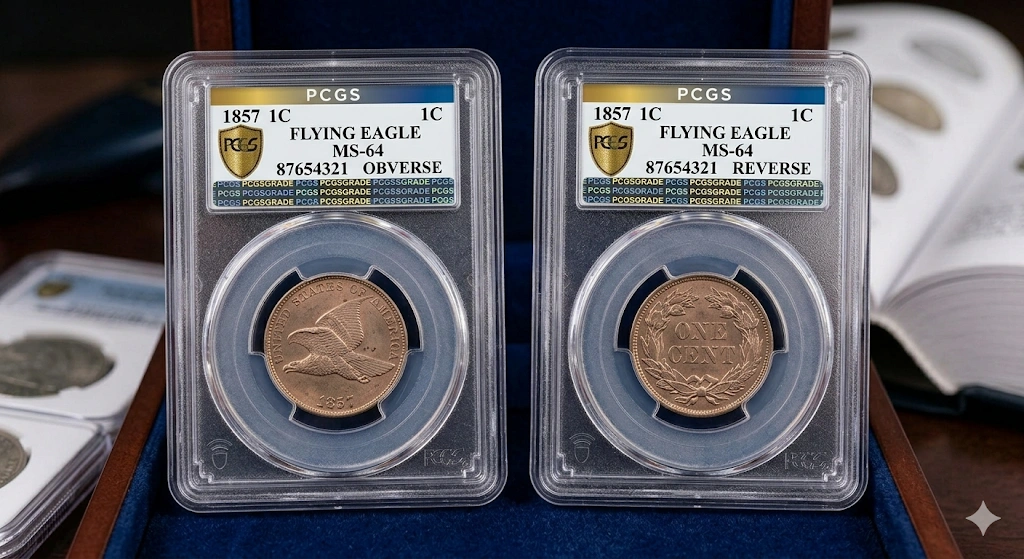
James B. Longacre designed the coin, borrowing the eagle from Christian Gobrecht’s earlier work on the Gobrecht dollar. The obverse features an eagle in full flight — bold, dynamic, and technically beautiful. The reverse shows a wreath encircling the denomination “ONE CENT.” The planchet shifted from pure copper to a copper-nickel alloy (88% copper, 12% nickel), which gave the coin its light, bright appearance and reduced production costs.
The practical problem was the die. The high-relief eagle on the obverse sat directly opposite the high-relief wreath on the reverse, meaning both sides competed for metal in the same strike. The result was chronic weak strikes — particularly on the eagle’s breast feathers and the details of the wreath. The Mint spent two years trying to solve the striking problem before abandoning the design entirely for Longacre’s Indian Head cent.
That striking weakness is important for collectors today. A Flying Eagle cent that looks EF-40 on the date, lettering, and rim can grade Fine-12 on the actual high points — the breast and wing details of the eagle. PCGS and NGC grade the coin holistically, and a weakly struck MS-63 is worth considerably less than a sharply struck MS-63, even in the same technical grade.
The 1856 Flying Eagle Penny: Is Yours a Proof or a Restrike?
The 1856 Flying Eagle penny was struck exclusively as a proof, not a business strike for circulation — but the Mint produced examples over several years (1856 through at least 1859) for collectors and presentation purposes, which means some 1856 coins in the market today are original strikings and others are later restrikes with subtle but meaningful differences in die characteristics. Knowing which you have matters significantly for value.
Original proof 1856 cents tend to show sharper die detail, particularly in the eagle’s feathers, and carry the “proof” characteristics of fully mirrored fields and frosted devices. Restrikes, struck later from worn or relapped dies, show less contrast between field and device. Both are genuine PCGS and NGC “proof” coins — but original strikings command premiums over restrikes among advanced collectors.
For most owners, the authentication path is the same: submit to PCGS or NGC. Do not buy or sell a raw 1856 Flying Eagle cent at any significant price. The coin has been counterfeited by altering the date on common 1857 or 1858 cents. Under magnification, an altered date shows tooling marks or an uneven surface in the date field. A genuine 1856 has clean, undisturbed fields around the digits.
At DEI, any 1856 Flying Eagle cent that comes through our doors goes immediately under our examination loupe before we discuss value. This is non-negotiable for us regardless of the seller’s provenance claims — the risk of altered dates is too high on this specific coin to do otherwise.
1858 Flying Eagle Cent Varieties: Large Letters vs Small Letters
The 1858 Flying Eagle cent comes in two distinct varieties — Large Letters and Small Letters — referring to the size of the lettering in “ONE CENT” on the reverse, and while both are common in circulated grades, the Small Letters variety consistently brings a 10–15% premium over Large Letters in all grades above EF-40. Knowing which variety you have before selling takes about ten seconds with a magnifying glass.
Large Letters (LL)
The Large Letters variety has noticeably taller and wider letterforms in “ONE CENT.” The “E” in “ONE” and the “C” in “CENT” are the easiest reference points. In the Large Letters variety, the crossbar of the “E” is prominent and wide. This is the more common of the two 1858 varieties.
Small Letters (SL)
The Small Letters variety features visibly thinner and shorter letterforms throughout the reverse. The difference is apparent side by side and clear enough to identify without a reference coin — just look at “CENT” on the reverse and assess whether the letters appear narrow or wide relative to the space in the wreath.
1858/7 Overdate
The rarest 1858 variety is the overdate, where a 7 is clearly visible under the 8 in the date. Under magnification, the curved base of the 7 protrudes below and to the right of the 8. This variety is genuine across all specimens — it’s not a die alteration but a working die where the 1857 hub impression wasn’t fully obliterated before the 1858 impression was applied. In Fine-12, the 1858/7 trades around $100–$145; in EF-40, $175–$250.
📌 DEI Market Observation: In our experience buying 19th-century small cents at our Las Vegas showroom, sellers almost never differentiate between the 1858 Large Letters and Small Letters varieties — they present both simply as “1858 pennies.” Over the past two years, we’ve purchased several 1858 Small Letters examples at common-date prices because the seller wasn’t aware the variety designation existed. The 10–15% premium is real and consistent, and it’s easy money for any collector who takes 30 seconds to check the reverse lettering before pricing.
How to Grade Flying Eagle Cents: The High Points That Determine Value
Grading Flying Eagle cents accurately requires examining four specific areas — the eagle’s breast feathers, the eagle’s left wing tip, the eagle’s head, and the wreath details on the reverse — because those four points show wear before everything else on this design. The date, lettering, and rim can look sharp on a coin that grades no better than VF-20 when you examine the actual high points.
Obverse High Points
The eagle’s breast is the first place to look. In circulated grades, wear on the breast starts as a slight flatness in the feathers just below the neck. In Good-4, the breast detail is completely flat. In Fine-12, outline of feathers shows but no inner detail. In EF-40, all major feather lines are visible with slight flatness on the very highest points only.
The left wing tip (closest to the date) also loses detail quickly. In AU-50, you’ll see a trace of wear here even on coins with otherwise sharp surfaces.
Reverse High Points
The bow knot at the base of the wreath and the leaves directly adjacent are the first reverse elements to show wear. In VF-20, the knot is still defined but the ribbon detail softens. In AU-55, full design sharpness with light rub visible only on the highest leaf tips.
The Strike Problem
As noted in the history section, weak strikes affect grade even on technically uncirculated coins. A weakly struck MS-62 Flying Eagle cent with flat breast feathers is worth less than a sharply struck MS-62. PCGS and NGC note weak strikes in their population data but do not discount the numerical grade for strike alone — the market does it for you in price. Ask specifically about strike quality before buying any MS-63 or higher example.
🪙 DEI Dealer Observation The most consistent grading mistake we see with Flying Eagle cents brought to our showroom is sellers confusing weak strike with wear. A coin with flat breast feathers that has never circulated can look worn to someone who doesn’t know the design’s striking history. We’ve had sellers bring in what they described as “heavily worn” 1857 cents that turned out to be weakly struck AU-55 examples — still worth $125–$160, versus the $25–$30 they expected. Before concluding a Flying Eagle cent is low grade, check the rim sharpness and the luster under a light source. If the rim is sharp and original cartwheel luster is visible in the fields, the flat breast is the die, not the wear.
Buying and Authenticating Flying Eagle Cents: What PCGS and NGC Certification Means
A PCGS- or NGC-certified Flying Eagle cent is worth 30–100% more than a raw example in the same grade, because the slab eliminates the authentication risk that defines this series — particularly on the 1856, where altered dates and outright counterfeits exist in meaningful numbers. For any Flying Eagle cent you’re considering buying above $50, certification is not optional.
PCGS and NGC both provide population data (the “pop report”) showing how many coins they’ve graded at each grade level. For Flying Eagle cents, the population at MS-65 Red is thin — the series is small and high-grade survivors are genuinely scarce. According to PCGS population data, fewer than 50 examples of the 1857 have been graded MS-65 Red or higher across all submissions. That scarcity drives the price premium at the top of the grade scale.
For collectors building a type set — one example of each US coin design — the Flying Eagle cent is a natural target. A single 1857 in EF-40 satisfies the type requirement for under $100 and represents one of the most elegant 19th-century designs in the American series. DEI’s certified silver coin inventory (link: /silver/silver-coins/certified-silver-coins/) and our appraisal service (link: /appraisals/) can help you evaluate Flying Eagle cents whether you’re buying, selling, or inheriting.
CAC (Certified Acceptance Corporation) verification adds another layer of confidence on PCGS and NGC slabs. A CAC sticker means the coin is solid or above average for its assigned grade — not just technically within the range. For MS-63 and higher Flying Eagle cents, CAC stickered examples trade at consistent premiums over non-CAC slabs at Heritage Auctions and Stack’s Bowers. At DEI, we provide CAC submission guidance for collectors who want that additional market endorsement.
Selling Flying Eagle Cents in Las Vegas: What DEI Sees at the Counter
Flying Eagle cents that come through DEI’s Las Vegas showroom arrive in three conditions — as part of larger estate sets of 19th-century coins, as single coins brought in by collectors who’ve decided to sell, and occasionally as part of bulk penny lots where the seller doesn’t know what’s in the group. Each scenario requires a different approach, and the right starting point is always the same: a no-pressure, informed appraisal before any offer is discussed.
For estate lots: we examine every coin individually. A single 1856 Flying Eagle cent in a box of otherwise common Indian Head pennies changes the entire value of the lot. We’ve bought estate collections in Las Vegas and Henderson where the Flying Eagle cent was the only significant coin — but it was significant enough to make the transaction worthwhile for both parties.
For single coins: condition and authenticity are everything. We use a 10x loupe and, for suspected 1856 examples, additional magnification to examine the date field for evidence of alteration. For uncirculated examples of any date, we assess strike quality, luster, and any evidence of cleaning or environmental damage before discussing value.
Tax note for sellers: The IRS classifies coin sales as collectibles, subject to a maximum long-term capital gains rate of 28% for coins held longer than one year. Short-term gains are taxed as ordinary income. Nevada imposes no state income tax, which benefits Las Vegas-area sellers compared to neighboring states. Consult a tax professional for your specific situation before completing any significant coin sale.
DEI’s we-buy page outlines our buying process, and same-day payment is always available. For collections requiring more time, we’re happy to schedule a dedicated appraisal appointment at (702) 460-5188.
CONCLUSION
If you have a Flying Eagle cent — or suspect you do — start with the date. An 1856 is always worth professional authentication before you price it, sell it, or dismiss it. An 1857 or 1858 in EF or better condition is worth checking against current PCGS values before treating it as a common coin. And any 1858 cent deserves a look at the reverse lettering to confirm whether you have the Large Letters or Small Letters variety.
Three takeaways: Flying Eagle cents value is entirely driven by date, variety, and condition — the three-coin series is short enough to master in an afternoon. The 1856 is the most counterfeited and the most valuable; never buy a raw example above $200 without authentication. And weak strikes look like wear on this design — check the rim and luster before concluding a coin is heavily circulated.
Whether you’re buying a type coin, evaluating an estate, or selling a specific date, our team at DEI Gold & Silver Coins has the PCGS and NGC credentials to give you a straight answer. Visit us at 8985 S. Eastern Ave, Suite 160, in Las Vegas, or call (702) 460-5188 for a free, same-day appraisal — no pressure, no obligation.
For your next reads, explore our guides on Indian Head pennies: key dates, values, and what to look for in 2026 and most valuable wheat pennies still in circulation — both natural continuations of the Lincoln cent story that follows the Flying Eagle series.
FAQ SECTION
1. What are Flying Eagle cents worth in 2026?
Flying Eagle cents value ranges from $20–$30 for common 1857 and 1858 dates in Good-4 to $7,500 or more for an 1856 proof in PR-65. In uncirculated grades, an MS-65 Red 1857 trades for $1,200–$1,800. Values are based on PCGS Price Guide and recent Heritage Auctions results. The 1856 is always the most valuable Flying Eagle cent regardless of grade.
2. How can I tell if my 1856 Flying Eagle cent is real or an altered date?
Examine the date field under 10x magnification. A genuine 1856 Flying Eagle cent has clean, undisturbed fields around the date digits with no tooling marks, filing lines, or uneven surfaces. Altered dates — made by modifying a common 1857 or 1858 cent — typically show disturbance in the metal directly adjacent to the digits. Any suspected 1856 should be submitted to PCGS or NGC for authentication before buying or selling.
3. What is the difference between the 1858 Large Letters and Small Letters Flying Eagle cent?
The 1858 Large Letters variety has taller, wider letterforms in “ONE CENT” on the reverse. The Small Letters variety has noticeably thinner, shorter letters. Compare the “E” in “ONE” and the “C” in “CENT” — large letters are broader and more prominent. The Small Letters variety commands a 10–15% premium over Large Letters in grades above EF-40, per PCGS Price Guide data.
4. Why do some Flying Eagle cents look weak or poorly struck even in uncirculated condition?
Flying Eagle cents were notoriously difficult to strike because the high-relief eagle on the obverse competed for metal with the high-relief wreath on the reverse. The result was chronic weak strikes, particularly on the eagle’s breast feathers. A weakly struck uncirculated Flying Eagle cent is genuine but worth less than a sharply struck example at the same numerical grade. Always ask about strike quality before buying MS-63 or higher.
5. How should I store Flying Eagle cents to protect their value?
Store Flying Eagle cents in PCGS or NGC slabs for certified examples. For raw coins, use inert 2×2 mylar flips or airtite capsules — never PVC holders, which cause chemical damage to copper surfaces over time. Keep coins away from humidity and direct light. Never clean a Flying Eagle cent. Original brown or red-brown patina is natural and preserves value; cleaning permanently damages copper surfaces and drops a coin to Details grade at PCGS and NGC.
6. Where can I sell a Flying Eagle cent in Las Vegas?
DEI Gold & Silver Coins at 8985 S. Eastern Ave, Suite 160, Las Vegas, NV 89123 buys Flying Eagle cents and 19th-century US coins with free same-day appraisals and same-day payment. As a PCGS- and NGC-certified dealer with 50+ years of combined numismatic experience, DEI authenticates and prices each coin individually. Call (702) 460-5188 to schedule. Coin sale profits may be subject to IRS collectibles capital gains tax — consult a tax professional.