What Determines Foreign Coin Value
Four things decide it, and they work together.
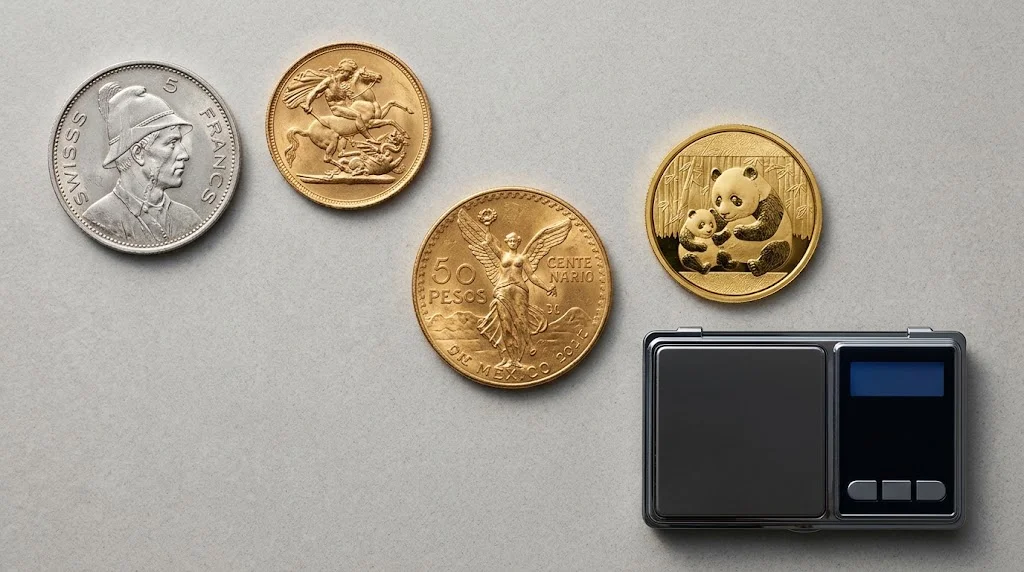
Metal content. A silver or gold coin has a floor value set by its pure-metal weight. Multiply total weight by fineness (the purity, such as .835 for 83.5 percent silver). A Swiss silver 5 francs weighs 15 grams at .835, which is 12.525 grams of silver, or about 0.4027 troy ounces. That is its melt value before any collector interest.
Date and mint. Mintages within one series can differ enormously, so two coins that look alike may not be equally scarce. Ottawa struck fewer than 1,000 British sovereigns in 1908 but over 250,000 in 1911.
Condition. Wear, scratches, rim damage and cleaning all reduce a coin’s collector appeal. A cleaned coin usually loses most of its premium over metal value, even if it looks brighter.
Collector demand. Some series have deep international followings, and demand varies by country and era. Age alone does not create value. Many old foreign coins are common and worth little.
Identify the Coin Before You Price It
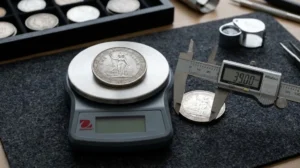
Record four details: country, denomination, date and metal. Weigh the coin and measure its diameter. Weight and size separate real silver from lookalikes faster than appearance does.
Dates can mislead. Thai coins often use Buddhist Era years, which run 543 years ahead of the Gregorian calendar, so “2500” means 1957. Republic of China coins count from 1912 as year 1. Japanese coins use reign-era years, and many Islamic-world coins use the Hijri calendar.
Once you know what you have, the standard reference is the Krause Standard Catalog of World Coins, whose “KM” numbers dealers use worldwide. Numista is a free online database, and NGC publishes a World Coin Price Guide. Catalog values are estimates of market level, not offers.
Silver World Coins That Often Carry Value
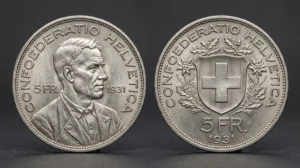
Swiss silver 5 francs. The small-type “Herdsman” 5 francs was struck from 1931 to 1969 in .835 silver at 15 grams and 31 mm, with a B (Bern) mintmark. It was demonetized in 1971. Mintages vary widely: reported figures are 416,000 for 1948-B and 13,817,000 for 1967-B. The date therefore matters, and condition decides much of the rest.
British and Commonwealth silver. British silver coinage was .925 sterling before 1920, .500 from 1920 to 1946, and cupro-nickel from 1947. Australia kept .925 through 1945 and used .500 silver for 1946–1963 issues. A pre-1920 florin weighs 11.31 grams, which is 0.3364 troy ounces of silver. The 1927 Canberra commemorative florin is recognized as a collectible beyond its metal.
Canadian silver. Canadian dimes, quarters, halves and dollars dated 1967 and earlier are mostly 80 percent silver. The 1967–1968 transition includes lower-silver and non-silver versions, so check composition rather than trusting the date. For general US and world identification tests, see our silver coin date list and identification guide.
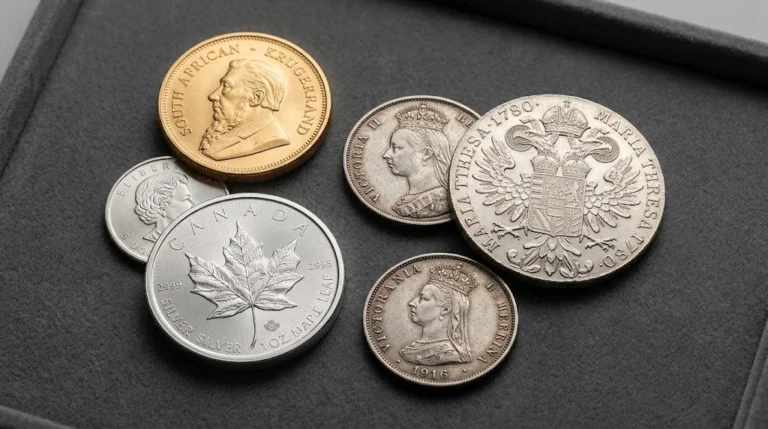
A cautionary example. The Maria Theresa thaler is still struck with the date 1780. It is about 0.75 troy ounces of .833 silver. Most examples are restrikes, so the date reflects a design, not an age.
Gold World Coins Worth Checking
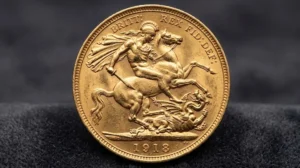
British gold sovereigns. A sovereign holds 0.2354 troy ounces of pure gold in a .9167 fine (22-karat) coin. London sovereigns carry no mintmark. Branch mints from 1871 added a letter: S (Sydney), M (Melbourne), P (Perth), C (Ottawa), I (Bombay) and SA (Pretoria). On George V sovereigns, the mark is on the reverse in the ground above the date. A common-date sovereign trades near gold value plus a modest premium. A scarce branch-mint date can bring far more, and Ottawa’s low-mintage years of 1908, 1913 and 1916 are examples. Browse our British gold sovereigns.
Mexican 50 pesos. The Centenario holds 1.2057 troy ounces of pure gold in a .900 fine coin. It was issued from 1921 to 1931, and later official restrikes carry a collector premium that is typically lower than original dates. Dealers sort original issues from restrikes, so keep them separate. See our Mexican gold coins.
Other gold. French and Swiss 20 francs contain 0.1867 troy ounces of gold at .900. The Krugerrand holds one troy ounce of gold at .9167. The Austrian 100 corona holds 0.9802 troy ounces, and many dated 1915 are later official restrikes.
Modern Bullion: Chinese Pandas
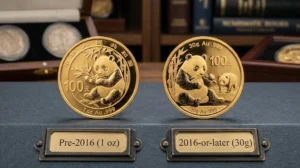
The Gold Panda has been issued since 1982. Through 2015 it came in ounce sizes, and from 2016 it moved to metric weights, so the 30 g coin holds about 0.9645 troy ounces. That difference matters when calculating melt, because ounce and 30 g coins are not interchangeable. The Silver Panda made the same change, from 1 oz to 30 g. Chinese coins are counterfeited often enough that authentication matters, and original mint packaging can influence buyers of modern bullion. See our Chinese Gold Pandas.
Metal Content at a Glance
| Coin | Metal and fineness | Pure metal | Watch for |
|---|---|---|---|
| Swiss 5 francs (1931–1969) | Silver .835 | ~0.4027 oz | Mintage varies by date |
| British or Australian florin (pre-1920 / pre-1946) | Silver .925 | ~0.3364 oz | Later dates are .500 |
| Maria Theresa thaler | Silver .833 | ~0.75 oz | Mostly restrikes dated 1780 |
| British sovereign | Gold .9167 | ~0.2354 oz | Mintmark and date |
| Mexican 50 pesos | Gold .900 | ~1.2057 oz | Original vs. restrike |
| French/Swiss 20 francs | Gold .900 | ~0.1867 oz | Date and country |
| Krugerrand | Gold .9167 | 1 oz | Common; priced near spot |
| Chinese Gold Panda (2016+) | Gold .999 | 30 g (~0.9645 oz) | Not a full ounce |
How Condition and Certification Change the Number
Grade describes wear and surface quality. Mint State coins show no wear. A coin’s strike, luster and eye appeal also matter, and a cleaned or damaged coin is often graded “Details” instead of a numeric grade. PCGS and NGC both certify world coins, and certification matters most for scarce dates and high grades.
The range can be wide. Numista’s auction records list a PCGS MS-64 Swiss large-type 5 francs sold at Heritage on June 15, 2026 for $317.20 including buyer’s premium, and an example described as uncirculated sold at Katz on December 6, 2025 for $41.19. These are different sales and are a loose illustration, not a price guide.
Getting a Foreign Coin Valued
An appraisal describes what a coin is and what it is worth. An offer is what a buyer will pay. Ask any buyer whether the number separates metal value from collector value. Bring everything together, keep original holders and paperwork, and do not clean anything.
DEI GOLD AND SILVER COINS offers coin appraisals for U.S. and foreign coins at its Eastern Avenue showroom in Las Vegas, and its appraisal page describes the process as no-pressure.
Conclusion
Foreign coin value comes down to metal, scarcity and condition. Weigh and identify first, check the date and mint, and don’t assume that old or foreign means valuable. When a coin might be scarce or carry a premium, get a second opinion before you sell.
By DEI GOLD AND SILVER COINS | Articles by DEI GOLD AND SILVER COINS