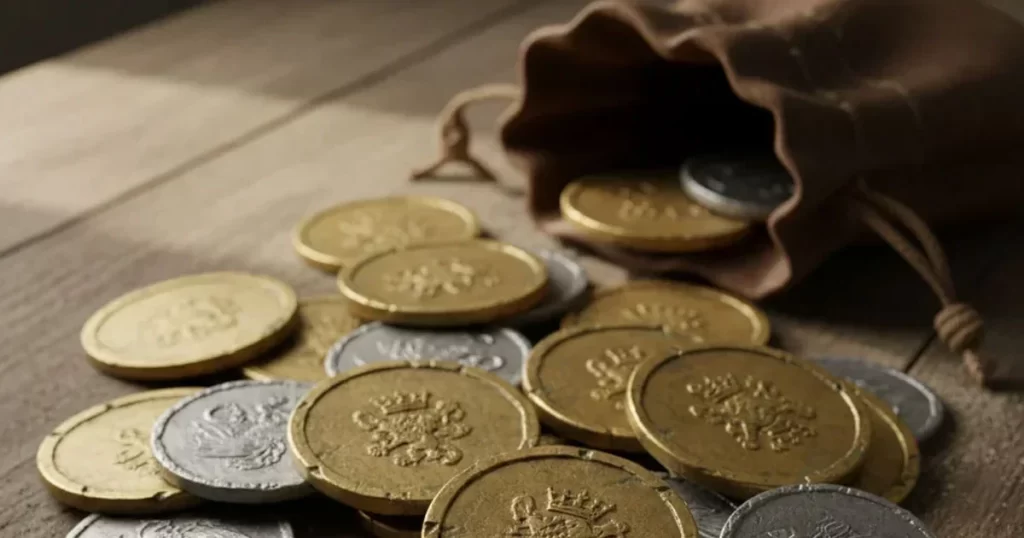
A woman walked into our showroom on Eastern Ave last spring carrying a zip-lock bag of coins her late father had kept in a coffee can for decades. She assumed they were foreign pocket change — worth maybe $10 total. Forty minutes later, she walked out with a check for $840. The difference? Five coins the rest of the world overlooks: foreign pieces with real silver and gold content that most people — and even many pawn shops — never bother to research.
According to PCGS CoinFacts, the global coin market saw more than $2.1 billion in collectible coin transactions in 2025, and foreign coin categories are among the fastest-growing segments, with European and Asian issues outpacing many U.S. type coins in percentage appreciation. Yet foreign coins remain one of the most undervalued categories sitting in American junk drawers, estate boxes, and inherited collections right now.
This foreign coin value guide covers five specific world coins — with exact dates, grades, and current values — that regularly cross our counter here at DEI and consistently leave sellers surprised. If you have any of these, you may be sitting on more than you think.
What Makes a Foreign Coin Worth Real Money?
Foreign coins hold significant value when they contain precious metal, carry numismatic rarity, or both — and the difference between a $5 coin and a $500 coin often comes down to one digit in the date or one letter in the mint mark.
Most people assume foreign coins are worthless because they can’t spend them at a U.S. store. That’s face value thinking, and it leaves serious money on the table. Here’s what actually determines worth in the world coins market:
Precious metal content: Many pre-1970 foreign coins were struck in 90% silver or 22-karat gold. At today’s silver spot price of approximately $32/oz (Kitco, June 2026), a single pre-decimal Australian florin containing 0.168 troy oz of silver has a melt value near $5.38 — before any numismatic premium.
Date and mint mark combinations: A 1948-B Swiss 5 franc in MS-63 is a common-date coin in circulated grades. That same coin in MS-65 with the ‘B’ (Bern) mint mark jumps dramatically — NGC Price Guide lists MS-65 examples at $280+ because the survival rate of gem-quality Swiss silver is surprisingly low.
Graded vs. raw: At DEI, we’ve seen ungraded Swiss francs sell for $25 that, after PCGS submission, returned MS-64 grades and resold for $95. Professional certification through NGC or PCGS doesn’t just add credibility — it unlocks buyer confidence and a substantially wider resale market.
Demand from international collectors: The Chinese Panda coin series has a massive domestic collector base in China that actively buys back high-grade Western-held examples. That global demand floor is a price stabilizer that many U.S.-only coins don’t have.
The Swiss Silver 5-Franc: Europe’s Most Overlooked Silver Coin
The Swiss silver 5-franc piece (minted 1931–1967 in 83.5% silver) is one of the most undervalued foreign silver coins in the U.S. foreign coin value guide for everyday sellers.
Each coin contains 0.4027 troy oz of silver. At a spot price of $32/oz, that’s roughly $12.87 in melt value — already well above face value. But the numismatic story is better than that. Circulated examples (VF-30 to EF-45) trade between $18 and $40 depending on date. The scarce 1939-B date in MS-63 commands $165 or more on Heritage Auctions sold listings. An MS-65 from any 1930s date can reach $320–$400.
Key Dates to Check First
- 1931-B: First year of issue; EF-40 examples average $45–$60
- 1939-B: Low mintage; MS-63 = approximately $165 (Heritage Auctions, 2025)
- 1948-B: Common date but rare in gem — MS-65 examples reach $280 (NGC Price Guide)
At DEI, we recommend having any Swiss 5-franc from before 1950 evaluated before selling. In circulated grades they’re modest silver; in gem grades, they’re a different conversation entirely.
Chinese Gold Panda Coins: The World Coin That Keeps Appreciating
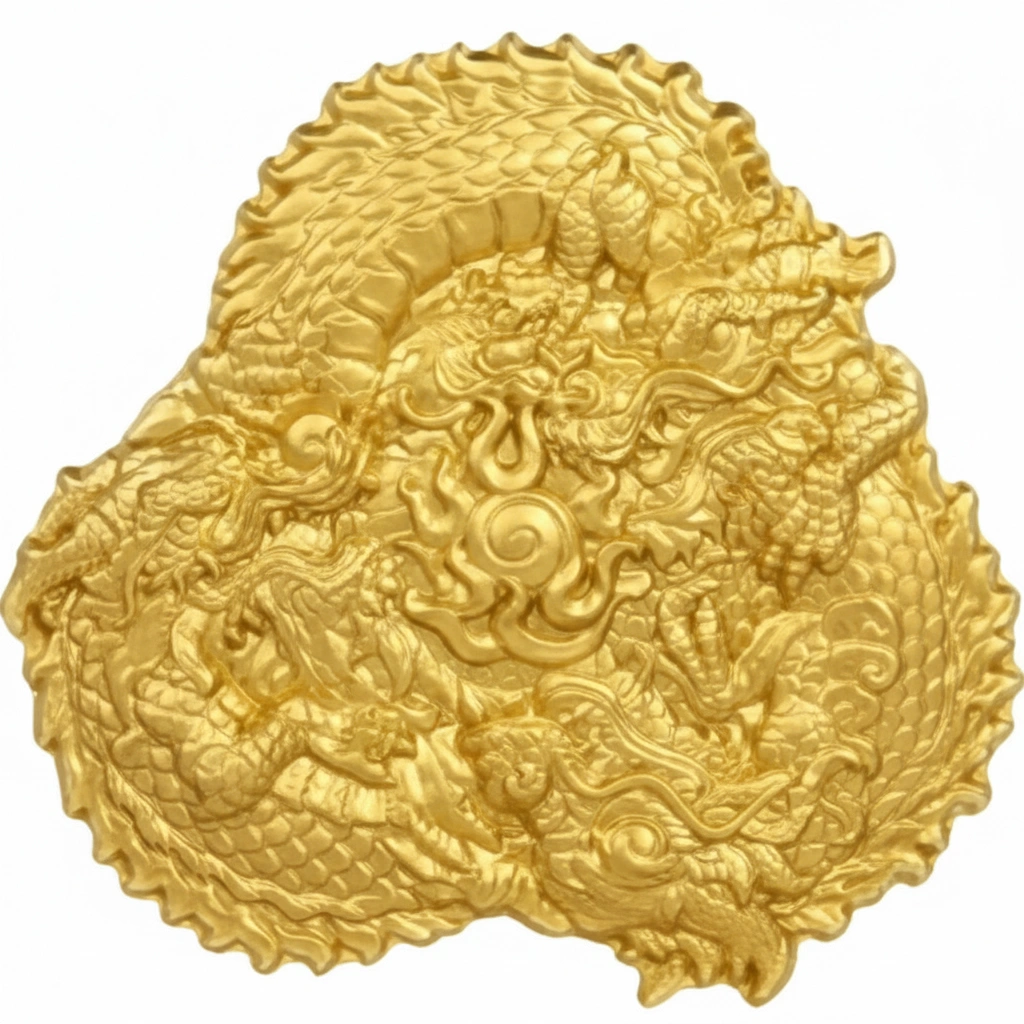
Chinese Gold Panda coins — issued annually by the People’s Bank of China since 1982 — are among the most actively traded world coins worth money in both the collector and investment markets.
The 1 oz Gold Panda (currently .999 fine gold) tracks gold spot price as a floor, but early-date issues trade at substantial premiums. A 1982 1 oz Gold Panda in MS-65 (NGC or PCGS graded) sold for $4,800 at Stack’s Bowers in late 2025 — roughly 2.4× its melt value at then-current gold prices. Even modern-date Pandas (2015–present) in NGC MS-70 carry $150–$300 premiums over spot because collectors value the perfect-strike designation.
What makes Pandas particularly interesting for U.S. holders is the bidirectional demand: American precious metals investors buy them as bullion-adjacent assets, while Chinese collectors seek specific years and grades for their annual designs. That two-market demand structure creates price resilience that single-market coins don’t have.
DEI carries Chinese Gold Pandas in our certified gold coin inventory . When buying or selling Pandas, the most important factor after grade is the specific year — certain design years (1986, 1988, 1991) consistently outperform spot on resale, sometimes by 40–60% above melt.
| 📌 DEI Market Observation
Over the past 18 months, early-date (pre-1990) Chinese Gold Panda coins brought to our showroom in original OGP (original government packaging) have averaged 15–22% higher appraisal values than the same dates in flips or 2×2 holders — even when the coins themselves grade identically. Provenance packaging matters in this series more than almost any other world coin we handle. |
Pre-1933 British Gold Sovereigns: Small Coin, Surprisingly Large Value
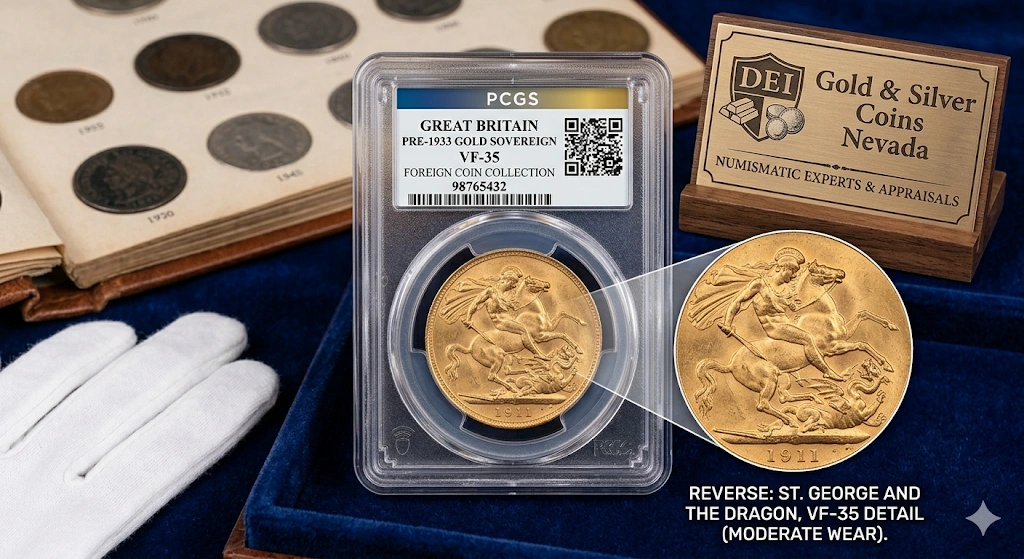
Pre-1933 British gold sovereigns contain 0.2354 troy oz of 22-karat gold and are one of the most liquid foreign gold coins in the world — and their numismatic premiums are frequently underestimated by American sellers.
A circulated sovereign (VF-30) in a common reign — Edward VII or George V — has a melt value around $565 at $2,400/oz gold. But date and mint mark combinations elevate that substantially. An 1879-S (Sydney mint) sovereign in EF-40 trades for $800–$1,100. A rare 1917-C (Ottawa mint) in VF-35 commands $2,500+ because that issue saw extremely limited production. For context, the average seller walking into a U.S. pawn shop with a circulated sovereign typically receives melt value or slightly under — missing the entire numismatic premium.
Why Las Vegas Sellers Specifically Benefit
Nevada has no state income tax on coin sales, and DEI’s appraisal process (link: /appraisals/) identifies both the precious metal value AND the numismatic premium for every British sovereign we evaluate. That dual-value approach has returned significantly more to sellers than spot-price-only offers from bullion dealers.
| 🪙 DEI Dealer Observation
When a British sovereign comes across our counter, the first thing we look for isn’t the monarch’s portrait — it’s the mint mark on the reverse, just above the date on the ground between the dragon’s feet. Most sellers don’t know mint marks exist on sovereigns, let alone what they mean for value. A George V 1925-SA (Pretoria mint) in EF-40 and a George V 1925 (London mint) in the same grade can differ by $200+ — same year, same portrait, completely different coin. That’s a detail that takes 10 seconds to check and can change your payout entirely. |
Pre-Decimal Australian Silver Coins: Hidden Silver in Commonwealth Collections
Pre-decimal Australian silver coins — florins, shillings, and crowns minted before 1946 in 92.5% silver, and 1946–1963 issues in 50% silver — represent one of the best-value silver buys in the foreign coin value guide for budget-conscious collectors.
The 1927 Canberra florin (commemorating the opening of Parliament House) is the most famous: EF-40 examples trade for $45–$65, while MS-63 coins reach $180+ according to PCGS CoinFacts. But even common-date florins from the 1920s–1940s in the 0.3364 troy oz silver weight carry a melt floor of approximately $10.77 at current silver prices.
For heirs evaluating estate collections, pre-decimal Australian coins frequently appear in Commonwealth-era accumulations alongside British and Canadian issues. The key distinguishing mark: ‘AUSTRALIA’ on the reverse and no decimal denomination. Any coin marked in shillings or pounds sterling with an Australian reverse is worth checking against current precious metals prices before selling. DEI’s free appraisal service (link: /appraisals/) covers Commonwealth silver coins with the same thoroughness as U.S. issues.
Mexican 50-Peso Gold ‘Centenario’: The Sleeper World Coin
The Mexican 50-peso gold coin — the Centenario — contains 1.2057 troy oz of pure gold and consistently trades at a modest premium over spot, making it one of the most cost-efficient large-gold-coin purchases in the world.
Originally minted 1921–1931 and officially reissued 1943–1947 (with restrike years running into the 1970s), the Centenario is recognized by IRS rules for Gold IRA eligibility when meeting fineness standards (.900 fine for original issues). Original 1921 examples in AU-55 have brought $3,200–$3,600 at Heritage Auctions based on 2025 sold data. Restrike years are more common but still trade at 1–3% over spot, which is favorable compared to many other large gold coins with higher premiums.
DEI regularly appraises Mexican gold coins including Centenarios as part of our free appraisal service (link: /we-buy-gold/). The most common error we see: sellers assume restrike and original-strike Centenarios are the same coin. They’re not — the numismatic premium difference on original 1920s dates can exceed $400 on a single coin.
📊 World Coin Value Quick Reference — DEI Quick Reference
| Coin | Metal Content | Grade Range | Value Range | Key Dates |
| Swiss Silver 5-Franc | 0.4027 oz silver (83.5%) | VF-30 to MS-65 | $18 – $400 | 1931-B, 1939-B, 1948-B |
| Chinese Gold Panda (1 oz) | 1.0 oz gold (.999) | MS-65 to MS-70 | Spot + $150 to $4,800+ | 1982, 1986, 1988, 1991 |
| British Gold Sovereign | 0.2354 oz gold (22k) | VF-30 to EF-45 | $565 – $2,500+ | 1879-S, 1917-C, 1925-SA |
| Australian Florin (pre-1946) | 0.3364 oz silver (92.5%) | EF-40 to MS-63 | $10 – $180+ | 1927 Canberra |
| Mexican 50-Peso Centenario | 1.2057 oz gold (.900) | AU-55 to MS-63 | Spot +1% to $3,600+ | 1921, 1922, 1943 restrike |
Values based on PCGS CoinFacts, NGC Price Guide, Heritage Auctions 2025 sold data, and DEI showroom observations. Spot prices per Kitco June 2026.
How to Sell Foreign Coins in Las Vegas the Right Way
Selling foreign coins in Las Vegas is straightforward if you know where to go — and DEI Gold & Silver Coins offers same-day cash payment after a free, no-obligation appraisal at our Eastern Ave showroom.
The biggest mistake sellers make is going to a general pawn shop with world coins. Pawn shops typically offer melt value on precious metals and have no numismatic premium pricing system for foreign coins. That means a 1939-B Swiss 5-franc in MS-63 worth $165 might be offered $13 (melt) at a pawn counter — a loss of $152 on a single coin.
DEI’s process:
- Free evaluation: Bring any foreign coins for a no-pressure appraisal. We check metal content, date, mint mark, and grade.
- Transparent pricing: We show you PCGS or NGC pricing alongside our offer — no mystery.
- Same-day payment: If you sell, you leave with cash or check the same day.
- CAC submission guidance: For coins with exceptional eye appeal, we advise whether CAC stickering adds resale value before you sell or hold.
For out-of-state sellers or Las Vegas visitors, we also handle mail-in appraisals and estate evaluations — call (702) 460-5188 to arrange.
Start With What You Have
Stop leaving money on the counter. The five coins in this foreign coin value guide — Swiss silver francs, Chinese Gold Pandas, British sovereigns, Australian pre-decimal silver, and Mexican Centenarios — are consistently undervalued by sellers who assume foreign means worthless.
Here are your four takeaways: First, precious metal content creates a hard floor value regardless of numismatic condition. Second, specific date and mint mark combinations can double or triple value compared to common dates in the same series. Third, professional grading through NGC or PCGS unlocks premiums that raw coins rarely capture. Fourth, getting a second opinion from a certified numismatist costs nothing at DEI and can be worth hundreds.
FAQ SECTION
1. How do I find out the foreign coin value of coins I inherited?
Answer: The fastest way to determine foreign coin value for inherited coins is to bring them to a certified numismatist for a free appraisal — DEI Gold & Silver Coins in Las Vegas offers same-day evaluations at no cost. A professional checks metal content, date, mint mark, and grade, which together determine whether a coin is worth melt value, a modest premium, or significantly more.
2. Which world coins are worth the most money right now in 2026?
Answer: The world coins currently worth the most money include early-date Chinese Gold Pandas (pre-1990), pre-1933 British gold sovereigns with rare mint marks, original-strike Mexican 50-peso Centenarios from the 1920s, and Swiss silver 5-franc pieces in gem grades (MS-65+). Values range from $150 to over $4,800 depending on date, grade, and precious metals spot prices per PCGS CoinFacts and Heritage Auctions data.
3. Are foreign silver coins eligible for a Gold IRA?
Answer: Most foreign silver coins are not IRS-eligible for a Gold IRA because they don’t meet the required .999 fine silver standard. Exceptions include silver coins explicitly approved by the IRS, such as the Canadian Maple Leaf (.9999 fine). Pre-decimal Swiss, Australian, and British silver coins are collectibles and not Gold IRA eligible. Consult a tax professional for your specific situation.
4. How do I tell if a foreign coin has been cleaned, and does it affect value?
Answer: A cleaned foreign coin shows unnatural brightness, hairline scratches under magnification, or a dull cartwheel luster rather than original mint shine. Cleaning permanently damages numismatic value — a cleaned Swiss 5-franc that would grade MS-63 raw will instead receive a ‘Details — Cleaned’ designation from PCGS or NGC, reducing its value by 40–70% compared to an unaltered example of the same date and grade.
5. Where can I sell foreign coins for the best price in Las Vegas?
Answer: To get the best price when you sell foreign coins in Las Vegas, go to a PCGS- or NGC-affiliated dealer who evaluates both metal content and numismatic premium separately. DEI Gold & Silver Coins on Eastern Ave offers free appraisals, transparent PCGS/NGC price comparisons, and same-day cash payment — avoiding the melt-only offers common at pawn shops, which frequently miss significant collector value.
6. Do I pay taxes when I sell foreign coins in the USA?
Answer: Yes — the IRS classifies coins as collectibles, subject to a maximum 28% long-term capital gains rate if held over one year. Short-term gains (under one year) are taxed as ordinary income. Nevada has no state income tax, which benefits Las Vegas sellers compared to many other states. Dealers may issue a 1099-B form for certain transactions. Always consult a tax professional for your specific situation.