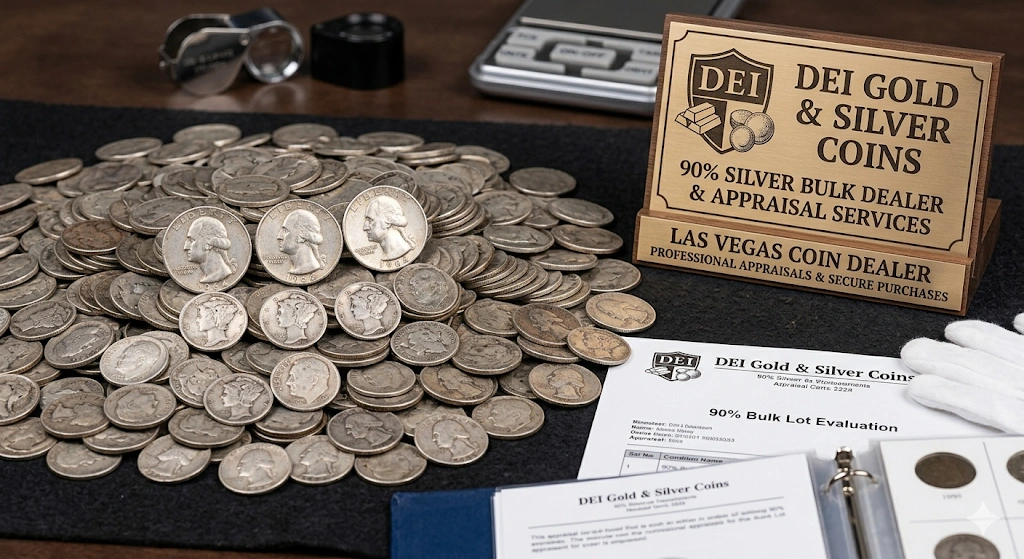
Last month, a Henderson resident walked in with a canvas bag of coins from her grandmother’s closet — quarters, dimes, half dollars, a few dollars. She figured they were worth face value. We weighed the silver content on the spot: $340 in melt value alone, before checking any numismatic premiums. The difference between that $340 and zero was knowing which coins are silver and which are not.
Silver spot price currently sits around $32 per troy ounce (Kitco, June 2026), meaning a single 90% silver Washington quarter contains roughly $5.79 in silver — nearly 23 times its face value. Multiply that across a roll of 40 quarters and you’re looking at $231.60 in melt value. The U.S. Mint stopped putting silver in most circulating coins after 1964 — but the cutoff year varies by denomination, and that’s exactly where people make mistakes.
This post gives you the complete silver coin date list for U.S. coins, plus the three fastest ways to identify silver coins at home. By the end, you’ll know exactly which coins from your jar, roll, or inherited collection are worth weighing.
What Coins Are Silver in the United States? The Complete Date List
U.S. silver coins fall into four main categories: 90% silver coins (pre-1965 dimes, quarters, halves, and dollars), 40% silver coins (1965–1970 Kennedy halves and certain Eisenhower dollars), 35% silver War Nickels (1942–1945), and modern silver bullion coins like the American Silver Eagle, which contain 99.9% silver.
The single most important date to remember: if a dime, quarter, or half dollar is dated 1964 or earlier, it almost certainly contains 90% silver. Coins dated 1965 or later are copper-nickel clad — no silver at all. The exception is Kennedy halves from 1965–1970, which contain 40% silver, and proof or special mint sets issued after 1992, which may contain 90% silver but are collector issues, not circulating coins.
The 90% Silver Coins — ‘Junk Silver’ Explained
Collectors and dealers call pre-1965 U.S. dimes, quarters, and half dollars ‘junk silver’ — not because they’re junk, but because they carry no numismatic premium beyond melt value. A face-value dollar’s worth of junk silver coins (say, four quarters) contains approximately 0.7234 troy oz of silver. At $32/oz, that’s $23.15 per face-value dollar. DEI’s junk silver coin inventory (link: /silver/junk-silver-coin/) carries 90% silver bags and rolls at competitive premiums above spot.
The 40% Silver Coins — Kennedy Halves 1965–1970
Kennedy half dollars from 1965 through 1970 contain 40% silver — 0.1479 oz per coin. They’re easy to mistake for clad coins because they were struck at the same time the Mint was transitioning away from silver. The easiest check: look at the coin’s edge. A 40% Kennedy shows a thin silver layer on both faces with a copper-colored core in the middle. A 1971 or later Kennedy is entirely copper-nickel — the edge stripe is wider and more obviously copper.
Buy or Sell Gold & Silver Coins with Confidence
Work with a trusted Las Vegas coin dealer offering fair pricing, honest appraisals, and expert guidance every step of the way.
How to Identify Silver Coins: 3 Fast Tests You Can Do at Home
You can identify silver coins at home using three reliable tests: the date check, the magnet test, and the edge inspection — no equipment required beyond what you likely already have.
Test 1 — The Date Check (Fastest)
For U.S. coins: check the date first. Any dime, quarter, or half dollar dated 1964 or earlier is 90% silver. Kennedy halves dated 1965–1970 are 40% silver. Any Roosevelt dime, Washington quarter, or Kennedy half dated 1971 or later has zero silver. Morgan and Peace dollars are always silver (1878–1935). Eisenhower dollars (1971–1978) are only silver in proof or uncirculated collector versions; circulating examples are clad.
Test 2 — The Magnet Test
Silver is not magnetic. Hold a strong neodymium magnet to any coin you’re testing. If the coin sticks, it contains ferrous metal and is not silver (and likely not genuine). If the coin has zero magnetic attraction, that’s consistent with silver, copper-nickel, or other non-magnetic alloys. The magnet test rules out fakes but doesn’t confirm silver on its own — use it alongside the date check.
Test 3 — The Edge Inspection
Look at the coin’s edge (the rim). A 90% silver coin has a uniform silver-gray edge with no color banding. A copper-nickel clad coin shows a clearly visible copper stripe running through the middle of the edge — it’s instantly obvious once you know what to look for. This test works especially well for quarters and dimes where the date is worn and hard to read. In our showroom, edge inspection is the first thing we do with worn coins where the date is partially obscured.
Silver Coin Date List for US Coins — Complete Reference
Every silver-bearing U.S. coin series, organized by type with exact date ranges, silver content percentages, and troy ounce weight per coin — the same reference DEI uses at the counter.
📊 US Silver Coin Date List — DEI Quick Reference
| Coin Type | Silver Years | Silver % | Oz Silver / Coin | Notes |
| Morgan Dollar | 1878–1921 | 90% | 0.7734 oz | Most traded silver dollar; key dates: 1893-S, 1895 |
| Peace Dollar | 1921–1935 | 90% | 0.7734 oz | Last circulating U.S. silver dollar |
| Eisenhower Dollar | 1971–1978 | 40% (proof/collector only) | 0.3161 oz | Only 40% Ikes are silver — clad coins are common |
| Walking Liberty Half | 1916–1947 | 90% | 0.3617 oz | Same design as modern Silver Eagle reverse |
| Franklin Half | 1948–1963 | 90% | 0.3617 oz | Bell Liberty design; no silver after 1963 |
| Kennedy Half | 1964–1970 | 90% (1964) / 40% (1965–70) | 0.3617 / 0.1479 oz | 1971+ Kennedy halves are clad — zero silver |
| Washington Quarter | 1932–1964 | 90% | 0.1808 oz | 1965+ quarters are copper-nickel clad |
| Roosevelt Dime | 1946–1964 | 90% | 0.0723 oz | 1965+ dimes are clad — no silver at all |
| Mercury Dime | 1916–1945 | 90% | 0.0723 oz | Key date: 1916-D; beloved by collectors |
| Barber Dime/Quarter/Half | 1892–1916 | 90% | 0.0723–0.3617 oz | All 90% silver; watch for low-mintage branch mint coins |
| War Nickel | 1942–1945 | 35% | 0.0563 oz | Only nickels with silver; identified by large P/D/S over dome |
Sources: US Mint composition records, PCGS CoinFacts, Silver Institute. Oz silver calculated at .900 or .400 fineness × total coin weight.
War Nickels: The Only US Nickels That Are Silver
War Nickels — the Jefferson nickels minted from mid-1942 through 1945 — are the only U.S. nickels that contain silver, at 35% silver content (0.0563 troy oz per coin).
The U.S. Mint added silver to nickels during WWII because nickel was a critical war material. The easiest way to identify them: look for a large mint mark — P, D, or S — above the dome of Monticello on the reverse. That oversized mint mark is unique to War Nickels and appears on no other Jefferson nickel series. The ‘P’ mint mark is significant because Philadelphia never used a mint mark on nickels before or after the war years.
At current silver prices, each War Nickel contains approximately $1.80 in silver — about 36× face value. A roll of 40 War Nickels has $72 in melt value. At DEI, we see War Nickels mixed into general nickel rolls regularly, and they’re consistently overlooked by sellers who don’t know the mint mark identifier. If you have a jar of old nickels, pull every coin dated 1942–1945 and check the reverse for that oversized dome mint mark.
| 🪙 DEI Dealer Observation
War Nickels are the most under-sorted silver coins we encounter at our Las Vegas showroom. Sellers bring in coffee cans of nickels expecting pocket change value — and we frequently find 8 to 15 War Nickels per can, representing $15 to $27 in silver melt that would have been handed back as face value at a bank. The tell-tale sign is easy once you know it: flip the coin to the reverse and look above Monticello’s dome. If there’s a large P, D, or S there, the coin is silver. There is no other Jefferson nickel with a mint mark in that position. For sellers in Las Vegas and Henderson, that 5-second check per nickel is the highest-ROI coin sorting habit you can develop. |
World Coins That Are Silver: What to Look For
Many world coins minted before the 1970s contain silver — and the most commonly encountered silver world coins in U.S. collections are British pre-decimal coins, Canadian pre-1968 coins, Mexican silver, and pre-1945 European issues.
Canadian Silver Coins
Canadian dimes, quarters, fifty-cent pieces, and dollars minted before 1968 are 80% silver (with a brief run of 50% silver from 1967–1968). Canadian silver dollars (1935–1967) contain 0.600 troy oz of silver each. The transition year 1968 is critical: some 1968 Canadian dimes are 50% silver and some are nickel — they cannot be distinguished by sight alone. At DEI, we weigh suspicious 1968 Canadian coins rather than guess.
British Pre-Decimal Silver
British shillings, florins (two shillings), half-crowns, and crowns minted before 1947 are 50% silver. Pre-1920 British silver coins are 92.5% sterling silver. The changeover year — 1947 — is sharp: coins dated 1946 and earlier are 50% silver; 1947 and later are cupro-nickel with zero silver content.
Mexican Silver Coins
Mexican silver coins represent some of the best silver value per dollar of cost in the world coin market. The pre-1945 Peso series and 1947–1963 Peso issues are 72% silver. The beloved ‘Onza’ (1 troy oz pure silver) is one of the most liquid silver bullion coins in the Western Hemisphere. DEI carries Mexican silver in our silver coins inventory .
📌 DEI Market Observation: Among world silver coins brought to our Las Vegas showroom for appraisal, Canadian silver dollars from the 1945–1967 period are the most consistently undervalued. Sellers typically price them at $15–$20 based on face denomination; melt value at current silver prices is approximately $19.20, and any coin grading MS-63 or better commands a $10–$40 numismatic premium above that.
Modern Silver Bullion Coins: American Silver Eagles and What Makes Them Different
American Silver Eagles — minted by the U.S. Mint since 1986 — contain exactly 1 troy oz of .999 fine silver and are the most widely traded silver bullion coins in the United States, with over 700 million sold since their introduction (U.S. Mint production data).
Unlike junk silver coins, American Silver Eagles carry a government-guaranteed 1-troy-oz silver content and legal tender status of $1. They’re also IRS-approved for Gold IRA accounts, making them the go-to silver coin for precious metals investors. In 2021, the Mint released the Type 2 reverse design — a significant design update that created two distinct collecting varieties for every mint facility that year.
Current American Silver Eagle premiums over spot run approximately $3–$6 per coin for generic dates (APMEX, June 2026). Key dates and grades command more: a 2021-S Reverse Proof in NGC PF-70 trades for $120–$160 based on recent GreatCollections sold listings. DEI’s American Silver Eagle inventory (link: /silver/silver-coins/american-silver-eagles/) includes Type 1 and Type 2 examples in raw and certified grades.
How to Sell Silver Coins in Las Vegas — What to Bring to DEI
When you bring silver coins to DEI Gold & Silver Coins in Las Vegas, our process starts with free identification and weighing — you don’t need to know what you have before walking in.
Here’s exactly what to expect:
- We identify every coin by date, denomination, and silver content at no cost.
- We weigh all 90% and 40% silver separately and calculate melt value at the current spot price.
- We check each coin for numismatic value above melt — a circulated 1916-D Mercury Dime is worth $900+, not just its silver content.
- We make a same-day cash offer. No waiting, no consignment, no fees.
Nevada’s lack of state income tax is a real advantage for Las Vegas sellers: you keep more of your payout than sellers in most other states. For transactions that generate a 1099-B from the dealer, the IRS collectibles rate applies at a maximum 28% long-term capital gains rate on coins held over one year. Consult a tax professional for your specific situation.
The most important thing to bring: everything. Don’t pre-sort assuming certain coins aren’t silver. We’ve caught Morgan dollars someone filed into a ‘clad’ pile and War Nickels dismissed as regular change. Free appraisals are available at our Eastern Ave showroom (link: /appraisals/) and for mail-in estate collections.
Your Next Step
Check every coin in your collection against this silver coin date list before you decide it’s worth nothing. The three-step identification process — date check, magnet test, edge inspection — takes seconds per coin and has found real silver in hundreds of junk drawers across Southern Nevada.
Four takeaways: First, any U.S. dime, quarter, or half dollar dated 1964 or earlier is 90% silver. Second, Kennedy halves from 1965–1970 are 40% silver. Third, War Nickels (1942–1945) are 35% silver — identified by the oversized mint mark above Monticello’s dome. Fourth, modern bullion coins like American Silver Eagles contain 1 oz of .999 silver and are IRS-approved for precious metals IRAs.
FAQ SECTION
1. What coins are silver in the United States?
Answer: U.S. coins that are silver include: Morgan and Peace silver dollars (1878–1935), Walking Liberty and Franklin half dollars (1916–1963), Kennedy halves (1964 at 90%; 1965–1970 at 40%), Washington quarters and Mercury/Roosevelt dimes dated 1964 and earlier (90% silver), and War Nickels (1942–1945, 35% silver). American Silver Eagles contain 1 troy oz of .999 fine silver.
2. How can I tell if a coin is silver without testing equipment?
Answer: Check the date first — U.S. dimes, quarters, and halves dated 1964 or earlier are 90% silver. Then inspect the edge: silver coins show a uniform gray rim, while clad coins display a visible copper stripe through the middle. A strong magnet also helps — silver is non-magnetic, so a clad coin won’t stick but neither will copper-nickel, so use the edge and date checks as primary methods.
3. Are Kennedy half dollars silver?
Answer: Yes — partially. The 1964 Kennedy half dollar is 90% silver (0.3617 oz). Kennedy halves from 1965 through 1970 are 40% silver (0.1479 oz each). Kennedy halves dated 1971 and later are copper-nickel clad with zero silver content. The edge test confirms this: 40% Kennedys show a thin copper core stripe, while 1964 coins have a uniform silver edge.
4. What is a War Nickel and how do I identify it?
Answer: War Nickels are Jefferson nickels minted from mid-1942 through 1945 with 35% silver content. To identify one, flip the coin to the reverse and look above the dome of Monticello — a large P, D, or S mint mark in that position confirms it’s a War Nickel. No other Jefferson nickel series uses a mint mark in that location. Each War Nickel contains 0.0563 troy oz of silver, worth approximately $1.80 at current prices.
5. What silver coin date list should I use to sort junk silver?
Answer: Use this silver coin date list for U.S. junk silver: dimes (Mercury 1916–1945, Roosevelt 1946–1964), quarters (Washington 1932–1964), half dollars (Walking Liberty 1916–1947, Franklin 1948–1963, Kennedy 1964 at 90% and 1965–1970 at 40%), and dollars (Morgan 1878–1921, Peace 1921–1935). Any coin outside these dates — except modern bullion or collector proof sets — contains no silver.
6. Are silver coins a good investment and where can I buy them in Las Vegas?
Answer: Silver coins offer a tangible, IRS-recognized store of value that tracks silver spot price and can appreciate numismatically above melt. For investment purposes, American Silver Eagles are the most liquid and IRS-approved for precious metals IRAs. DEI Gold & Silver Coins in Las Vegas carries 90% junk silver, American Silver Eagles, and certified silver coins at competitive premiums — with free appraisals and same-day cash for sellers.