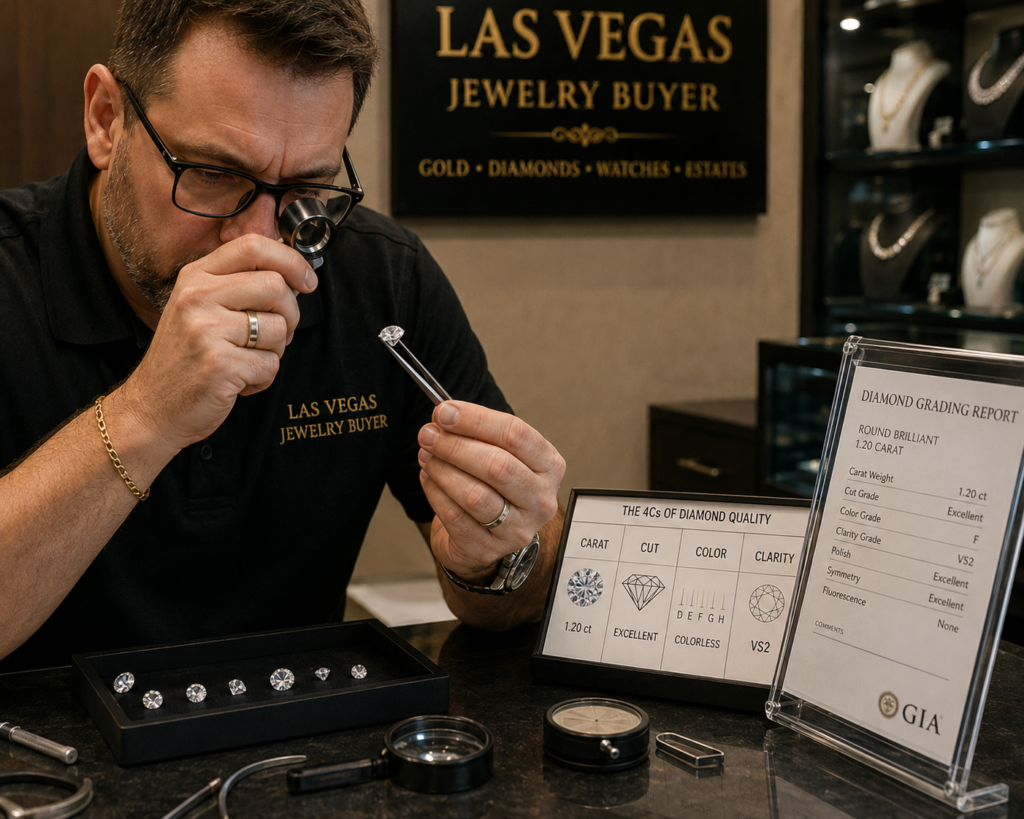
Last month, a woman brought in her late mother’s engagement ring with an old, yellowed grading certificate tucked inside the box. It was filled with letters and abbreviations such as “VS2,” “H,” and “Excellent,” which meant nothing to her. She wanted to determine whether the ring was worth keeping insured, selling, or having it reset. Understanding diamond grading 4 Cs is what turns those confusing letters and terms into a meaningful value, making it the first thing anyone buying or selling a diamond should understand.
Whether you’re evaluating an engagement ring, an inherited piece, or a diamond you’re thinking about purchasing, this guide breaks down what each of the 4 Cs actually means and why they matter just as much when you sell as when you buy.
What Are the 4 Cs of Diamond Grading?
The 4 Cs — Carat, Cut, Color, and Clarity — were introduced by the Gemological Institute of America (GIA) in the 1940s as a universal standard for evaluating diamonds worldwide. Before this system was developed, diamond quality was mainly judged subjectively. Today, the 4 Cs of diamond grading provide a consistent and internationally recognized way to assess a diamond’s quality.
Carat measures a diamond’s weight, not its physical dimensions — one carat equals 200 milligrams, or 1/5 of a gram. Carat weight is further broken into 100 “points” per carat, allowing for extremely precise measurements (a 0.75-carat diamond, for example, is described as “75 points”). Two diamonds of the same carat weight can look noticeably different in size depending on their cut, which is why carat alone never tells the whole story.
Cut: The C That Creates Sparkle
Cut refers to how well a diamond’s facets are proportioned and angled to interact with light — it’s the factor most responsible for a diamond’s brilliance and fire. GIA grades the cut of round brilliant diamonds on a five-tier scale: Excellent, Very Good, Good, Fair, and Poor. A well-cut diamond of lower carat weight can often out-sparkle a larger, poorly cut stone.
Color: The D-to-Z Scale
Color grading measures how colorless a diamond is, using a scale that runs from D (completely colorless) to Z (light, noticeable yellow or brown tint). Introduced by GIA in 1953, this scale remains the industry standard: diamonds graded D through F are considered colorless, G through J near-colorless, and grades further down the alphabet show increasingly visible tint.
Clarity: From Flawless to Included
Clarity grades the presence of internal inclusions and external blemishes, on an 11-point scale ranging from:
Flawless (FL) — no inclusions or blemishes visible under magnification
Internally Flawless (IF) — no inclusions, minor surface blemishes only
Very, Very Slightly Included (VVS1, VVS2) — inclusions difficult even for a trained grader to see
Very Slightly Included (VS1, VS2) — minor inclusions, visible only with effort
Slightly Included (SI1, SI2) — inclusions noticeable under magnification
Included (I1, I2, I3) — inclusions visible and potentially affecting brilliance
Why the 4 Cs Matter More When You’re Selling, Not Just Buying
Most people first encounter the 4 Cs while buying — but they matter just as much, if not more, when it’s time to sell. A diamond’s resale value is driven almost entirely by where it falls on these four scales, not by what was originally paid for it or its retail sentimental price tag. Two rings that look identical to the eye can have significantly different resale values once carat, cut, color, and clarity are properly assessed.
This is one of the most common surprises for people selling inherited jewelry: the emotional and original purchase value of a diamond rarely matches its current market value, which is based strictly on the stone’s graded characteristics and today’s market demand.
GIA Certification: Why It’s the Standard Buyers and Appraisers Trust
Not all grading reports carry the same weight. GIA certification is widely regarded as the most trusted and consistent standard in the industry, since GIA is a nonprofit research institute with no financial stake in the diamonds it grades — unlike some in-house or less rigorous labs.
When buying, selling, or insuring a diamond, a GIA report gives both parties a documented, independently verified basis for value, rather than relying on a seller’s word or an uncertified appraisal. DEI Gold and Silver Coins applies similarly rigorous third-party standards when evaluating valuables, utilizing strict parameters like those used to authenticate certified gold coins to build lasting consumer trust.
Buy or Sell Gold & Silver Coins with Confidence
Work with a trusted Las Vegas coin dealer offering fair pricing, honest appraisals, and expert guidance every step of the way.
Getting a Diamond Appraisal in Las Vegas
A proper diamond appraisal in Las Vegas should include a full 4 Cs evaluation performed under magnification by someone trained in gemological assessment — not a quick visual glance. When choosing where to get a diamond appraised, look for:
GIA-trained or certified appraisers, rather than general jewelry buyers.
A written appraisal that documents carat, cut, color, and clarity individually.
No pressure to sell immediately — a trustworthy appraiser separates evaluation from the sale decision.
DEI Gold and Silver Coins offers private diamond and fine jewelry appraisals at our Las Vegas showroom, backed by certifications including GIA, alongside our numismatic certifications from CAC, NGC, PCGS, and AGL, and more than 50 years of experience serving Las Vegas families and collectors.
Common Diamond Grading Myths and Mistakes
“Bigger carat weight always means more valuable.” Not true — a smaller, excellently cut, high-clarity diamond can be worth more than a larger stone with poor cut or heavy inclusions.
“A diamond without a certificate is worthless.” Uncertified diamonds can still have real value, but it’s much harder to establish without professional grading — which is exactly why an appraisal matters before selling.
“All grading labs are equally reliable.” Grading standards vary between labs, and GIA reports are generally considered the most consistent and widely trusted in the resale and insurance markets.
Get an Honest Diamond Appraisal in Las Vegas
Whether you’re evaluating an engagement ring you’re thinking of selling, an inherited diamond, or a piece you’re considering purchasing, understanding the 4 Cs is the first step — but a professional evaluation is the only way to know the real number.
Contact our showroom or call/text DEI Gold and Silver Coins at (702) 460-5188 to schedule a private diamond appraisal or to sell your jewelry in Las Vegas. Our team will walk you through your diamond’s carat, cut, color, and clarity, and give you a clear, honest value before you decide anything.
Frequently Asked Questions
The 4 Cs are Carat (weight), Cut (how well the diamond is proportioned to reflect light), Color (graded D to Z, from colorless to tinted), and Clarity (graded from Flawless to Included based on internal and external imperfections). Together, they determine a diamond’s overall quality and value.
All four interact together, but cut is often considered the most impactful for visual appearance, since it directly affects brilliance and sparkle. For pure value, carat weight combined with clarity and color typically has the largest effect on price per carat.
It’s not strictly required, but it helps significantly. A GIA report provides an independent, trusted assessment of the 4 Cs, which typically results in a more accurate and often stronger offer than an uncertified stone.
Carat measures weight (200 milligrams per carat), not physical dimensions. Two diamonds with identical carat weight can appear different in size depending on how they’re cut, since a shallow or deep cut changes how the weight is distributed.
DEI Gold and Silver Coins offers private, in-person diamond appraisals at our Las Vegas showroom, evaluating carat, cut, color, and clarity with GIA-informed standards — call or text (702) 460-5188 to schedule a same-day appointment.
Browse our Gold Notes collection to discover investment-grade and collectible options available through DEI Gold & Silver Coins.