The Fed rate cuts gold price effect gets repeated constantly in financial media, usually as a simple rule: rates go down, gold goes up. That shorthand isn’t wrong exactly, but it skips over the actual mechanism connecting the two, and that gap is where a lot of confused investors end up. Precious metals don’t pay interest or dividends, which is precisely why the relationship exists — but understanding why requires looking past the headline correlation and into what interest rates actually change about the incentive to hold gold and silver in the first place.
Why Interest Rates Matter to an Asset With No Yield
Gold and silver produce no income on their own. A bar of gold sitting in a vault doesn’t pay a coupon the way a bond does, and it doesn’t distribute a dividend the way a stock might. That absence of yield is the entire reason interest rates matter to precious metals at all. When interest rates are high, holding gold carries a real opportunity cost: money sitting in gold could instead be earning meaningful interest in a savings account, a money market fund, or short-term Treasury bills. That opportunity cost makes gold comparatively less attractive, all else being equal. When rates fall, that opportunity cost shrinks. The interest income you’d give up by holding gold instead of cash gets smaller, which makes gold’s lack of yield less of a drawback by comparison. This is the foundation of the relationship between interest rates and precious metals, and it’s a real, mechanical link — not just a market superstition. But it’s only one piece of a larger picture, and it doesn’t operate in isolation.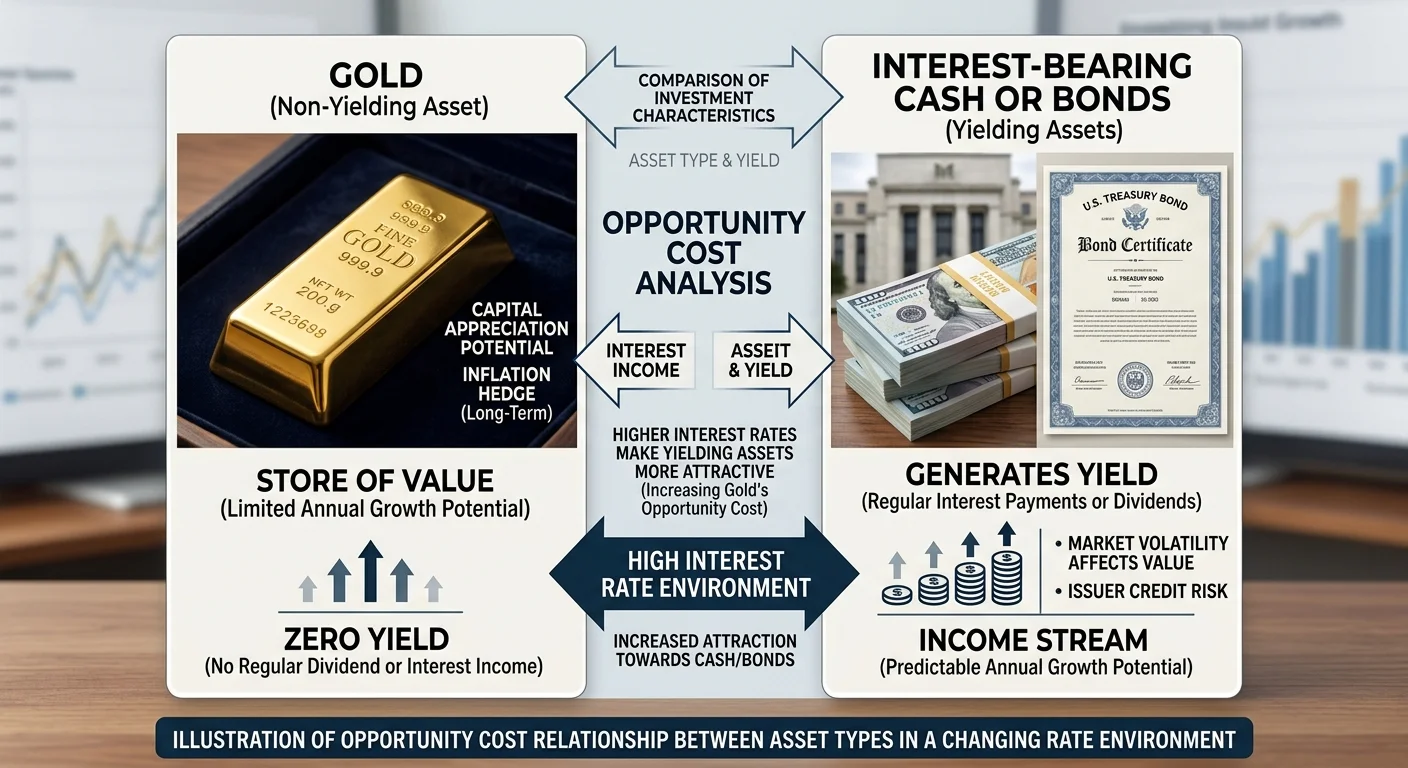
Real Interest Rates Matter More Than the Headline Number
One of the most common oversimplifications is treating the nominal interest rate — the number the Federal Reserve actually sets — as the whole story. What tends to matter more to gold’s price is the real interest rate: the nominal rate minus inflation. If interest rates are falling but inflation is falling just as fast, the real rate may not move much at all, and gold’s incentive structure doesn’t change dramatically either. But if the Fed cuts rates while inflation stays elevated, real rates can fall sharply — sometimes into negative territory, meaning the interest earned on cash doesn’t even keep pace with rising prices. Negative or deeply low real rates have historically coincided with some of gold’s strongest periods, because holding cash in that environment means guaranteed erosion of purchasing power, while gold has no such structural decay. This distinction explains why gold sometimes rallies hard during a rate-cutting cycle and other times barely reacts: the headline rate cut matters less than what’s happening to real, inflation-adjusted returns at the same time.The Dollar Connection
Interest rate changes also move gold indirectly, through the U.S. dollar. Gold is priced globally in dollars, and interest rates are one of the primary forces driving currency values. Higher U.S. rates tend to attract foreign capital seeking better returns, which increases demand for dollars and tends to strengthen the currency. A stronger dollar makes gold more expensive for buyers holding other currencies, which can dampen international demand and put downward pressure on the dollar price of gold. When the Fed cuts rates, that dynamic can work in reverse: a weaker dollar makes gold cheaper for international buyers, which can support demand and prices even independent of the opportunity-cost effect described above. This is why traders watching the Fed rate cuts gold price effect often watch the U.S. Dollar Index alongside gold prices — the two are frequently moving in response to the same underlying rate decisions.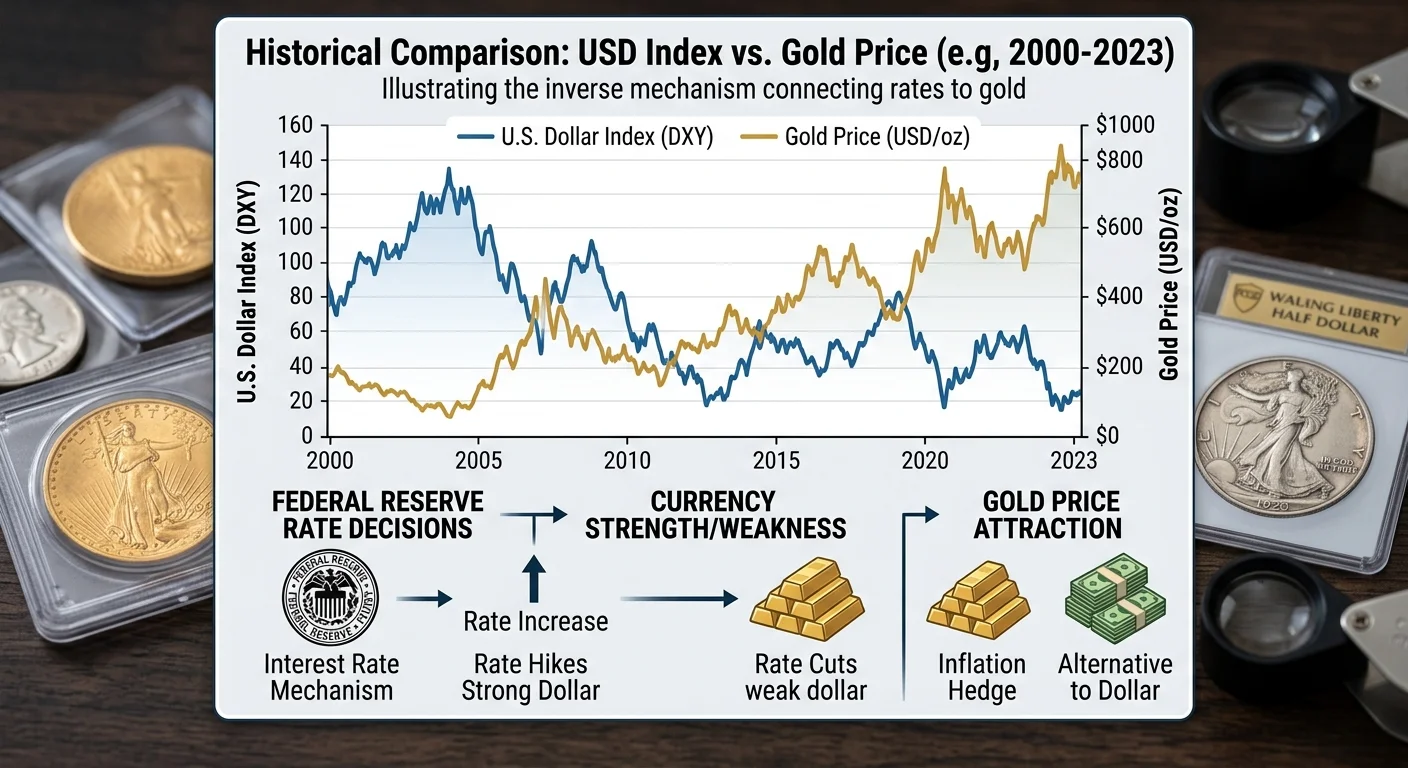
What History Shows — With the Right Caveats
Looking at past rate-cutting cycles is genuinely useful, as long as it’s done carefully and each period is treated as its own event rather than proof of a universal rule. During the 2007–2008 financial crisis, the Federal Reserve cut rates aggressively as the economy weakened. Gold’s price rose meaningfully over that stretch, though the move wasn’t perfectly smooth — gold actually fell sharply for a period in late 2008 alongside a broad liquidity crunch that hit nearly every asset class, gold included, before resuming its climb as the crisis response unfolded. That episode is a useful reminder that a rate-cutting cycle triggered by acute financial stress can produce more volatility in gold, not just a steady rise. The 2019–2020 cutting cycle offers a cleaner example. The Fed cut rates three times in 2019 as a preemptive move amid slowing global growth, then slashed rates to near zero in March 2020 as the pandemic hit. Gold rose substantially across that stretch, reaching a new all-time high in August 2020, supported by the combination of falling real rates, aggressive monetary stimulus, and broad economic uncertainty — several of the reinforcing factors described above arriving at once. The Fed began a more recent cutting cycle in September 2025, lowering its benchmark rate for the first time since earlier reductions, with additional cuts following before the end of that year. As with prior cycles, gold and silver responded to a mix of factors beyond the rate decisions alone — including inflation expectations, currency movements, and broader demand for safe-haven and inflation-hedging assets. By 2026, the pace of further cuts had become a genuinely contested question among Fed officials themselves, illustrating that a cutting cycle doesn’t move in a straight line, and neither does gold’s response to it. The consistent lesson across these periods isn’t that rate cuts guarantee a gold rally. It’s that rate cuts tend to remove headwinds and can add tailwinds, but the size and timing of gold’s response depends heavily on what else is happening in the economy at the same time — inflation trends, currency strength, geopolitical stress, and overall investor demand for safe assets.Why Silver Often Moves Differently Than Gold
Silver tends to track gold’s general direction during rate-driven moves, but usually with more volatility in both directions. Part of this comes down to silver’s dual identity: it’s held as a monetary and inflation-hedge asset much like gold, but it also has substantial industrial demand, particularly in electronics, solar panel manufacturing, and other manufacturing applications. That industrial component means silver’s price responds not just to the same interest-rate and currency dynamics affecting gold, but also to expectations about economic growth and manufacturing activity — which interest rate decisions influence in their own right. A rate cut aimed at supporting a slowing economy can be read two ways for silver: positively, through the same reduced-opportunity-cost and weaker-dollar effects benefiting gold, but with added uncertainty if the rate cut also signals concern about industrial demand weakening. This tension is part of why silver’s price swings, in percentage terms, are typically larger than gold’s during major rate-driven moves — a pattern often described in the market as silver’s higher beta relative to gold.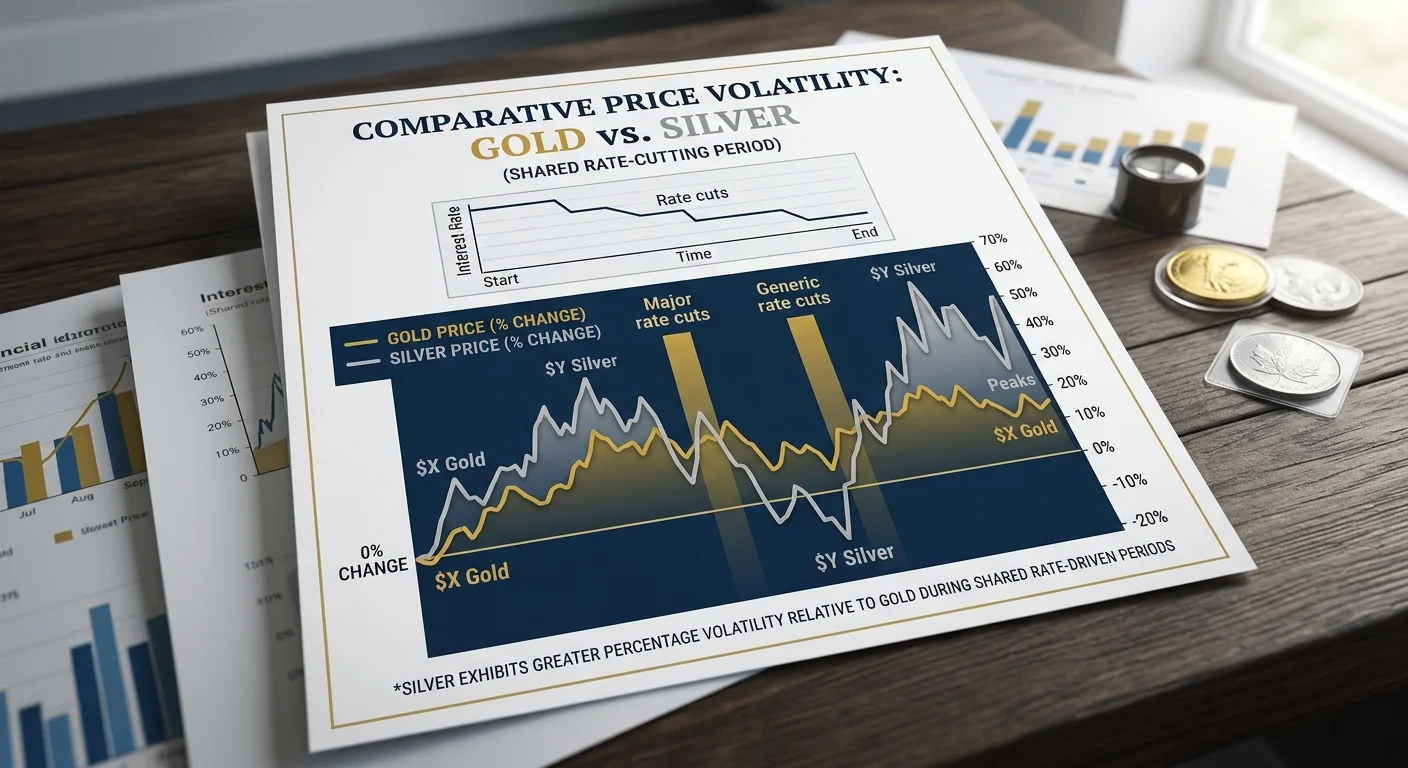
What This Means for Coin and Bullion Buyers
For someone holding or considering gold and silver coins or bullion, the practical takeaway isn’t to try to precisely time purchases or sales around Fed meetings — a difficult exercise even for professional traders. It’s to understand that rate decisions are one input among several that shape precious metals demand and pricing, and that headlines announcing a single rate cut rarely tell the whole story on their own. This matters for both bullion and numismatic coins, though the connection is more direct for bullion. A common-date bullion coin’s price tracks spot metal prices closely — reflecting the same gold silver premium over spot dynamics — so the interest-rate effects described above flow through to its price in a fairly direct way. A certified rare coin — such as a certified pre-1933 U.S. gold coin — carries a numismatic premium tied to rarity, condition, and collector demand that moves largely independent of interest rate cycles.— a scarce, high-grade coin’s collector value doesn’t rise or fall with a Fed announcement the way a generic silver round’s bullion value does. As a hypothetical illustration: a collector holding both a stack of common-date silver bullion coins and a single certified, high-grade rare coin would likely see the bullion coins’ value shift with broader precious metals market movements tied to rate decisions, while the rare coin’s numismatic premium remains driven mainly by its own scarcity and collector demand, largely independent of what the Fed does at its next meeting.A Practical Way to Think About the Relationship
Rather than asking simply “will this rate cut send gold higher,” a more useful set of questions includes: what’s happening to inflation alongside this rate move, since real rates matter more than the headline number? What’s happening to the dollar, since currency strength is a direct pass-through to gold’s price for international buyers? And is this cut happening because of acute economic stress, in which case gold may see more volatility even if it ultimately trends higher, or is it a calmer, preemptive adjustment? Working through those questions gives a far more useful read on the Fed rate cuts gold price effect than treating it as an automatic, one-directional rule — because history shows it very much isn’t.Getting an Accurate Picture of Your Holdings
Whether you’re holding bullion, certified coins, or a mix of both, understanding how much of your holdings’ value is tied to spot metal movements versus independent numismatic value matters for any decision about buying, holding, or selling — especially during periods when interest rate policy is actively shifting. DEI Gold and Silver Coins provides a free coin appraisal in Las Vegas that separates bullion value from numismatic premium, helping collectors and investors understand exactly what they hold before making a decision.Conclusion
The link between Fed interest rate decisions and precious metals prices is real, but it works through several channels at once — opportunity cost, real interest rates, currency strength, and broader economic conditions — rather than through a single, simple lever. Understanding those channels, and recognizing that gold and silver often respond differently from each other even to the same rate decision, gives collectors and investors a far more grounded framework than the oversimplified headlines usually offer.Beyond helping sellers evaluate offers with confidence, DEI Gold and Silver Coins also connects with the wider Las Vegas numismatic community through the coin shows it proudly supports.
DEI Gold and Silver Coins is the official sponsor of these shows.
Held and produced by CK Shows, Las Vegas, NV.
IG @CKShows
702-528-2091By DEI Gold and Silver Coins | Articles by DEI Gold and Silver Coins