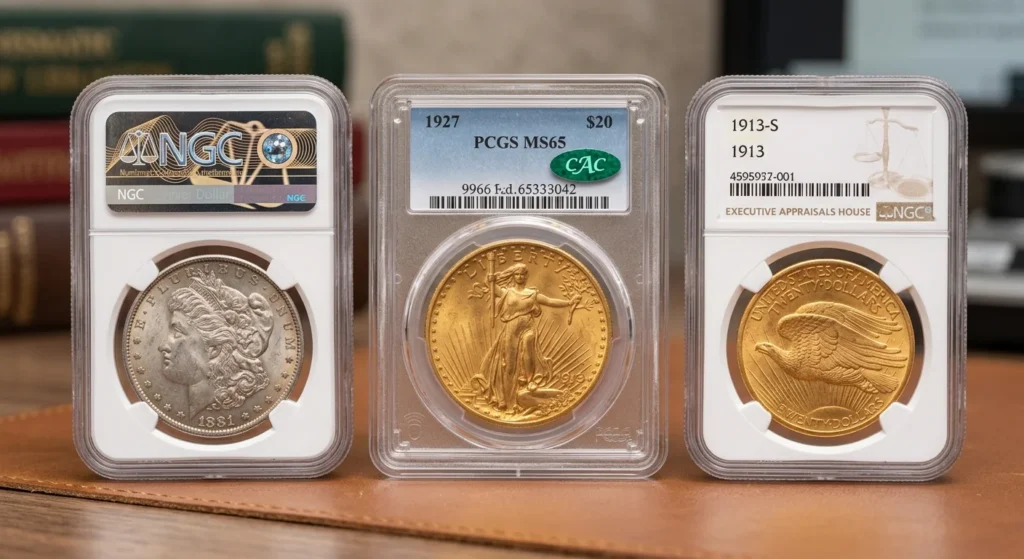
Two identical-looking coins sit in matching plastic holders. Both say MS-65. One sells for noticeably more than the other. The difference often comes down to a small sticker, a different logo on the label, or a quality gap the grade itself doesn’t capture. That is the puzzle behind PCGS vs NGC vs CAC grading.
These three names get lumped together, but they do different jobs. Two of them authenticate and grade coins. One reviews coins that have already been graded. This guide covers coin grading services explained in plain terms: what each verifies, what none of them verifies, and how to read a holder before you buy or sell.
Three Names, Three Different Jobs
The short version is this. PCGS and NGC are third-party grading services. Each examines a coin, decides whether it is genuine, assigns a grade, and seals it in a tamper-evident holder. CAC began as something different: a second-opinion service that reviews coins already graded by PCGS or NGC and marks the ones it considers strong for their grade with a sticker.
Confusing the roles causes most of the misunderstandings. A CAC sticker is not a grade. A PCGS or NGC label is not a price. And none of the three is a promise about what a coin will be worth next year.
Where Third-Party Grading Came From
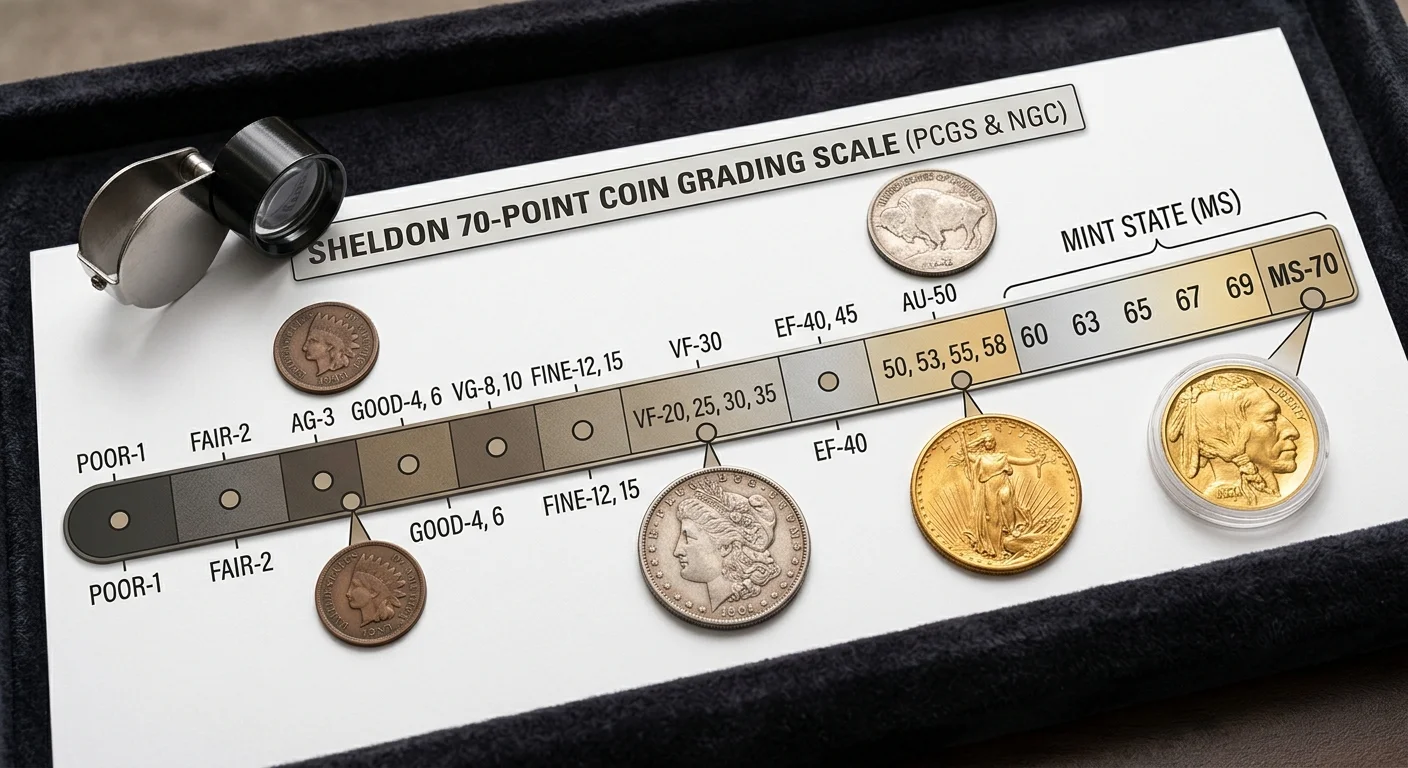
Before third-party grading, a coin’s grade was whatever the seller said it was. The 70-point scale collectors use today traces to Dr. William Sheldon in the late 1940s, who built it for large cents, and it gradually spread across U.S. coinage. It gave the hobby a shared vocabulary, but the word “MS-63” from one dealer could mean something quite different from another’s.
The market’s answer was independent grading. PCGS was founded by a group of seven dealers, including David Hall, to standardize grading, and it began operations on February 3, 1986. NGC followed in 1987. Their holders, informally called slabs, sealed the coin and its grade together, which allowed collectors to buy without seeing the coin in person.
What PCGS and NGC Actually Verify
Both services do the same core work, and it helps to separate the pieces.
Authentication. Is the coin genuine, and has it been altered or repaired? A counterfeit or tampered coin does not get a normal grade.
Grade. Graders assess wear, luster, strike, surface preservation and marks, then assign a number on the Sheldon scale. Mint State coins run from MS-60 to MS-70, and Proof coins use a parallel PR scale.
Attribution. The label identifies the coin: date, mintmark, denomination and, where relevant, a die variety or overdate.
Problem detection. If a coin has been cleaned, altered or damaged, it typically does not receive a numerical grade. Such coins are given a general grade and are commonly called “details” coins, which usually carry lower value to collectors.
Encapsulation and record-keeping. The coin is sealed in a tamper-evident holder with a certification number on the label. That number ties the coin to the service’s records, and each service publishes population data showing how many examples it has graded at each level.
Some designations add nuance. PCGS uses a plus designation, and NGC uses a star designation for exceptional eye appeal. Both are ways of saying that a coin stands out within its grade.
Each service also offers a grading guarantee. The terms and limits differ, so read the current policy on the service’s own site before relying on it.
What CAC Adds
CAC, the Certified Acceptance Corporation, was founded in 2007 by John Albanese working with a group of numismatic leaders. Its original job was narrow: look at a coin already in a PCGS or NGC holder and judge whether it deserves a sticker.
A green sticker means the coin is solid for the grade it was assigned. A gold sticker means the coin exceeds the assigned grade, so it would earn a green sticker at the next numeric grade. CAC does not issue its own numerical grade for this service, and it does not re-encapsulate the coin.
Three points are worth knowing:
- No sticker does not mean a bad coin. Many correctly graded coins that are average or low-end for their grade do not get a sticker, and CAC’s own materials treat a review without a sticker as a private matter for the owner.
- Scope is limited. CAC accepts most numismatically valuable coins but not modern or bullion coins
- CACG is a separate service. CACG launched in 2023 as a full-service authentication, grading and encapsulation option, so CAC now also grades coins itself in its own holders. That is different from the sticker.
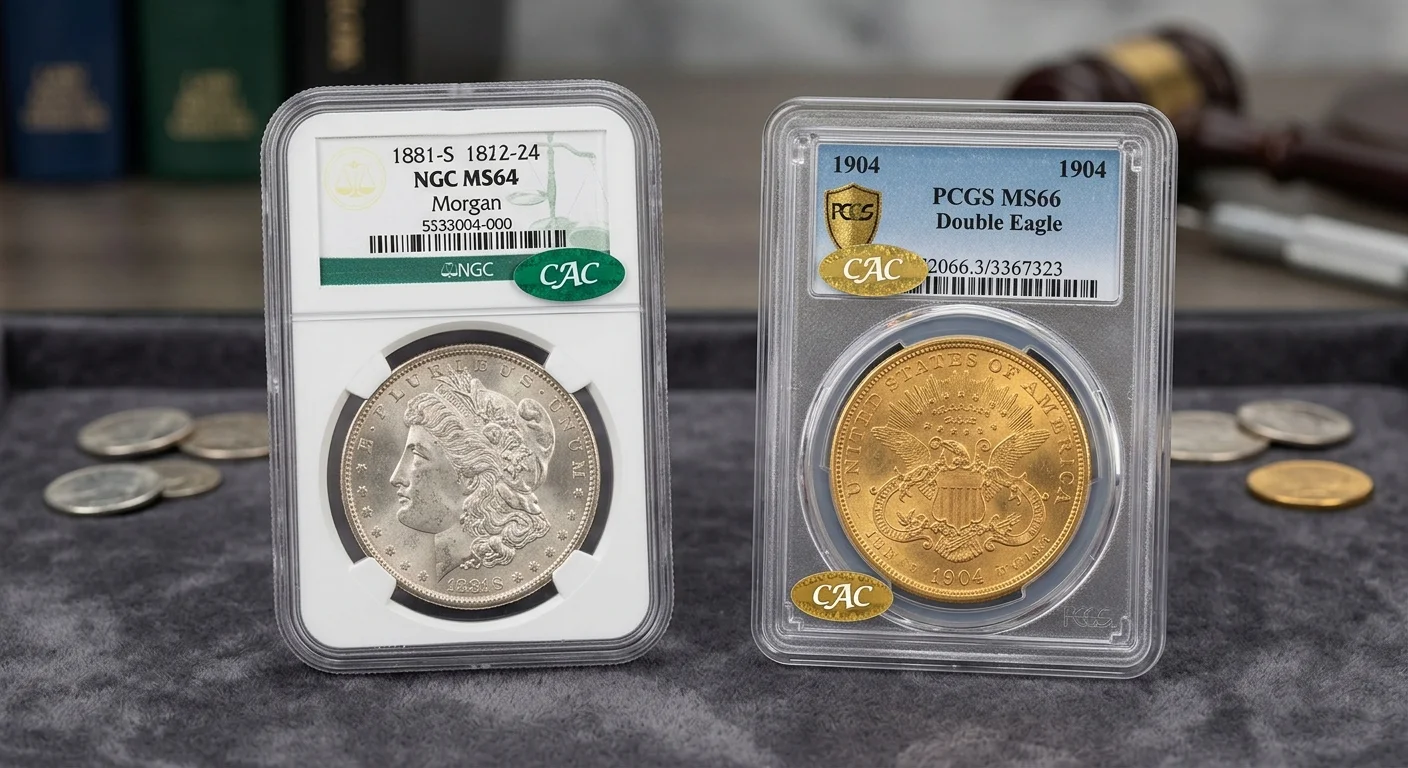
PCGS vs NGC vs CAC Grading: Side by Side
| PCGS | NGC | CAC (sticker) | |
|---|---|---|---|
| Began | Operations in 1986 | 1987 | 2007 |
| Authenticates? | Yes | Yes | Reviews coins already authenticated |
| Assigns a grade? | Yes | Yes | No, evaluates the existing grade |
| Seals the coin? | Yes | Yes | No, adds a sticker to another service’s holder |
| Answers | Is it genuine, and what is the grade? | Is it genuine, and what is the grade? | Is this a solid or strong coin for that grade? |
What Grading Services Do Not Verify
A certified coin carries useful information, but there are limits worth knowing.
Price. No service sets or guarantees market value. A grade helps establish what a coin is, and the market decides what it is worth.
The future. A high grade or a sticker is not a forecast of appreciation.
Eye appeal in full. Two coins can share a grade and still differ in luster, toning and strike. That variation is the entire reason CAC exists.
Consistency across time. Grading standards shift and opinions differ. Coins are sometimes resubmitted and come back with a different grade.
That the holder is genuine. Counterfeit slabs exist. Verify the certification number using the issuing service’s own lookup tool before paying for a valuable coin.
Why Same-Grade Coins Sell for Different Prices
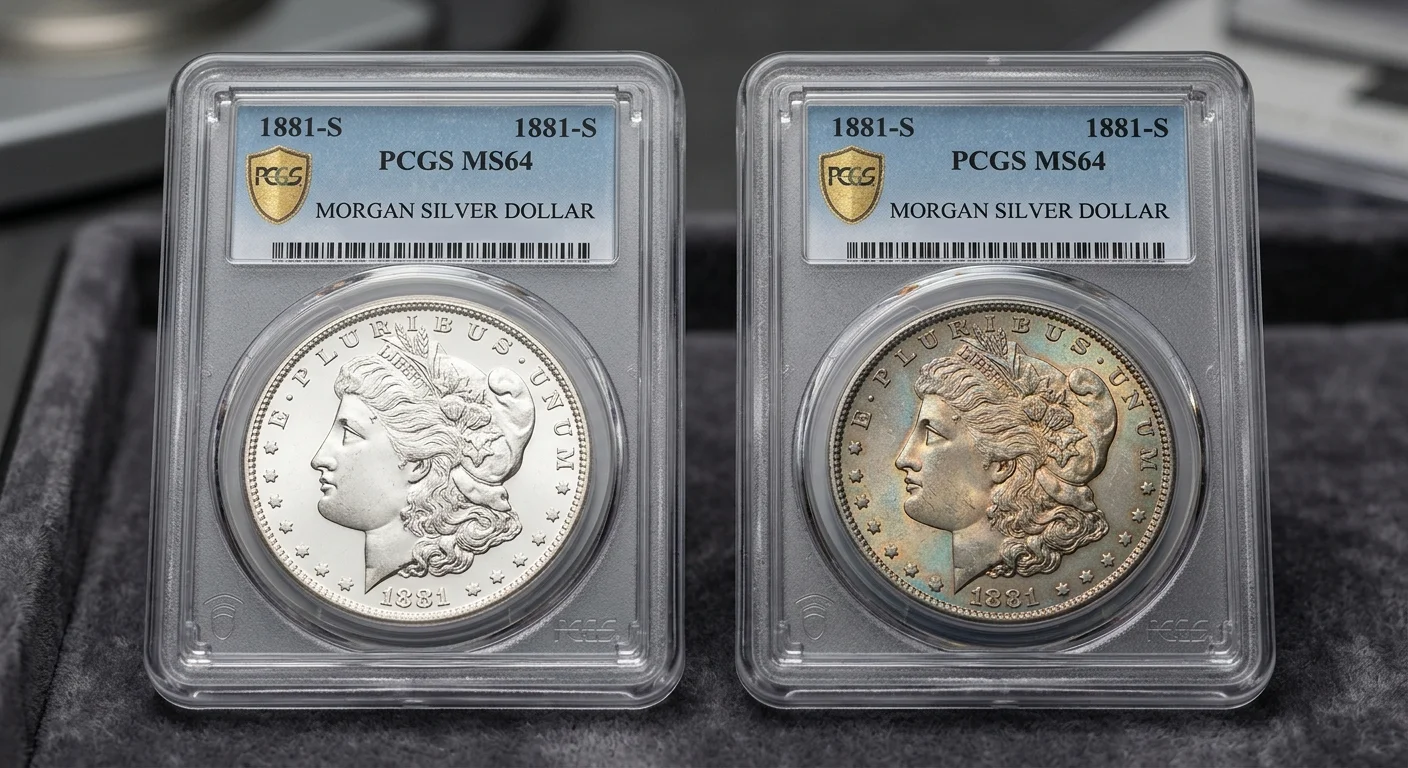
Grades are ranges, not points. Within MS-65, a coin near the top of the range and a coin at the bottom carry the same number. Buyers who have looked at many coins learn to see the difference, and that is where the market’s premiums come from.
CAC’s own materials illustrate this with Saint-Gaudens double eagles. The point is that a sticker matters most when few coins of a given date meet the standard. If only a fraction of submitted examples of a scarce date qualify, the sticker separates the coin from the pack. When many nice examples exist, the same sticker earns a smaller premium. Premiums are set by the market and vary widely by coin, date and moment, so no single percentage applies.
A Hypothetical Example
This scenario is illustrative, not a real transaction.
A collector is choosing between two MS-65 coins of the same date. One is in a PCGS holder with no sticker. The other is in an NGC holder with a green CAC sticker. The asking prices differ.
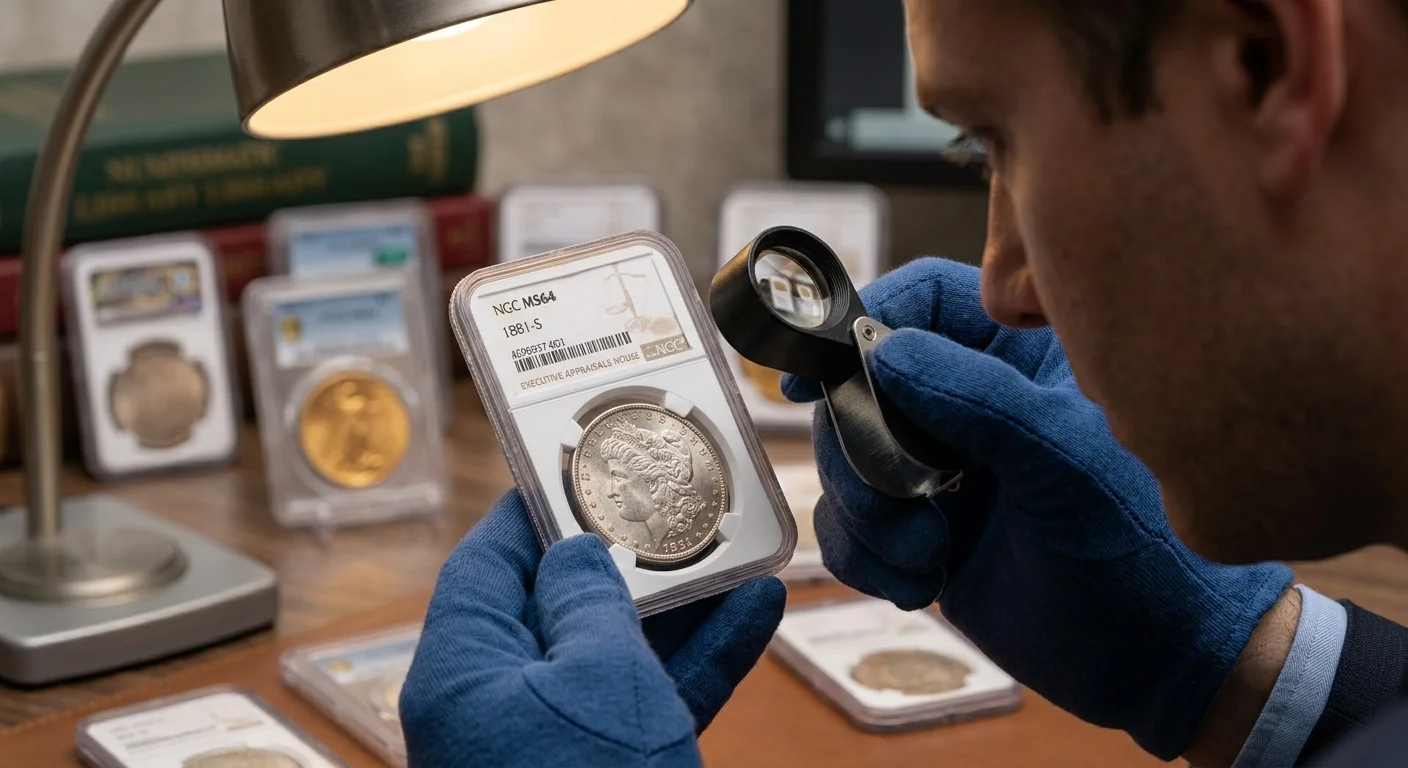
Neither holder guarantees the better buy. What the sticker adds is a second qualified opinion that the coin is strong for its grade. What the lower price on the unstickered coin might reflect is a coin that is fine but plainer. The collector who examines both under a light, checks the certification numbers, and asks how each was priced has learned far more than any label can tell.
Tips for Buyers and Sellers
- Read the whole label. Grade, date, mintmark, variety and any designation all matter.
- Check the certification number through the issuing service before buying a significant coin.
- Look at the coin, not just the holder. Eye appeal is still your call.
- Do not clean coins. Cleaning can turn a valuable coin into a details coin.
- Ask about a sticker’s absence. A coin without a sticker may simply not have been submitted.
- Learn the vocabulary. DEI Gold and Silver Coins keeps a glossary of numismatic terms and a category of articles on coin grading, authentication and preservation.
How DEI Gold and Silver Coins Uses Grading
DEI Gold and Silver Coins is a Las Vegas coin dealer that buys, sells and appraises gold coins, silver coins, rare coins, bullion, paper money and fine jewelry. The company lists CAC, NGC and PCGS among the credentials behind its evaluations, and it offers certified gold coins and certified silver coins.
For collections that include raw or certified coins, its free and confidential appraisal service is a way to learn what you have before deciding whether certification, a sticker or a sale makes sense. Appointments can be set by calling or texting 702-460-5188.
Conclusion
PCGS and NGC answer whether a coin is genuine and what grade it earned. CAC answers a narrower question: whether that grade is a strong one. Together they give collectors three layers of information, but none of them replaces looking at the coin, understanding the market, and asking questions.
Knowing what each label verifies, and what it leaves open, makes you a better buyer, a better seller and a more confident collector.
Seeing certified coins in person, holder and sticker included, is one of the best ways to learn what grading means, and Las Vegas collectors can do that at coin shows produced by CK Shows. Confirm dates and details with CK Shows before you go.
DEI Gold and Silver Coins is the official sponsor of these shows.
Held and produced by CK Shows, Las Vegas, NV.
IG @CKShows
By DEI Gold and Silver Coins | Articles by DEI Gold and Silver Coins