Gold is supposed to rise when inflation does. In the fall of 2026, it has been doing the opposite. Spot gold slipped to roughly $4,086 to $4,093 an ounce on October 14, 2026, the same day the government reported that September inflation had come in hotter than expected. That is the paradox behind why is gold price falling: a hot inflation number pushed gold down, not up.
The explanation is not that inflation stopped mattering. It is that gold is currently trading on what the Federal Reserve does next, not on the inflation number itself. This article walks through the 2026 rate-hike paradox, what it means for anyone holding gold coins or bullion, and why collectible coins answer to a different set of questions entirely.
What Happened in October 2026
The sequence is worth laying out plainly, because it explains the paradox better than any single headline.
On October 14, 2026, gold fell to roughly $4,086 to $4,093 an ounce after September’s consumer price data showed headline inflation at 3.7% and core inflation at 2.6%, both above what had been expected. Normally, a hot inflation print is read as bullish for gold, since gold is often described as an inflation hedge. Instead, the report pushed gold lower. discoveryalert
Why? The hot reading raised the odds that the Federal Reserve would raise interest rates again, and gold fell on that expectation rather than on the inflation number itself. Higher interest rates make gold less attractive because gold pays no yield of its own. When bonds and savings accounts offer more competitive returns, holding non-yielding bullion carries a higher opportunity cost. The Fed had already raised its benchmark rate by 25 basis points in September, to a range of 3.75% to 4.00%. discoveryalertaol

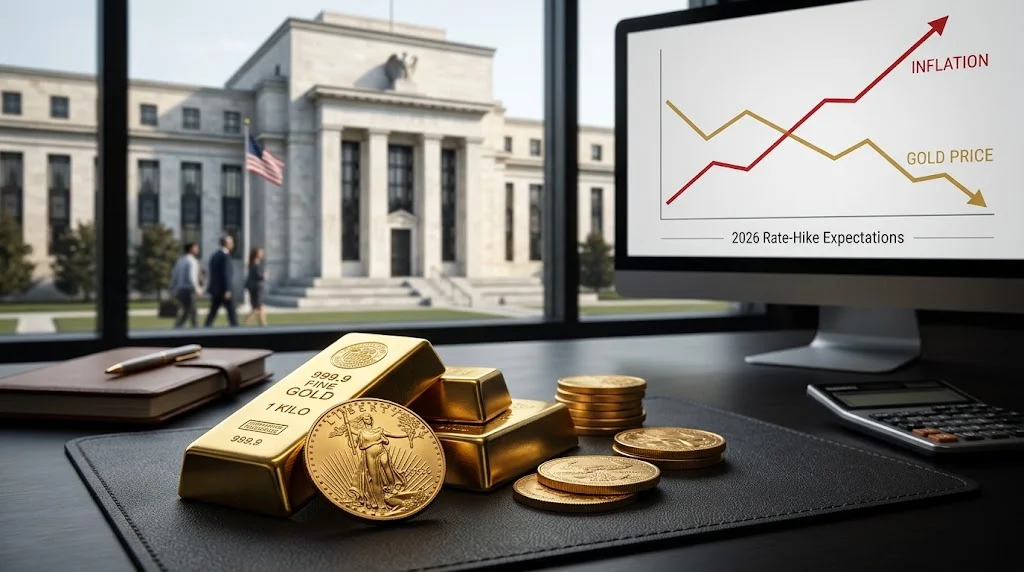
Sourcing note: build this as an original graphic from the dates and figures cited in the article, not copied from another site.
By October 7, 2026, spot gold had closed at $4,109.90, down 1.28% for the session and its lowest level since August 5, 2026, after Fed meeting minutes released that month stated that most participants believed another rate increase would likely be appropriate by year end. That pullback followed a sharp run-up earlier in the year: gold had set a record of $5,589.38 on January 28, 2026, and had fallen roughly 26% from that peak by early October. 247wallst247wallst
As of October 20, 2026, the story continued. Spot gold slipped 0.3% to $4,126.84 an ounce in early trading, with a firm US dollar and elevated Treasury yields weighing on the metal as investors awaited the Fed’s October 27–28 policy meeting, where officials were expected to leave rates unchanged this time. Traders were pricing an 83% chance the Fed would hold rates steady that month, while odds of a December hike stood near 94%. Gold slips as investors weigh Fed rate outlook – Markets – Business Recorder +2
These are recent, dated figures, not a live quote. Gold moves daily, so check a current spot price before making any decision based on this article.
The Mechanics: Why Rate Expectations Beat Inflation Headlines
Gold’s relationship with interest rates comes down to a simple trade-off. Gold produces no income. A bond, a savings account, or a money market fund does. When interest rates rise, those yield-bearing alternatives become more attractive relative to gold, and some investors shift money away from bullion toward them.
Inflation is supposed to work in gold’s favor because it erodes the purchasing power of cash and bonds alike. But when inflation runs hot enough to push a central bank toward raising rates, two forces point in opposite directions at once: inflation argues for owning gold, while higher rates argue against it. In October 2026, the rate-expectation effect won out, and the market read hot inflation as more hikes rather than more inflation hedging. discoveryalert
That is the paradox in a sentence: gold was not trading on inflation fear, it was trading on the Fed’s expected response to that inflation.
A firm dollar reinforced the same move. A stronger dollar makes gold, which is priced in dollars, more expensive for buyers using other currencies, which can soften demand and pressure the price further. Analysts watching the market noted that the tone of the Fed’s guidance, not just whether it raised rates, would matter for gold’s next move. brecorder
Historical Context: Gold Has Danced With the Fed Before
This is not the first time gold has moved on interest-rate expectations rather than on inflation headlines. Through much of the late twentieth century, periods of aggressive Fed tightening tended to cap gold’s gains even when inflation was elevated, because rising yields raised the opportunity cost of holding a non-yielding asset. The pattern reversed during periods of rate cuts and near-zero rates, when gold often performed strongly even as inflation stayed moderate.
What makes the current stretch notable is the speed of the swing. Gold went from a record high above $5,500 in January 2026 to a roughly 26% pullback within months, then kept drifting lower into October on renewed hike expectations. That kind of volatility is a reminder that gold prices reflect expectations about monetary policy as much as they reflect the inflation data itself. 247wallst
What This Means If You Hold Bullion or Bullion Coins
For modern bullion coins, the metal content is most of the price, so these swings matter directly. A pullback from a record high changes what an ounce of gold is worth today versus a few months ago.
A few habits help when prices are volatile:
- Watch the spot price, not the headline. A single inflation report or Fed statement can move gold quickly in either direction.
- Understand the premium you pay. The price you pay over spot reflects minting, distribution and dealer costs, not just the metal. DEI Gold and Silver Coins explains this in its guide to what you pay over spot when buying gold or silver.
- Think in terms of your own timeline. Short-term price swings matter more to someone trading actively than to someone holding for years.
This article is educational, not investment advice. For decisions involving significant money, a qualified financial professional can help weigh your specific situation.
What This Means for Collectible Coins
Here the picture changes. A collectible coin’s value is not just its melt value. It is shaped by numismatic value: rarity, condition, certification, eye appeal, provenance and collector demand.
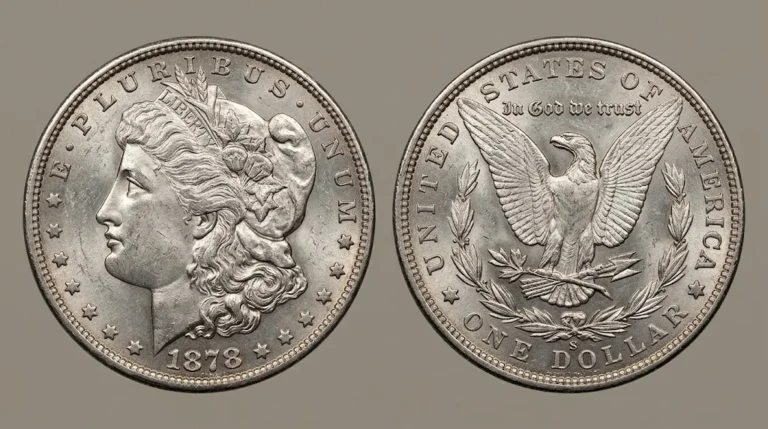
Sourcing note: use an original photo or a licensed image from a grading service or auction house after confirming usage rights.
A scarce, high-grade, PCGS- or NGC-certified coin does not move dollar-for-dollar with spot gold. Its price is set largely by how many collectors want that specific date, mintmark and grade, and how few exist. A common-date bullion-type gold coin tracks spot much more closely, since its price is mostly metal plus a modest premium.
That distinction matters most during a stretch like this one. A buyer or seller focused only on the spot price may misjudge what a certified rarity is actually worth, in either direction. The gap between bullion value and numismatic value is explained further in DEI Gold and Silver Coins’ article on scrap gold vs. collectible coins.
A Hypothetical Example
This scenario is illustrative, not a real transaction.
Imagine a collector who bought a common-date gold bullion coin near gold’s January 2026 record and also owns a certified, scarce-date gold coin inherited from a relative. By October, the bullion coin’s value has fallen with spot gold, roughly tracking the broader pullback. The certified rarity’s value depends on a different question entirely: what collectors are currently willing to pay for that date and grade, which may have moved very little, a lot, or not at all, independent of what spot gold did.
The lesson is not that one holding is better than the other. It is that they answer to different forces, and conflating them leads to the wrong read on either one.
How DEI GOLD AND SILVER COINS Approaches a Moving Market
DEI GOLD AND SILVER COINS is a Las Vegas coin dealer that buys, sells and appraises gold coins, silver coins, rare coins, bullion, paper money and fine jewelry. In a market where spot prices are moving on Fed expectations as much as on inflation data, the company’s role is to help separate metal value from collector value for each coin or collection.
Its free and confidential appraisal service is built for exactly that kind of sorting, whether the holding is bullion, a semi-numismatic coin, or a certified rarity. Appointments can be set by calling or texting 702-460-5188.
Conclusion
Gold fell in October 2026 on a hot inflation report because the market was reading the number through the lens of what the Federal Reserve would do next, not as a simple inflation hedge. That is the rate-hike paradox: inflation and interest-rate expectations can pull gold in opposite directions, and in this stretch, rate expectations won.
For bullion holders, that means watching the Fed as closely as the inflation data. For collectors, it is a reminder that rarity and grade answer to a different market than spot price does, and the two should never be confused with each other.
DEI GOLD AND SILVER COINS is the official sponsor of the CK Shows coin shows in Las Vegas. See show dates and what to bring.
By DEI Gold and Silver Coins | Articles by DEI Gold and Silver Coins