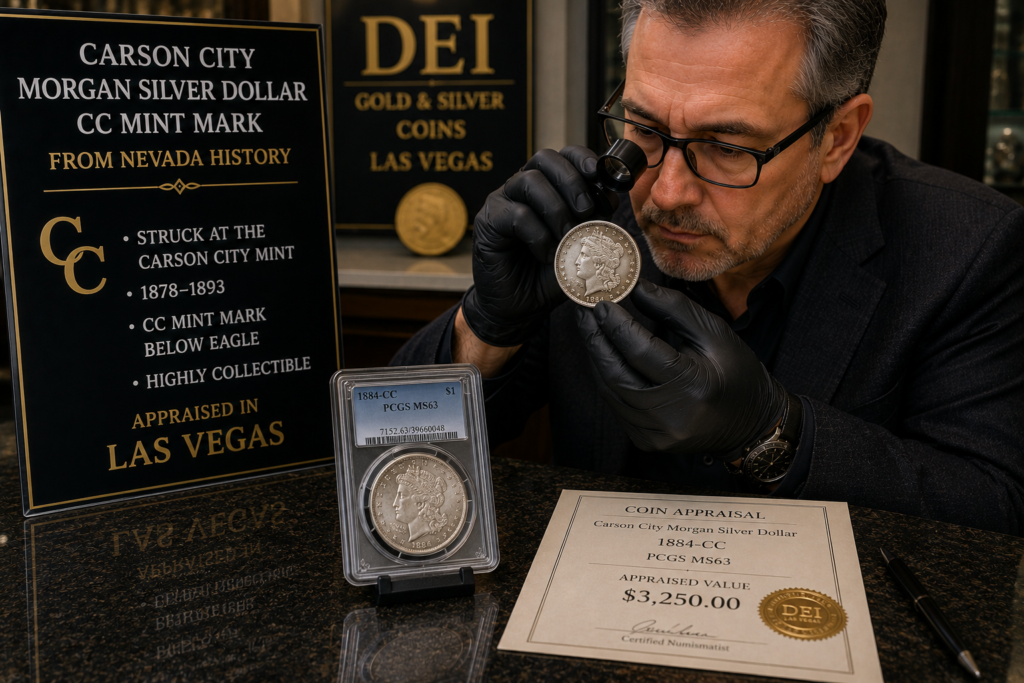
A Henderson family brought in their late father’s coin album last year, and tucked into one of the plastic sleeves was a Morgan dollar with a small “CC” stamped beneath the eagle. They had no idea what it meant — but that tiny mint mark alone can be the difference between a coin worth $35 and one worth thousands. Carson City silver dollars carry a mystique that no other U.S. mint’s coinage quite matches, and as a Nevada-based dealer, we get asked about them more than almost any other series.
This guide covers where Carson City dollars came from, what actually drives their value, and how to know if the one in your collection — or your parents’ — is worth real money.
The History Behind Carson City Silver Dollars
The story starts with the Comstock Lode, the massive silver and gold strike discovered beneath Virginia City, Nevada, in 1859 — one of the richest precious metal deposits in American history. To process that silver locally rather than shipping it out of state, Congress authorized the Carson City Mint, which opened in 1870 and operated intermittently until it closed for good in 1893.
Carson City struck Morgan silver dollars from the series’ debut in 1878 through 1885, then again from 1889 through the mint’s final year in 1893. Because Carson City produced far fewer coins than the Philadelphia, San Francisco, or New Orleans mints, and because much of that mintage was later melted, every CC-marked dollar carries a built-in scarcity that collectors have chased for well over a century.
What Drives CC Mint Mark Coin Value
CC mint mark coin value isn’t just about age — it comes down to a combination of mintage, survival rate, and condition, and those three factors don’t always line up the way you’d expect.
Mintage Numbers Don’t Tell the Whole Story
A coin with a relatively high mintage can still be scarce today if a large share of that mintage was melted down or heavily circulated. The 1879-CC, for example, had a mintage of 756,000 — not tiny by Morgan dollar standards — but heavy circulation and melting left far fewer surviving examples than the mintage number suggests, making it one of the scarcest dates from the 1878–1885 run.
Key Dates: 1889-CC, 1893-CC, and 1879-CC
Three dates stand above the rest of the Carson City series:
1889-CC — widely considered the single most difficult Carson City Morgan to find in mint state, with combined PCGS/NGC certified populations far below most other dates in the series. Circulated examples can bring several thousand dollars, and gem mint-state coins have sold at auction for well into six figures.
1893-CC — the final year of Carson City production, combining genuine rarity with the sentimental weight of being the mint’s last silver dollar issue.
1879-CC — the scarcest date of the earlier 1878–1885 run, despite a mintage that looks unremarkable on paper.
By contrast, more common dates — such as 1882-CC through 1885-CC and 1890-CC through 1891-CC — are far more accessible to new collectors, especially in certified mint-state condition.
The GSA Hoard: Why So Many CC Dollars Survive in Mint State
One reason Carson City dollars are unusually well represented in high grades traces back to a discovery in U.S. Treasury vaults: roughly 2.8 million Morgan dollars, more than 95% of them bearing the CC mint mark, had simply never been released into circulation. In 1970, Congress authorized the General Services Administration (GSA) to sell these coins to the public, and a series of sales through the 1970s brought over $100 million and reshaped the entire Carson City Morgan market almost overnight.
Coins from this hoard are still sometimes found in their original GSA holders, and that original packaging can itself add collector value, since it documents an unbroken chain of custody back to the U.S. Mint.
Grading and Authentication: Why Certification Matters More for CC Coins
Because the price gap between grades can be enormous — a common CC date might jump from a few hundred dollars to several thousand between circulated and gem mint-state condition — third-party grading from services like NGC or PCGS isn’t optional for anything beyond a casual purchase. Certification also protects against altered or artificially toned coins, and against counterfeit CC mint marks added to genuine Philadelphia-struck dollars, which does happen given how much value that small “CC” stamp can add.
Building a Carson City Silver Dollar Collection
For collectors just getting started, a sensible approach looks like this:
Start with common dates (1882-CC through 1885-CC) in certified silver coins mint state to learn the series without a major financial commitment.
Learn to recognize genuine GSA holders, since original packaging carries its own collector demand.
Save key dates for last, once you’re comfortable evaluating strike quality, surface preservation, and authenticity.
Buy only certified or dealer-guaranteed coins once you move beyond the most common dates, given how much a grade — or a fake mint mark — can swing the price.
Selling or Appraising Carson City Dollars in Las Vegas
If you’ve inherited a coin album with CC-marked dollars, or you’re not sure whether what you have is a $40 common date or a four-figure key date, the mint mark alone won’t tell you — grade, strike, and authenticity all factor in. As a Las Vegas dealer with deep roots in Nevada numismatics, we evaluate Carson City dollars regularly, and can tell you within minutes whether a coin warrants certified grading before you sell.
Buy or Sell Gold & Silver Coins with Confidence
Work with a trusted Las Vegas coin dealer offering fair pricing, honest appraisals, and expert guidance every step of the way.
Get Your Carson City Silver Dollars Appraised in Las Vegas
Carson City silver dollars carry a piece of Nevada’s own mining history in every coin — and knowing exactly what you have can mean the difference between a modest sale and a significant one.
Call or text DEI Gold and Silver Coins at (702) 460-5188 to schedule a same-day, private appraisal. Our numismatists will confirm the date, mint mark, and grade of your Carson City dollars and give you an honest value before you decide to sell.
Frequently Asked Questions
“CC” indicates the coin was struck at the Carson City Mint in Nevada, which operated from 1870 to 1893. It’s one of the most collected mint marks in U.S. numismatics because of the mint’s relatively low output and strong ties to the Comstock Lode silver boom.
The 1889-CC is widely regarded as the key date of the entire Carson City series. Even in circulated condition it can bring several thousand dollars, and gem mint-state examples have sold at auction for well over $100,000.
A large hoard of unreleased Morgan dollars, over 95% of them CC-marked, was discovered in U.S. Treasury vaults and sold to the public by the General Services Administration (GSA) between 1972 and 1980. That sale put a significant number of high-grade, never-circulated CC dollars into collectors’ hands.
For anything beyond the most common dates, yes. Because value can swing dramatically between grades, third-party certification from NGC or PCGS gives buyers confidence in both the grade and the authenticity of the mint mark — which typically results in a stronger offer.
The only reliable way is an in-person evaluation from a numismatist who can confirm the date, mint mark authenticity, and grade. Values for the same date can range from well under $100 to five or six figures depending on condition.