A seller walked into our Las Vegas showroom last spring carrying a PCGS-slabbed 1884-O Morgan dollar graded MS-64. He’d been quoted $185 by a pawn shop and thought he was getting a fair deal. He wasn’t. The PCGS Population Report showed only 312 examples certified MS-64 with 847 graded higher — details printed right there on the label he hadn’t fully read. That coin sold at Heritage Auctions for $420. Knowing how to read a PCGS or NGC grading report isn’t optional for sellers. It’s the difference between walking out satisfied and walking out shortchanged.
According to the PCGS CoinFacts database, there are currently over 55 million coins certified across the PCGS and NGC registries combined. With that volume, professional grading reports have become the universal language of the rare coin market — yet most sellers who come through our door have never been walked through what every line on that label actually means. This guide fixes that, section by section.
What Is a PCGS or NGC Grading Report and Why Does It Matter for Sellers?
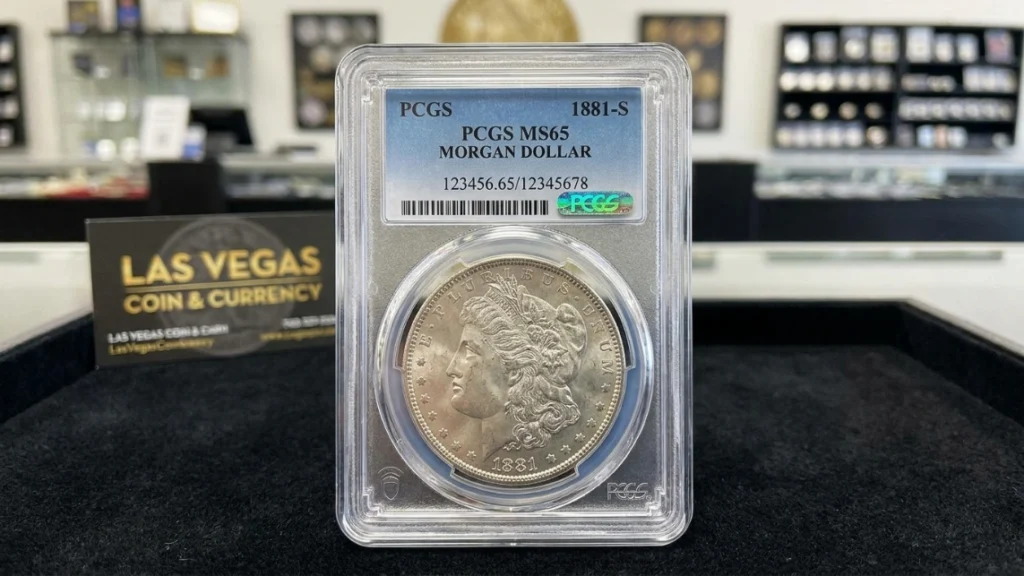
A PCGS or NGC grading report is the printed label sealed inside a tamper-evident plastic holder — commonly called a “slab” — that certifies a coin’s authenticity, grade, and key attributes, providing an independently verified foundation for pricing it accurately in any market.
PCGS (Professional Coin Grading Service, founded 1986 in California) and NGC (Numismatic Guaranty Company, founded 1987 in Florida) are the two most recognized third-party grading services in the United States. Their reports function as a passport for your coin: any dealer, auction house, or collector in the country — including buyers at Heritage Auctions in Dallas, Stack’s Bowers in New York, and GreatCollections in California — accepts their grades as the baseline for any transaction.
When you bring a coin to DEI without a certification, we estimate grade from scratch. When you bring a PCGS or NGC slab, we can immediately cross-reference the label against live market data and give you a precise, defensible offer. That’s why understanding what each field on that label says translates directly into money in your pocket.
The core fields every seller must know: the grade number, the designation, the certification number, the population data, and the special designations (CAC sticker, plus/star grades, etc.). We’ll break down each one.
How to Read the Grade Number on a PCGS or NGC Label
The grade number — displayed prominently on every PCGS and NGC label — is a point on the 70-point Sheldon scale, where 1 means barely identifiable and 70 means a perfect, flawless coin that has never been touched; for sellers, the difference between MS-63 and MS-65 on a common-date Morgan dollar can represent a $150–$400 swing in realized value.
The Sheldon scale groups into broad categories you’ll see abbreviated on labels:
- P (Poor), FR (Fair), AG (About Good): Grades 1–3. Heavily worn, type identifiable.
- G (Good) through F (Fine): Grades 4–12. Circulated but major details clear.
- VF (Very Fine) through AU (About Uncirculated): Grades 20–58. Light to moderate wear.
- MS (Mint State): Grades 60–70. No wear whatsoever — strictly uncirculated.
- PR or PF (Proof): Specially struck collector coins with mirror-like fields.
The practical implication for sellers: every grade point in the MS-60 to MS-65 range has enormous market consequences on scarcer dates. A 1921-S Morgan dollar in MS-63 trades around $275–$325 based on recent PCGS CoinFacts price data. The same coin in MS-65 commands $2,000+. That’s not a rounding error — that’s a completely different asset class.
At DEI, we see sellers undervalue MS-64 coins constantly because the difference between 64 and 65 isn’t visible to the naked eye. On the label, it’s one digit. In your wallet, it can be hundreds of dollars.
Understanding the Coin Designation: Mint State vs. Proof vs. Details Grades
The coin designation — the word or abbreviation appearing alongside the grade number on a PCGS or NGC label — tells you the strike type and whether any problems were noted, with “Details” grades being the single most important warning flag a seller must understand before pricing their coin.
Here’s what you’ll see and what it means:
MS (Mint State): A business-strike coin with no wear. Graded 60–70. PR or PF (Proof): A specially manufactured collector coin with polished dies and frosted devices. Graded 60–70 on the same scale but commands separate, often higher, pricing. SP (Specimen): A presentation strike — rarer than proof but less common than business strike. Separate pricing tier. Details: This is the word that should make every seller pause. “MS-63 Details — Cleaned” or “AU-58 Details — Environmental Damage” means the coin received a technical grade but carries a problem that disqualifies it from a clean numeric grade.
The Details designation is the most misunderstood field on the label at our counter. A coin graded “MS Details — Cleaned” does NOT have an MS-grade value. It has a “problem coin” premium — typically 30–60% below the clean-grade equivalent depending on the date and how visible the issue is. A 1881-S Morgan dollar graded MS-63 trades around $95. The same coin with a Details — Cleaned designation might bring $45–$60. The label says “MS” and sellers often expect MS money. It doesn’t work that way.
How to Read Population Data on a PCGS or NGC Report (The Most Overlooked Field)
Population data on a PCGS or NGC grading report shows exactly how many coins of that specific date, mint mark, and grade have been certified — and this number directly determines market scarcity, which is the primary driver of premium over melt value for collector coins.
You’ll find population data on the PCGS Population Report (pop.pcgs.com) or the NGC Census, not printed directly on the slab label — but you can look it up instantly using the certification number printed on the label. Here’s what to look for:
Pop at Grade: How many coins of this exact date and grade have been certified. Low pop = potential scarcity premium. High pop = pricing closer to the guide value with less upside.
Pop Higher: How many coins of this date have been certified above this grade. A large “pop higher” number means better examples exist in volume, which suppresses demand for your example.
Registry Competition: For coins in the NGC Registry or PCGS Registry Sets, top-pop coins (the finest known) command dramatic premiums over guide value — sometimes 3–5x in competitive series like early American gold or key-date Morgans.
📌 DEI Market Observation: Over the last 18 months, we’ve noticed that coins graded MS-64 with a “pop higher” below 50 consistently realize 20–35% above the published PCGS CoinFacts price guide value at Heritage Auctions, while the same grade with a pop higher above 500 rarely exceeds guide value at all.
A 1903-O Morgan dollar — a classic better date — graded MS-64 with a PCGS pop of 342 at grade and 41 higher recently hammered at $1,950 at Heritage Auctions against a price guide value of $1,400. Population data explained that entire premium. If the seller had walked in unaware of pop data, they might have accepted a guide-price offer without question.
The Certification Number: How to Verify Your PCGS or NGC Slab Is Genuine
The certification number on a PCGS or NGC slab — the alphanumeric code printed on the label, typically 8 digits for PCGS and found in both barcode and printed form for NGC — allows anyone to verify the coin’s authenticity, grade history, and current owner-of-record status in under 60 seconds at no cost.
For PCGS: Go to pcgs.com/verify and enter the cert number. The result will show the coin’s exact specs as graded (date, mint mark, denomination, grade, designation, any special stickers). If the number does not match, the slab is either fake or the label has been tampered with.
For NGC: Go to ngccoin.com/certlookup and do the same. NGC’s system also shows the coin’s encapsulation date and any recognized designations like Star (★) grades for exceptional eye appeal.
🪙 DEI Dealer Observation
In our 50+ years of combined experience buying coins across Las Vegas, Henderson, and from estate collections throughout Southern Nevada, we’ve encountered counterfeit PCGS and NGC slabs more than most sellers expect. Modern fakes are printed with convincing fonts and correct-looking cert numbers — but those numbers don’t verify online. The single fastest way to confirm a slab’s legitimacy before you accept any offer or make any purchase is to run the cert number yourself on the grading service’s website, right in front of the buyer or seller. At DEI, we do this for every slabbed coin that comes through the door, no exceptions. If someone asks you to skip this step, walk away.
Special Designations That Change the Value: CAC, Star Grades, and Plus Grades
Special designations on PCGS and NGC labels — including CAC stickers, Plus (+) grades, and Star (★) designations — signal that a coin exceeds typical quality for its assigned grade and can command meaningful premiums over standard examples in the same numerical slot.
CAC (Certified Acceptance Corporation) Sticker: A green CAC sticker on the outside of a PCGS or NGC slab means that CAC’s independent review found the coin to be at the high end of its assigned grade — sometimes called a “solid” or “premium quality” example. Gold CAC stickers indicate the coin exceeded its grade. According to CAC’s published data, CAC-approved coins realize on average 20–30% more than non-CAC coins of the same grade in auction. DEI is a CAC-authorized submission dealer and guides collectors through the submission process.
Plus (+) Grade (PCGS): A grade of MS-64+ means the coin narrowly missed MS-65 and sits at the top of the 64 band. In strong series like Morgan dollars or Walking Liberty half dollars, the + grade can add 15–25% to realized value compared to a standard MS-64.
Star (★) Grade (NGC): NGC assigns the star designation to coins with outstanding eye appeal for their grade — exceptional color, luster, and strike. A 1921 Morgan dollar MS-64★ commands more than a standard MS-64, especially in series where eye appeal is a major driver of collector demand.
📊 PCGS vs. NGC Grading Report: Quick Comparison — DEI Quick Reference
| Feature | PCGS | NGC |
|---|---|---|
| Founded | 1986, Newport Beach, CA | 1987, Sarasota, FL |
| Slab Style | Slab with sonically sealed insert | Similar slab, distinct label design |
| Verification URL | pcgs.com/verify | ngccoin.com/certlookup |
| Population Data | PCGS Pop Report (pop.pcgs.com) | NGC Census (ngccoin.com/census) |
| Special Strike Designation | SP (Specimen), PL (Prooflike), DMPL | SP, PL; Star (★) for eye appeal |
| Plus Grade | Yes — MS-64+ available | No direct equivalent |
| Top-Pop Registry | PCGS Set Registry | NGC Registry |
| CAC Accepted | Yes — green/gold sticker on slab exterior | Yes — green/gold sticker on slab exterior |
| Typical Turnaround (Economy) | 20–30 business days | 20–30 business days |
| Accepted for Gold IRA | Yes (meets IRS fineness standards for qualifying coins) | Yes (same) |
How Las Vegas Sellers Can Use a Grading Report to Get the Right Offer
Sellers in Las Vegas, Henderson, and throughout Southern Nevada can use a PCGS or NGC grading report most effectively by cross-referencing the grade, population data, and any special designations against the current PCGS CoinFacts price and NGC Price Guide before accepting any offer — a process that takes under five minutes and virtually eliminates the risk of undervaluing a coin.
Here’s the step-by-step process we walk through with every seller at DEI:
- Run the cert number at pcgs.com/verify or ngccoin.com/certlookup. Confirm the coin is genuine and review the exact designation.
- Check the grade and designation. MS vs. Details is the first fork. If it says Details, adjust your expectations accordingly.
- Look up the population data. Pull the PCGS Pop Report or NGC Census for this date, mint mark, and grade. Note pop at grade and pop higher.
- Check the price guide. PCGS CoinFacts and NGC Price Guide both publish free retail price estimates updated regularly. This is your baseline, not the floor.
- Check recent auction results. Heritage Auctions (ha.com) and GreatCollections both publish free searchable sale archives. Search your exact coin — same date, mint mark, grade, and designation. Three to five recent sales will tell you what the market is actually paying today.
- Note any special designations. CAC sticker? Plus grade? Star designation? Add the appropriate premium to your baseline.
- Bring it to DEI. We offer free appraisals, same-day payment, and pricing grounded in real auction data — not a formula designed to maximize our margin.
Nevada has no state income tax, which means Las Vegas sellers keep more of any coin sale proceeds than sellers in California, New York, or other high-tax states. That’s a meaningful advantage for serious collectors liquidating a collection. For federal tax purposes, coins held over one year are subject to the IRS collectibles rate — a maximum of 28% on long-term capital gains. Consult a tax professional for your specific situation before making large coin sale decisions.
Conclusion
Reading a PCGS or NGC grading report correctly is one of the highest-leverage skills a coin seller can develop — and it takes about ten minutes to learn. Before you walk into any dealership or accept any offer, run the cert number, check the population data, and look up three recent auction results for your exact coin.
The four things that matter most: grade and designation (MS clean grade vs. Details), population at grade (scarcity premium driver), pop higher (competition suppressor), and special designations (CAC, Plus, Star). Those four data points, cross-referenced against the PCGS CoinFacts or NGC Price Guide, tell you everything you need to negotiate with confidence.
If reading a PCGS or NGC grading report still feels complicated, that’s exactly what our free appraisal service is for. Visit DEI Gold & Silver Coins at 8985 S. Eastern Ave, Suite 160, in Las Vegas, or call (702) 460-5188 for a no-pressure, same-day evaluation. We’ll walk through the label with you, run the population data live, and give you a transparent offer backed by current market data.
For your next read: learn how CAC certification works and whether it’s worth submitting your coins, or explore our breakdown of how coin grades affect Gold IRA eligibility for tax-advantaged precious metals investing.
FAQ SECTION
1. What is a PCGS grading report and what does it tell me about my coin?
A PCGS grading report is a label sealed inside a tamper-evident plastic holder certifying your coin’s grade on the 70-point Sheldon scale, its authenticity, designation (Mint State, Proof, or Details), and a certification number you can verify free at pcgs.com/verify. It tells you the coin’s independently assessed condition, which is the primary factor determining its market value.
2. How do I read an NGC coin grading report if I’ve never seen one before?
An NGC grading report shows the coin’s date, mint mark, denomination, grade number (from 1–70), designation (MS, PF, SP, or Details), and an NGC certification number. Look up that number at ngccoin.com/certlookup to confirm authenticity and pull population data from the NGC Census. The grade number and any special designations like Star (★) or Details are the first fields to read.
3. What does “Details” mean on a PCGS or NGC slab, and does it hurt the value? “
Details” on a PCGS or NGC label means the coin has a problem — cleaning, damage, environmental corrosion, or a repair — that prevents it from receiving a clean numeric grade. Yes, it significantly hurts value. A Details coin typically sells for 30–60% less than a cleanly graded coin of the same date and grade. A 1881-S Morgan dollar MS-63 Details — Cleaned might bring $45–$60 where a clean MS-63 brings $90–$100.
4. What is population data on a PCGS report and why does it matter for pricing?
Population data shows how many coins of that exact date, mint mark, and grade have been certified by PCGS. It matters because low population means scarcity, which drives premiums above guide value. A coin graded MS-64 with only 20 examples certified at that grade and 10 higher is significantly rarer — and more valuable — than a coin with 800 at grade and 1,200 higher, even if both carry the same number on the label.
5. Is a PCGS-certified coin automatically worth more than an NGC-certified coin?
Not automatically. Both PCGS and NGC are equally respected by major auction houses including Heritage Auctions and Stack’s Bowers. Value depends on grade, population, and market demand for the specific coin — not which service certified it. In certain series, PCGS-certified examples command a slight premium in auction due to collector preference; in others, NGC is preferred. DEI accepts both services equally for buying and appraisal purposes.
6. Can I sell a PCGS- or NGC-certified coin directly to DEI Gold & Silver Coins in Las Vegas?
Yes. DEI Gold & Silver Coins buys PCGS- and NGC-certified coins directly, with free same-day appraisals at our showroom at 8985 S. Eastern Ave, Suite 160, Las Vegas, NV 89123. Call (702) 460-5188 to arrange an appointment. We cross-reference your coin’s grading report against live PCGS CoinFacts data, population reports, and recent Heritage Auctions results to give you a transparent, market-based offer.