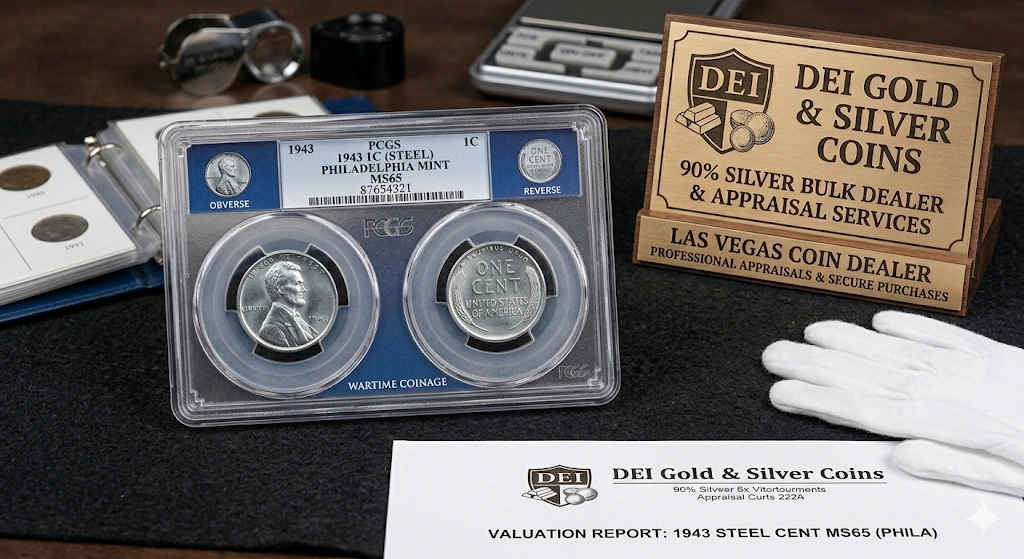
A 1943 steel penny sold for $840 at a Heritage Auctions sale — not because it was gold or silver, but because it was graded MS-67 by PCGS and represented the absolute finest known example from the San Francisco Mint. Most 1943 steel cents sitting in cigar boxes and sock drawers across America are worth a dollar or two at best. But the gap between a common circulated example and a supergrade survivor is enormous, and knowing where your coin falls is the difference between tossing it in a junk bin and submitting it for certification.
The 1943 steel cent is one of the most recognizable wartime coins in U.S. numismatic history, yet collectors still confuse its value constantly. The PCGS Price Guide shows a 1943-S steel cent in MS-65 commanding around $70, while the same coin in MS-67 jumps to over $500 — a 7x difference based on two grade points. And that’s before you even start talking about the legendary 1943 copper penny, one of the most coveted error coins in all of American numismatics.
This post explains exactly how to assess your 1943 steel penny value by mint mark, grade, and condition — and gives you a clear, honest picture of when a steel cent is worth submitting to PCGS or NGC, and when it isn’t.
Why the U.S. Mint Made Steel Pennies in 1943
The U.S. Mint switched to zinc-coated steel cents in 1943 because copper was a critical war material needed for ammunition casings, shell casings, and military equipment during World War II. According to the U.S. Mint’s official historical records, the decision to substitute steel for copper saved approximately 95% of the copper previously used in cent production — enough to make a meaningful contribution to the war effort. The new coins, struck at Philadelphia, Denver, and San Francisco, were composed of low-carbon steel with a thin zinc coating that gave them a silvery appearance and made them easy to confuse with dimes.
The practical result was over one billion steel cents produced across all three mints in a single year. Philadelphia alone struck approximately 684.6 million coins. Denver produced about 217.7 million, and San Francisco contributed roughly 191.6 million. Those mintage numbers are important context: this is not a rare coin by any measure. What makes individual examples valuable is grade and preservation — not scarcity of the issue itself.
From a collector’s standpoint, the steel composition created immediate problems. The zinc coating was prone to rust and spotting, especially in humid climates. Vending machines rejected them because they resembled dimes electromagnetically. And the public disliked the coins so intensely that the Mint returned to brass cents in 1944 using salvaged shell casings. That one-year wartime detour is exactly why 1943 steel cents have fascinated collectors for over 80 years.
1943 Steel Penny Value by Mint Mark: What Your Coin Is Actually Worth
The 1943 steel penny value depends heavily on which mint struck the coin, because mintage numbers and survival rates differ significantly across Philadelphia, Denver, and San Francisco. A coin with no mint mark came from Philadelphia; “D” below the date indicates Denver; “S” indicates San Francisco.
Here is a realistic value breakdown based on the current PCGS Price Guide and recent NGC registry auction results:
Philadelphia (No Mint Mark) — 684.6 million struck Heavily circulated (G-4 to F-12): $0.10–$0.25. Very Fine (VF-20): $0.50–$1. Extremely Fine (EF-40): $1–$3. About Uncirculated (AU-50): $3–$6. Mint State MS-63: $8–$12. MS-65: $20–$35. MS-67: $200–$500+.
Denver (D Mint Mark) — 217.7 million struck Circulated grades carry a slight premium over Philadelphia due to lower mintage. MS-63: $10–$18. MS-65: $30–$50. MS-67: $300–$600+.
San Francisco (S Mint Mark) — 191.6 million struck The scarcest of the three. MS-63: $15–$25. MS-65: $60–$90. MS-67: $500–$900+.
At DEI, we regularly advise sellers that circulated 1943 steel cents in average condition are not worth submitting to PCGS or NGC — the $30–$45 grading fee exceeds the coin’s market value at any grade below EF-40. The math only starts to work in your favor on sharp, original-luster, uncirculated examples — particularly those from Denver or San Francisco.
1943 Copper Penny vs Steel: How to Tell the Difference
The 1943 copper penny is one of the most famous U.S. coin errors in existence, and it is also one of the most counterfeited. A genuine 1943 copper cent — produced when a small number of pre-war copper planchets were accidentally fed into the presses — is worth $100,000 at minimum, with the finest known examples exceeding $1 million at auction. Stack’s Bowers sold a PCGS MS-62 Brown 1943 Philadelphia copper cent for $204,000 in a recent sale, underlining just how rare and valuable these errors remain.
The problem is that counterfeiters have been making fake 1943 copper cents for decades using two primary methods. The first is copper-plating an authentic 1943 steel cent — a technique that feels convincing to the naked eye. The second is altering the date on a 1948 copper cent, shaving the “8” into a “3.” Both fakes show up at our counter regularly.
Here is how to test your 1943 cent at home before paying for authentication:
The magnet test is your first step. Steel is magnetic; copper is not. Hold a magnet near the coin. If it attracts, the coin is steel, not copper. If it does not attract, do not celebrate yet — it still could be a plated steel cent or an altered date coin, and only a professional examination under magnification can confirm authenticity. At DEI, we offer free appraisals on any coin you suspect may be a copper error. Do not clean the coin, do not polish it, and do not attempt to test it with chemicals — any surface alteration, however minor, destroys collectible value and makes authentication harder.
If your coin passes the magnet test, the next step is weight. A genuine 1943 copper cent weighs approximately 3.11 grams. A steel cent weighs approximately 2.70 grams. A kitchen postal scale is not precise enough for this — you need a jeweler’s gram scale accurate to 0.01 grams. Even then, weight alone is not definitive. The only confirmed authentication method is submission to PCGS or NGC, both of whom DEI works with directly for coin submissions.
📊 1943 Steel Penny vs 1943 Copper Penny — DEI Quick Reference
| Feature | 1943 Steel Cent | 1943 Copper Cent (Error) |
|---|---|---|
| Composition | Zinc-coated steel | Bronze (95% copper) |
| Weight | ~2.70 grams | ~3.11 grams |
| Magnetic? | Yes | No |
| Mintage (approx.) | 1.09 billion total | ~20 known specimens |
| Circulated value | $0.10–$3 | $100,000–$200,000+ |
| Uncirculated value (MS-65) | $20–$90 (by mint) | $500,000–$1,000,000+ |
| Worth PCGS submission? | Only MS-63+ examples | Always — immediately |
| Fake risk | Low | Extremely high — test first |
| Most common fake method | N/A | Copper-plated steel / altered 1948 date |
How Grade Affects 1943 Steel Penny Value More Than Mint Mark
For 1943 steel cents, the grade — not the mint mark — is the single biggest driver of value at the collector and dealer level. A circulated 1943-S cent in VG-8 is worth fifty cents. The same coin in MS-67 has sold for over $900. That is a 1,800x difference in value created entirely by preservation.
The zinc coating on steel cents is the core challenge. Even coins that never saw pocket circulation can develop spotting, streaking, and oxidation from humidity and environmental exposure during storage. A coin with original bright luster, no rust or spotting, sharp strike detail, and no contact marks on Lincoln’s cheek or in the fields above his shoulder is genuinely rare in high grade — even though over a billion of these coins exist.
When evaluating 1943 steel cents for potential NGC or PCGS submission, our team at DEI looks at three areas first: the cheekbone and jaw of Lincoln’s portrait (where wear concentrates fastest), the fields immediately around the bust (where bag marks typically cluster), and the reverse wheat stalks at 7 o’clock and 5 o’clock (where strike weakness commonly appears on Denver coins). A coin that is clean in all three areas on both sides is a legitimate MS-65 candidate.
One important note on cleaned coins: a 1943 steel cent that has been polished or cleaned, even gently, will receive a “Details” designation from PCGS or NGC rather than a numeric grade. Details-graded coins sell at a steep discount — often 50–70% less than a straight-graded coin of comparable appearance. In our showroom, details-graded steel cents come in weekly, and sellers are always surprised by how much value was lost by someone who tried to “brighten up” the coin before selling.
🪙 DEI Dealer Observation
Of all the wartime-era U.S. coins we examine at our Eastern Avenue showroom, 1943 steel cents in MS-65 or better are consistently harder to find with original, unblemished zinc surfaces than their mintage numbers would suggest. The zinc coating on these coins was never intended for long-term survival — it was a wartime expedient. Over 80 years of storage in humid conditions, cardboard holders with sulfur-based adhesives, and well-meaning “cleaning” by previous owners has taken a heavy toll on the available supply of premium examples. When a genuinely original, bright MS-66 or MS-67 steel cent comes across our counter, we take it very seriously — those coins have real collector demand and meaningful auction results to support premium pricing.
What Makes a 1943 Steel Penny Worth Submitting to PCGS or NGC
Submitting a 1943 steel cent for professional grading makes financial sense only when the coin’s potential certified value exceeds the cost of grading plus a reasonable margin. Based on PCGS and NGC current fee schedules and typical turnaround grades, here is a practical threshold:
Worth submitting: Any 1943-D or 1943-S steel cent that appears uncirculated with original luster, no spots, no cleaning evidence, and strong strike detail. Even a conservative PCGS MS-63 grade on a 1943-S returns $15–$25 in market value — which barely covers grading costs. At MS-65 and above, the economics improve substantially. Philadelphia examples need MS-66 or better to justify standard submission fees.
Not worth submitting: Any circulated 1943 steel cent regardless of mint mark. Any coin showing rust, spotting, cleaning, or smoothed surfaces — these will come back with Details grades that rarely recoup submission costs. Any coin you paid less than $5 for in the circulated grades.
DEI offers free appraisals and can evaluate your 1943 steel cents before you commit to grading fees. We’re also authorized CAC submission agents, which means if your coin qualifies for a CAC sticker after PCGS or NGC grading, we can facilitate that process from our Las Vegas showroom. CAC verification on a high-grade steel cent adds a further premium — typically 10–20% above the certified price — because it signals the coin grades at the top of its tier.
📌 DEI Market Observation: In the past 24 months, we have seen a consistent increase in customers bringing in 1943 steel cents they received in estate lots and inherited collections. Approximately 70% of these are circulated examples worth under $2 each. Of the remaining 30%, roughly half show cleaning or oxidation damage that limits their appeal. Genuinely original, high-grade examples — those that grade MS-65 or above with no details issues — represent less than 5% of what we see, and those coins sell quickly when we price them accurately.
Buying 1943 Steel Pennies: What Las Vegas Collectors Should Know
If you’re buying 1943 steel cents as a collector rather than selling them, the market is relatively accessible and transparent. Raw (uncertified) circulated examples are inexpensive and widely available. The better strategy for serious collectors is to focus on PCGS or NGC certified examples at MS-65 and above, purchased from reputable dealers or established auction houses like Heritage Auctions, Stack’s Bowers, or GreatCollections.
A few buying cautions specific to the 1943 steel cent market: First, be skeptical of any raw coin sold as “MS-67” or “Gem Uncirculated” without third-party certification, especially online. The difference between an MS-63 and MS-67 steel cent is measurable in hundreds of dollars, and that spread creates strong incentive for overgrading. Second, watch for rust or spotting that has been covered with light wax or oil — a common technique that conceals surface issues temporarily. Under proper lighting at an angle, original steel cents have a distinct metallic sheen; altered surfaces often look flat or artificially uniform.
Nevada collectors have a geographic advantage: DEI’s Las Vegas showroom at 8985 S. Eastern Ave maintains a rotating inventory of certified U.S. coins, including Lincoln cents across a range of dates and grades. We can let you examine coins in hand before purchase — a significant advantage over online buying, where photography can obscure critical surface details. We also frequently have estate-lot steel cents available at dealer pricing, which beats eBay sold listings for budget-conscious collectors building a type set.
Conclusion
Before you sell or store that 1943 steel penny, run it through three quick checks: Is it magnetic? (If not, get it authenticated immediately.) Does it show original luster with no spots or cleaning? (If yes, it’s worth a closer look.) Is it from Denver or San Francisco? (Those carry a modest premium over Philadelphia at every grade level.) Those three questions will tell you whether you’re holding a fifty-cent circulated coin or something worth a professional opinion.
Here are four things to take away from this guide: The 1943 steel penny value is driven far more by grade than by mint mark for the vast majority of examples. Copper-plated counterfeits are common — never skip the magnet test. Only MS-63 or better examples from Denver and San Francisco are typically worth the cost of PCGS or NGC submission. And the genuine 1943 copper penny error is one of the rarest and most valuable U.S. coins in existence — worth professional authentication the moment a coin fails the magnet test.
Ready to get an honest assessment of your 1943 steel penny collection? Visit DEI Gold & Silver Coins at 8985 S. Eastern Ave, Suite 160, in Las Vegas, or call (702) 460-5188 for a free, same-day appraisal — no pressure, no obligation. Our certified numismatists handle Lincoln cents, wartime coinage, and error coins daily. You can also book an appointment at DEI’s appraisals page.
For your next read, explore our guides on junk silver and 90% silver coinage — another category of common wartime-era U.S. coins with values that surprise most sellers — and our overview of certified silver coins for collectors ready to move from raw to graded holdings.
FAQ SECTION
1. How much is a 1943 steel penny worth today?
A circulated 1943 steel penny is worth $0.10 to $3 depending on condition and mint mark. Uncirculated examples graded MS-63 by PCGS or NGC range from $8 to $25. Top-grade MS-67 coins from the San Francisco or Denver mints have sold for $500 to $900 or more at Heritage Auctions and Stack’s Bowers.
2. How do I know if my 1943 penny is the rare copper version?
Test it with a magnet. A 1943 steel penny is magnetic; the rare 1943 copper penny error is not. If your coin does not attract a magnet, do not clean it — take it immediately to a professional dealer like DEI Gold & Silver Coins in Las Vegas for a free appraisal and PCGS or NGC authentication referral. Only about 20 genuine 1943 copper cents are confirmed to exist.
3. What is the 1943 steel penny value in MS-65 grade?
A 1943 steel penny graded MS-65 by PCGS is worth approximately $20–$35 for the Philadelphia issue, $30–$50 for Denver, and $60–$90 for San Francisco, based on current PCGS Price Guide data. Grade and mint mark together determine value at the uncirculated level more than any other factor.
4. Is it worth getting a 1943 steel penny graded by PCGS or NGC?
It is worth submitting a 1943 steel penny for PCGS or NGC grading only if the coin appears uncirculated with no rust, spotting, or cleaning. Circulated steel cents at any grade are worth less than the $30–$45 grading fee. Focus on bright, original-luster examples from Denver or San Francisco — those are the candidates that make financial sense to certify.
5. How many 1943 steel pennies were made and why?
The U.S. Mint struck approximately 1.09 billion 1943 steel cents across three facilities — about 684.6 million in Philadelphia, 217.7 million in Denver, and 191.6 million in San Francisco — because copper was a critical wartime material needed for military ammunition and equipment. The steel composition was a one-year emergency measure; the Mint returned to brass cents in 1944.
6. Can I sell my 1943 steel penny to DEI Gold & Silver Coins in Las Vegas?
Yes. DEI Gold & Silver Coins at 8985 S. Eastern Ave, Suite 160, Las Vegas, NV buys 1943 steel cents as part of its coin-buying service. Bring your coins in for a free, same-day appraisal with no obligation to sell. DEI pays fair market value based on current PCGS and NGC pricing, and same-day cash payment is available. Call (702) 460-5188 to confirm availability or book an appointment.