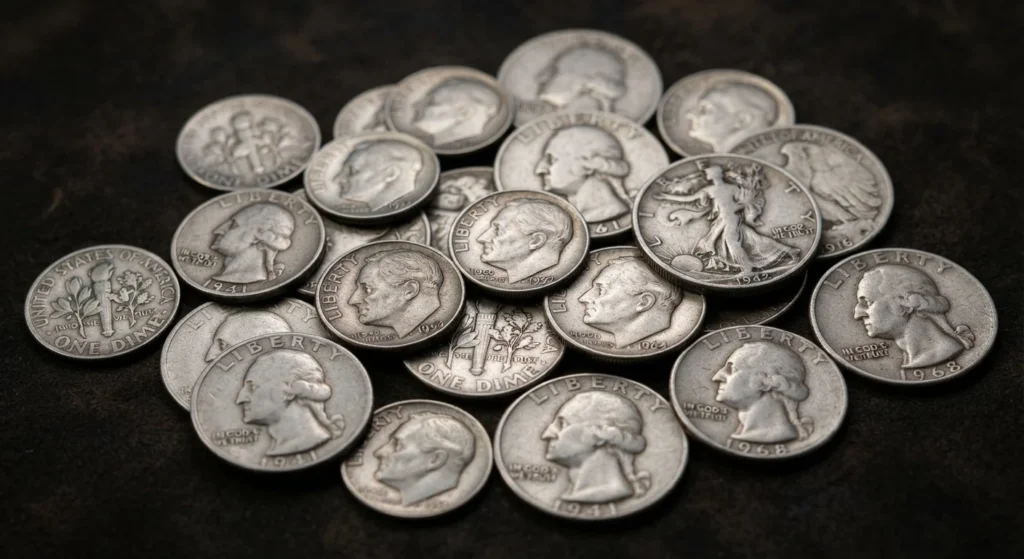
Every roll of pre-1965 dimes or quarters pulled from a bank bag, an old dresser drawer, or an inherited coffee can carries a number most people never think to calculate. Understanding junk silver melt value starts with a simple fact: before 1965, American dimes, quarters, and half dollars were struck from 90 percent silver, and that silver content still determines much of what those coins are worth today. The term “junk silver” sounds dismissive, but it describes something specific and genuinely valuable — circulated 90 percent silver coinage with no meaningful numismatic premium, priced almost entirely on metal content. This guide explains how that value is actually calculated, what belongs in the 90 percent category, and how it differs from the far higher values that certain dates, mint marks, and conditions can command.
What “Junk Silver” Actually Means
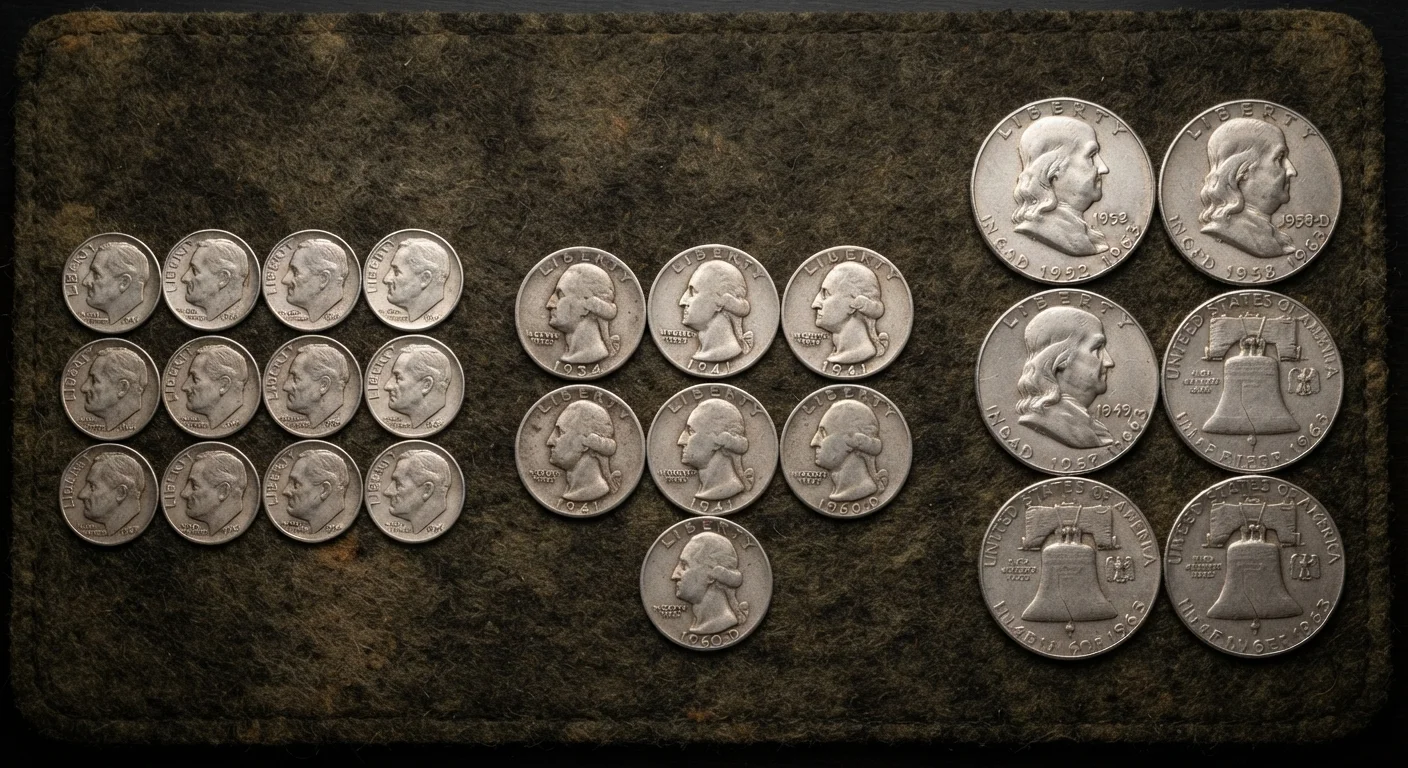
In numismatic circles, “junk silver” is not an insult — it is a category. The term refers to common-date, circulated United States silver coins that carry no collector premium beyond their silver content. That includes Roosevelt dimes, Washington quarters, and Franklin or Walking Liberty half dollars struck in 1964 or earlier, along with Mercury dimes and Standing Liberty quarters from earlier in the twentieth century. Because millions of these coins were produced and survive in circulated grades, dealers and stackers buy and sell them by face value rather than by date and mint mark, using the coin’s silver weight as the pricing basis.
This is the key distinction collectors need to understand early: junk silver is priced for its bullion content, while a rare-date coin in the same series can be worth many times its melt value because of scarcity, condition, and collector demand. A worn 1943 Mercury dime and an extremely rare 1916-D Mercury dime are both 90 percent silver, but only one of them trades near melt.
The History Behind 90% Silver Coinage
For most of the twentieth century, US dimes, quarters, and half dollars were struck to a fixed silver standard: 90 percent silver and 10 percent copper, a composition the Mint had used since the Coinage Act of 1837 and continued largely unchanged into the 1960s. Silver dollars — the Morgan and Peace dollar series — shared the same 90 percent alloy, though they were struck on a larger, heavier planchet.
That changed with the Coinage Act of 1965. Rising industrial demand had pushed the market price of silver close to the metal value already contained in circulating coinage, and the Treasury faced a real risk that people would pull silver coins out of circulation and melt them for profit rather than spend them. Congress responded by eliminating silver from dimes and quarters entirely, replacing it with a copper-nickel clad composition still used today. Half dollars were not cut to zero silver immediately; from 1965 through 1970, Kennedy half dollars were struck in a transitional 40 percent silver alloy before the Mint moved to fully clad half dollars in 1971. Any dime or quarter dated 1964 or earlier, and any half dollar dated 1964 or earlier, is 90 percent silver. Any half dollar dated 1965 through 1970 is 40 percent silver — a related but separate category from true junk silver.
How Junk Silver Melt Value Is Calculated
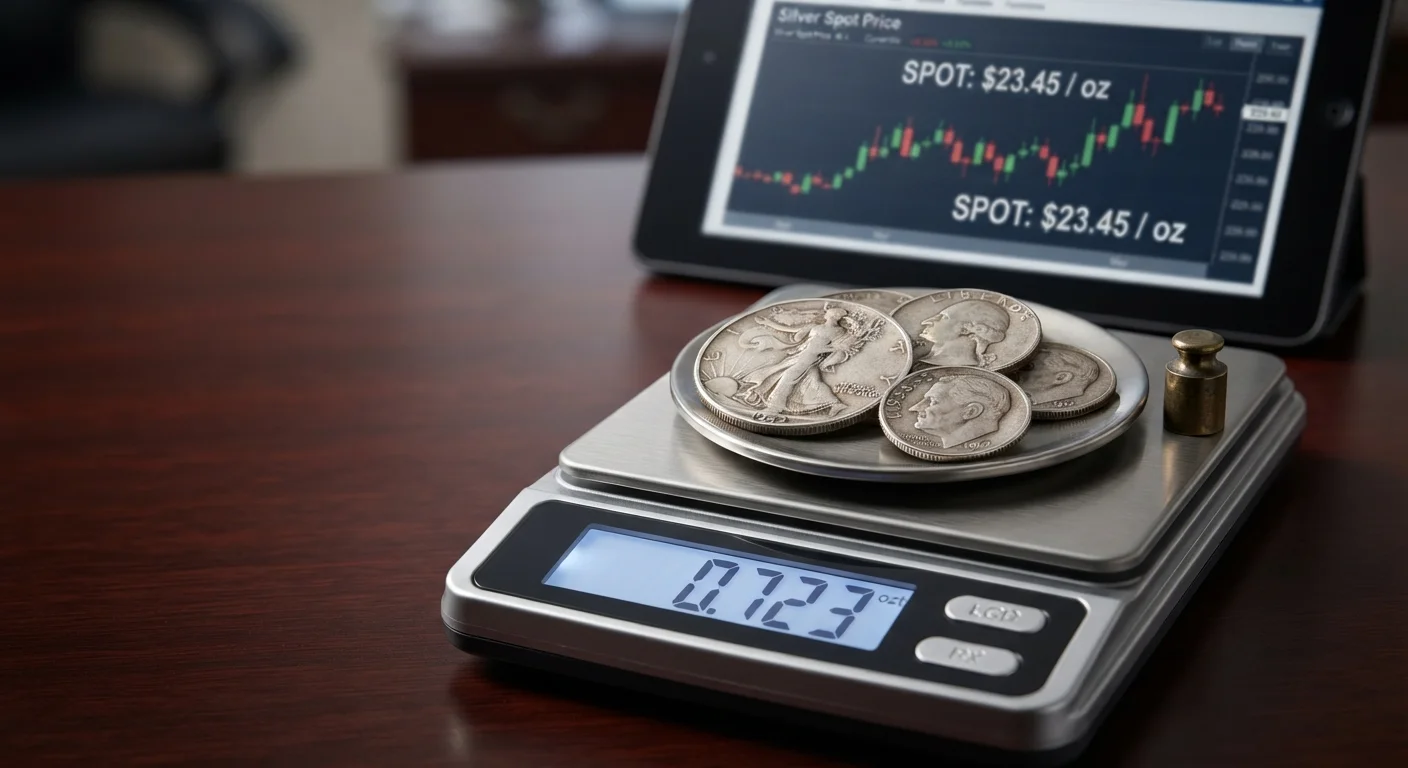
The math behind junk silver is more consistent than most collectors expect, because the Mint used the same alloy and the same basic planchet weight across denominations. One dollar of face value in 90 percent silver coins — whether that’s ten dimes, four quarters, or two half dollars — was struck from 25 grams of metal containing 22.5 grams of pure silver, which works out to 0.7234 troy ounces of silver per dollar of face value at the original Mint specification.
In practice, dealers rarely use that exact figure. Decades of circulation wear away a small amount of metal from every coin that passes through cash registers and pockets, so the bullion industry settled on 0.715 troy ounces per dollar of face value as the standard, conservative multiplier for circulated 90 percent coins. That means a $100 face-value bag of junk silver contains roughly 71.5 troy ounces of pure silver, and a $1,000 face-value bag — the traditional “silver dollar bag” quantity dealers still reference — contains approximately 715 troy ounces.
The full formula is straightforward:
Face value × 0.715 × current spot price of silver = approximate melt value
Silver dollars are the one exception worth remembering. Morgan and Peace dollars were struck on a heavier planchet than the subsidiary coinage, so each coin contains 0.7734 troy ounces of pure silver on its own — noticeably more silver per dollar of face value than the equivalent amount in dimes, quarters, or half dollars.
Because the spot price of silver moves throughout every trading day, an accurate melt value calculation always depends on checking the live spot price at the moment of the transaction rather than relying on a figure quoted weeks or months earlier. Silver has been a volatile market in recent years, which makes it especially important to confirm the current spot price — rather than a remembered or outdated figure — before finalizing any melt value estimate.
What’s Inside a Standard “Bag” of Junk Silver
Historically, the US Mint shipped circulating silver coinage to banks in canvas bags containing $1,000 in face value — the origin of the “silver dollar bag” terminology still used in the bullion trade today. A full bag of dimes, quarters, or half dollars in that quantity weighs roughly 55 pounds and, using the 0.715 multiplier, contains about 715 troy ounces of pure silver.
Most collectors and sellers today deal in smaller increments. A $10 face-value roll of quarters contains approximately 7.15 troy ounces of silver. A single pre-1965 quarter contains roughly 0.18 troy ounces, and a single dime contains about 0.072 troy ounces. Because the coins are divisible and universally recognized, junk silver remains one of the easiest forms of physical silver to buy, sell, and liquidate in partial amounts — an advantage that silver bars and larger bullion products don’t offer as conveniently.
Junk Silver vs. Collectible Value: A Distinction That Matters
The most important thing to understand about junk silver melt value is what it does not include. Melt value reflects the silver content alone. It does not account for rarity, mint mark, condition, or historical significance — the same factors that separate a common coin from a genuinely valuable one.
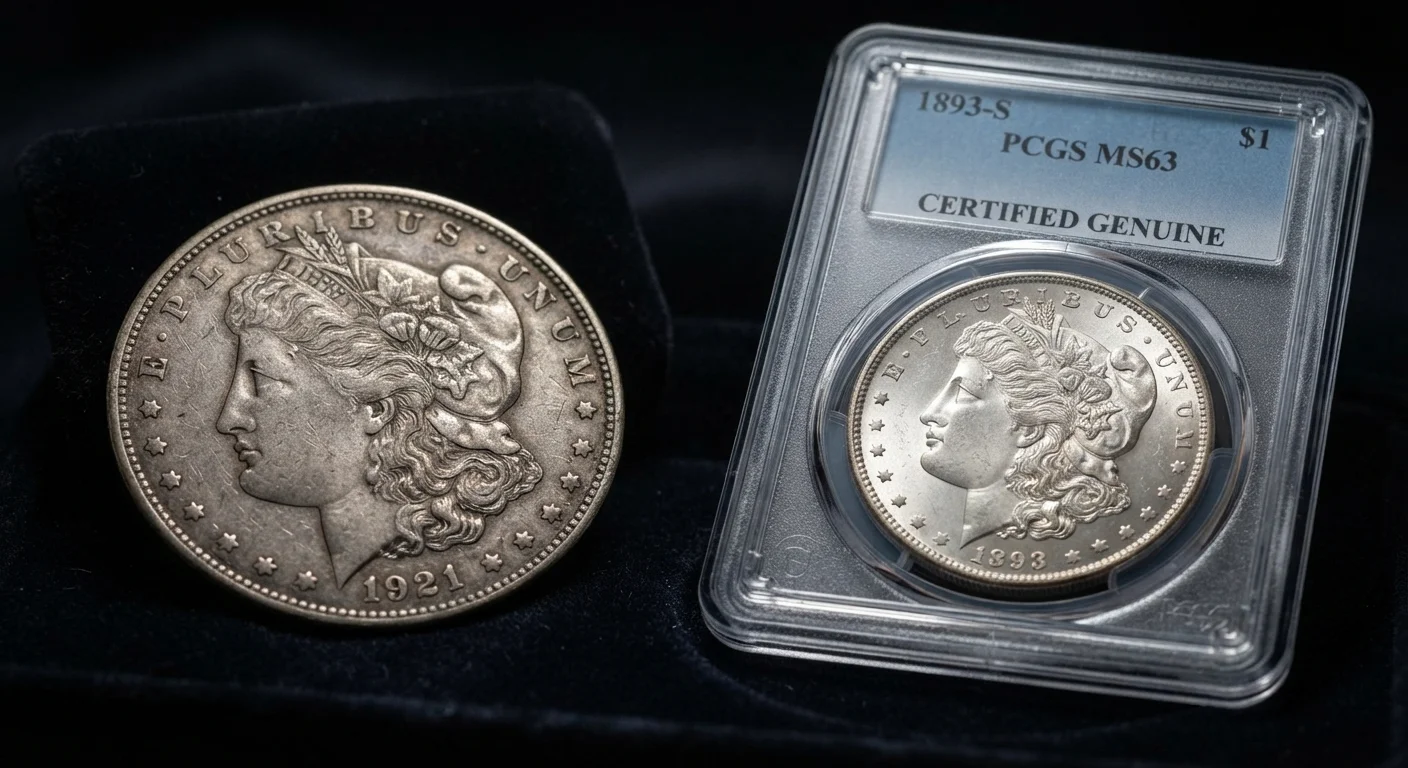
Consider a hypothetical example: two collectors each bring in a Washington quarter dated 1964. One coin is heavily worn, with no remaining detail in Washington’s hair — a coin that trades purely on its 0.1808 troy ounces of silver content. The other happens to be a well-preserved specimen in uncirculated condition with full luster and sharp strike. Both coins contain identical silver content and share the same melt value, but the uncirculated example may carry a modest numismatic premium above melt because collectors value condition, even in a common date.
The gap becomes far more dramatic with certain scarce dates and varieties. A common 1943 Mercury dime trades at melt value. A 1916-D Mercury dime — the key date of the series, with a mintage of just over 264,000 — can be worth many multiples of its silver content even in worn condition, and a well-preserved, certified example can bring a price that has nothing to do with the coin’s 0.0723 troy ounces of silver. This is why an experienced numismatist always checks date, mint mark, and condition before assuming a silver coin belongs in the junk silver category rather than the collectible one.
90 Percent Silver Coin Value by Denomination
Understanding 90 percent silver coin value at the denomination level helps collectors and sellers estimate what they’re holding before requesting a formal appraisal.
- Dimes (1964 and earlier): approximately 0.0723 troy ounces of silver per coin at full Mint weight, or about 0.0715 troy ounces using the circulated-wear standard.
- Quarters (1964 and earlier): approximately 0.1808 troy ounces per coin at Mint weight.
- Half dollars (1964 and earlier): approximately 0.3617 troy ounces per coin — Franklin and Walking Liberty half dollars, along with 1964 Kennedy halves, all fall into this category.
- Half dollars (1965–1970): approximately 0.1479 troy ounces per coin, reflecting the transitional 40 percent silver alloy rather than 90 percent.
- Silver dollars (Morgan and Peace, 1878–1935): approximately 0.7734 troy ounces per coin, the heaviest silver content per coin in the series.
These figures represent theoretical Mint-specification content; actual melt value calculations for circulated coins typically apply the 0.715 dealer convention described earlier to account for wear.
Why Junk Silver Still Matters to Collectors and Investors
Junk silver occupies a useful middle ground in the precious metals market. For investors, it offers a way to hold physical silver in a recognizable, divisible, government-issued form without paying the premiums that certified or specialty bullion products often carry. For collectors, it serves as an entry point into numismatics — a box of circulated Roosevelt dimes or Washington quarters is often how a new collector first learns to read dates, mint marks, and wear patterns before moving on to more specialized areas of the hobby.
Junk silver also connects directly to American monetary history. Every coin in a junk silver bag is a physical artifact of a monetary system that backed its circulating coinage with precious metal — a system Congress deliberately ended in 1965 as silver’s market value began to outpace its face value. Holding a pre-1965 quarter is, in a small but real sense, holding a piece of that transition.
Selling or Appraising 90% Silver Coins in Las Vegas
Anyone sitting on an inherited coin jar, a family collection, or an accumulated stack of pre-1965 silver coins often has a mix of true junk silver and coins worth considerably more than melt — and the only way to know which is which is a proper evaluation. DEI Gold and Silver Coins, a Las Vegas coin dealer serving collectors, investors, and estates, evaluates 90 percent silver coins, silver dollars, and full collections to separate ordinary bullion-value coins from dates and varieties that carry genuine numismatic premiums. For anyone in the Las Vegas area sorting through a collection, an appraisal is the most reliable way to know whether a coin belongs in the junk silver category or deserves a closer look before it’s sold for metal content alone.
What Old Silver Coins Are Really Worth
The real answer to what a bag of old silver coins is worth depends on two separate questions: how much silver is actually inside them, and whether any individual coin is scarce enough to be worth more than its metal content. Junk silver melt value gives collectors and sellers a reliable, transparent baseline using a well-established formula — face value, multiplied by silver content per dollar, multiplied by the current spot price. But that baseline is a floor, not a ceiling. The most valuable coin in any collection of old silver is rarely the one with the most silver in it; it’s the one with the date, mint mark, and condition that collectors are actively competing to own.
Collectors looking to buy, sell, or simply learn more in person can find DEI Gold and Silver Coins at upcoming Las Vegas coin shows.
DEI Gold and Silver Coins is the official sponsor of these shows.
Held and produced by CK Shows, Las Vegas, NV.
By DEI Gold and Silver Coins | Articles by DEI Gold and Silver Coins