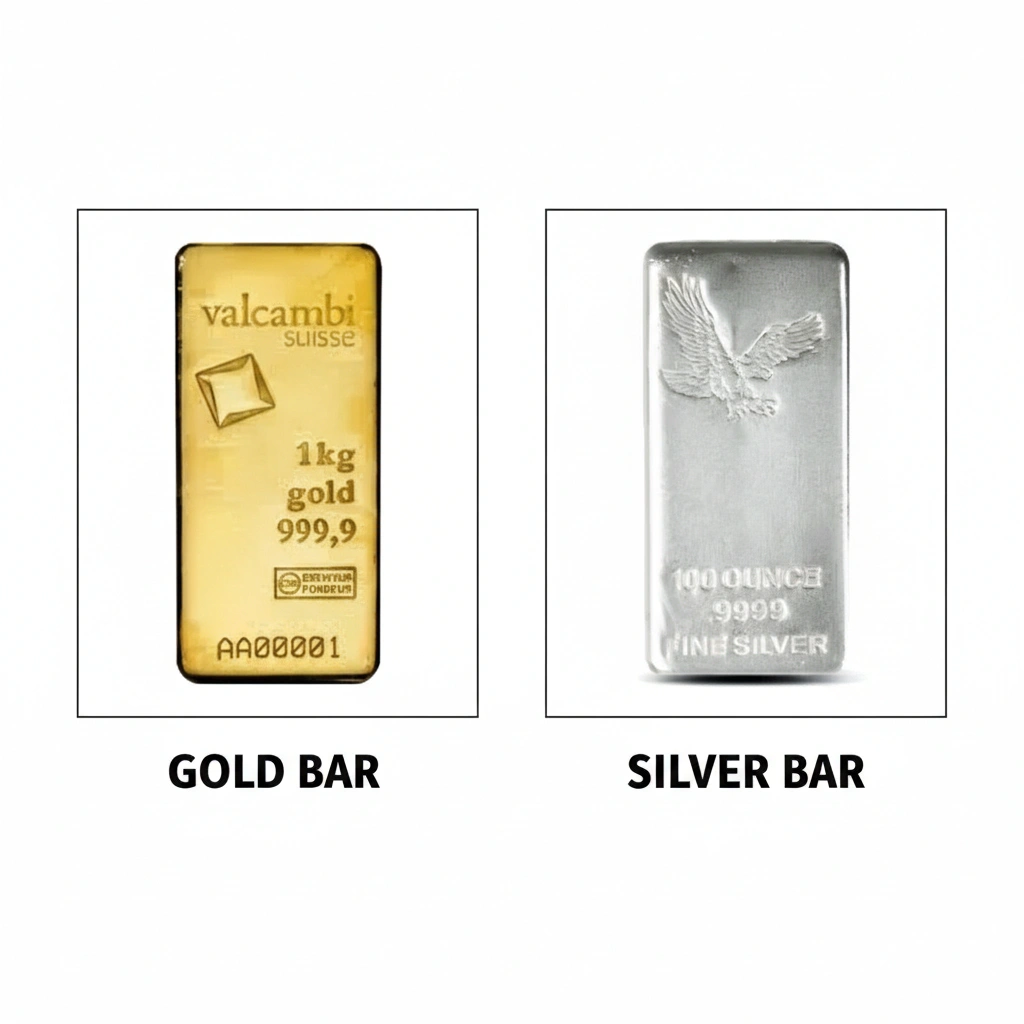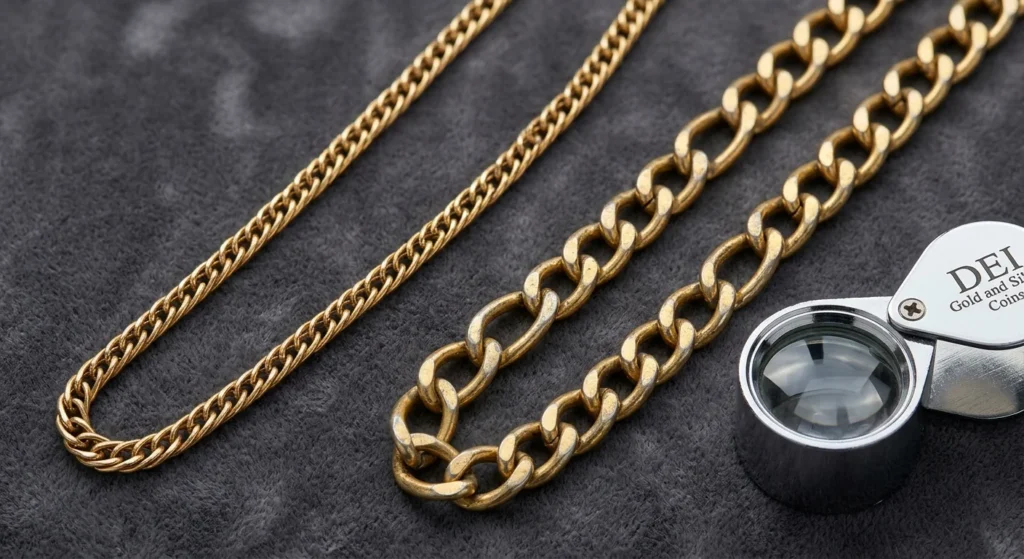
A necklace can look identical to its neighbor in the jewelry box and still be worth many times more. One is a solid gold chain. The other is brass with a thin gold-colored finish, made to look expensive for a few years of wear. Knowing how to tell real gold jewelry from costume pieces is the first step in finding out whether anything you own is worth selling.
Costume jewelry versus gold jewelry is not always an obvious call. Plating, gold-filled construction, and gold-toned alloys can all pass a quick glance. This guide covers what the stamps mean, which simple checks are useful, which are misleading, and why the final answer often needs a professional.
Why the Question Matters Before You Sell
Solid gold is priced largely by weight and purity, so an incorrect assumption costs you either way. Assume a plated piece is gold and you may set expectations that no buyer can meet. Assume a real piece is costume jewelry and you may give away something valuable, or leave it in a drawer.
Many people meet this problem while sorting an inherited box: broken chains, single earrings, tangled bracelets, a few old coins. Some of it is scrap gold. Some is costume jewelry. Some is collectible. Separating those categories is more useful than guessing at a value for the whole box.
Start With the Stamp: Reading Gold Hallmarks
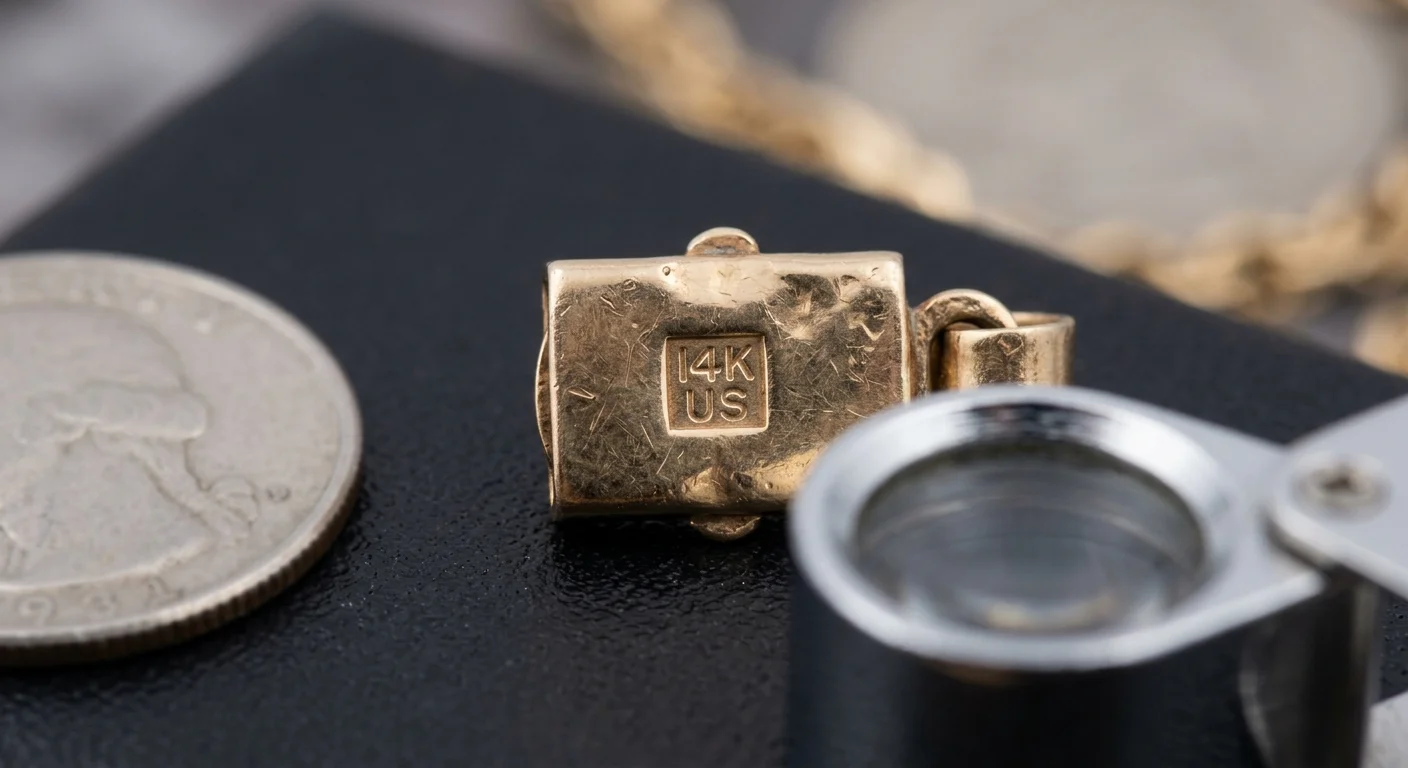
Solid gold jewelry is usually stamped with its purity. Look on clasps, the inside of rings, the tag near a chain’s clasp, or the back of a pendant. A loupe or a phone’s magnifier helps, since the marks are often tiny.
Purity is measured in karats, out of 24 parts:
| Stamp | Also seen as | Gold content |
|---|---|---|
| 24K | 999 | about 99.9% |
| 18K | 750 | 75% |
| 14K | 585 | 58.3% |
| 10K | 417 | 41.7% |
The remainder in lower-karat gold is alloy metal, often copper, silver, nickel or zinc. Alloying makes the gold harder and can change its color. That is why 14K gold is common in everyday jewelry: pure gold is soft.
Marks That Signal “Not Solid Gold”
Some stamps tell you the piece is not solid gold, even though it carries the word “gold.” Common examples include:
- GP or GEP: gold plated or gold electroplated, meaning a very thin gold layer over another metal.
- HGE: heavy gold electroplate, still a plated finish.
- GF or “gold filled”: a gold layer bonded to a base metal. It is heavier-duty than plating, but it is not solid gold and is not valued like it.
- RGP: rolled gold plate.
- Vermeil: gold over sterling silver.
Fractions such as “1/20 12K GF” describe the gold-filled layer, not the purity of the whole piece. The 12K refers to the outer layer only.
Costume jewelry frequently carries no gold mark at all, or only a maker’s name. That alone does not prove it is costume, but if a piece shows no purity stamp and is gold-colored, it deserves a careful test rather than an assumption. For a comparable question with silver, DEI Gold and Silver Coins has written about how to tell sterling silver from silver-plated pieces.
Simple Checks You Can Do at Home
A few observations can help you sort a pile, as long as you do not treat any single one as final.
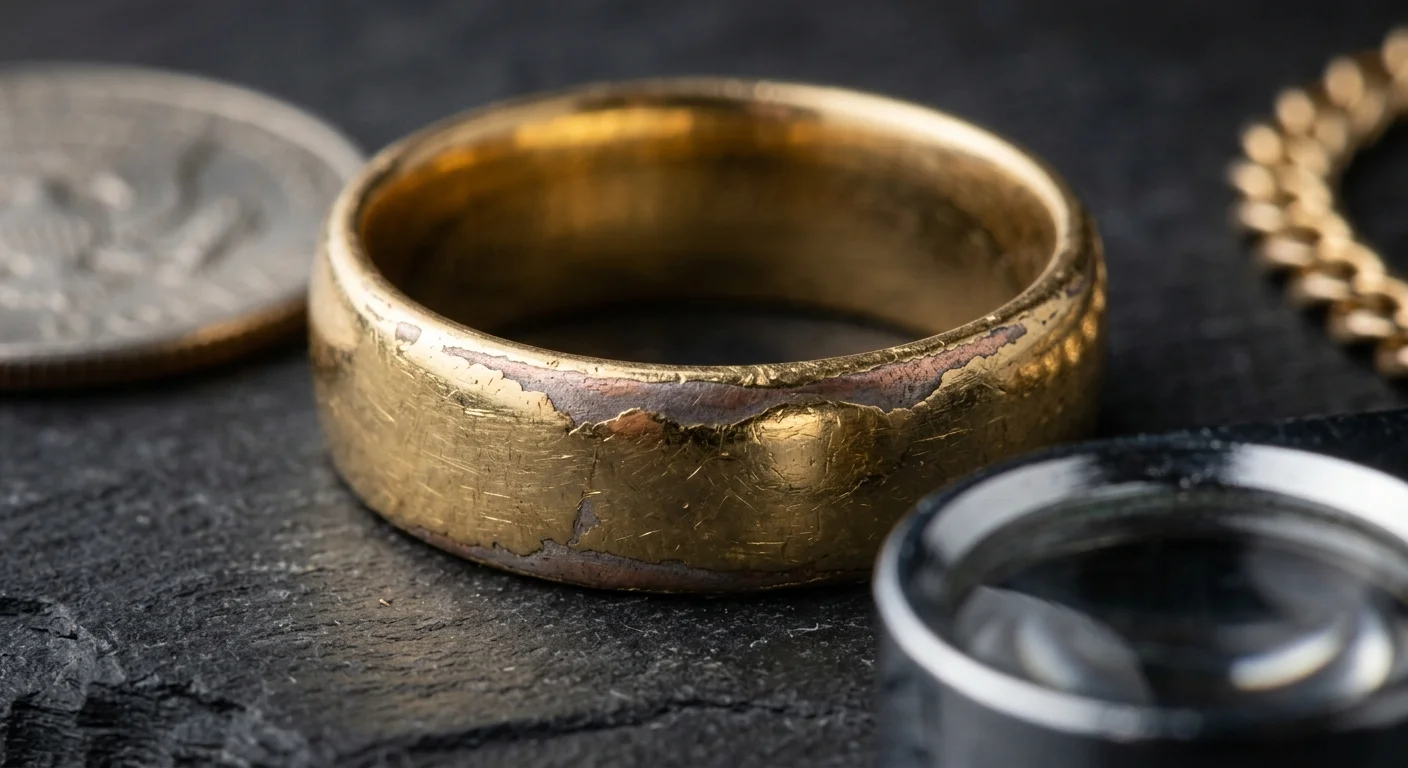
Look at the wear. Plating tends to wear first on high-contact edges: ring bottoms, clasps, the corners of pendants. If a different metal color shows through, the finish is a surface layer. Solid gold stays gold through the piece.
Check the weight. Gold is a dense metal. A real gold chain typically feels heavier than a lookalike of the same size. This works best as a comparison between two pieces, not as a measurement.
Try a magnet. Gold is not magnetic, so a piece that clearly sticks to a strong magnet is not solid gold. Be careful with the reverse: passing the test proves little, because brass, copper and many other metals are also non-magnetic. Real jewelry can also include magnetic steel parts, such as clasp springs.
Inspect solder joints and settings under magnification. Discoloration, flaking, or a differently colored base metal near joints can point to plating.
Do not rely on skin discoloration. A green or dark mark on the skin is often blamed on fake gold, but reactions vary with skin chemistry and with the alloys in some real pieces. It is not a dependable test.
Tests to Leave to a Professional
Most people have heard of the acid test, where a small mark on a testing stone is treated with acid to see how it reacts. Professionals use it, along with electronic testers and other methods, and they know how to interpret results across different alloys and finishes. At home, it is a poor idea. The acids are hazardous, and scratching a piece to expose the metal beneath the surface can permanently damage it.
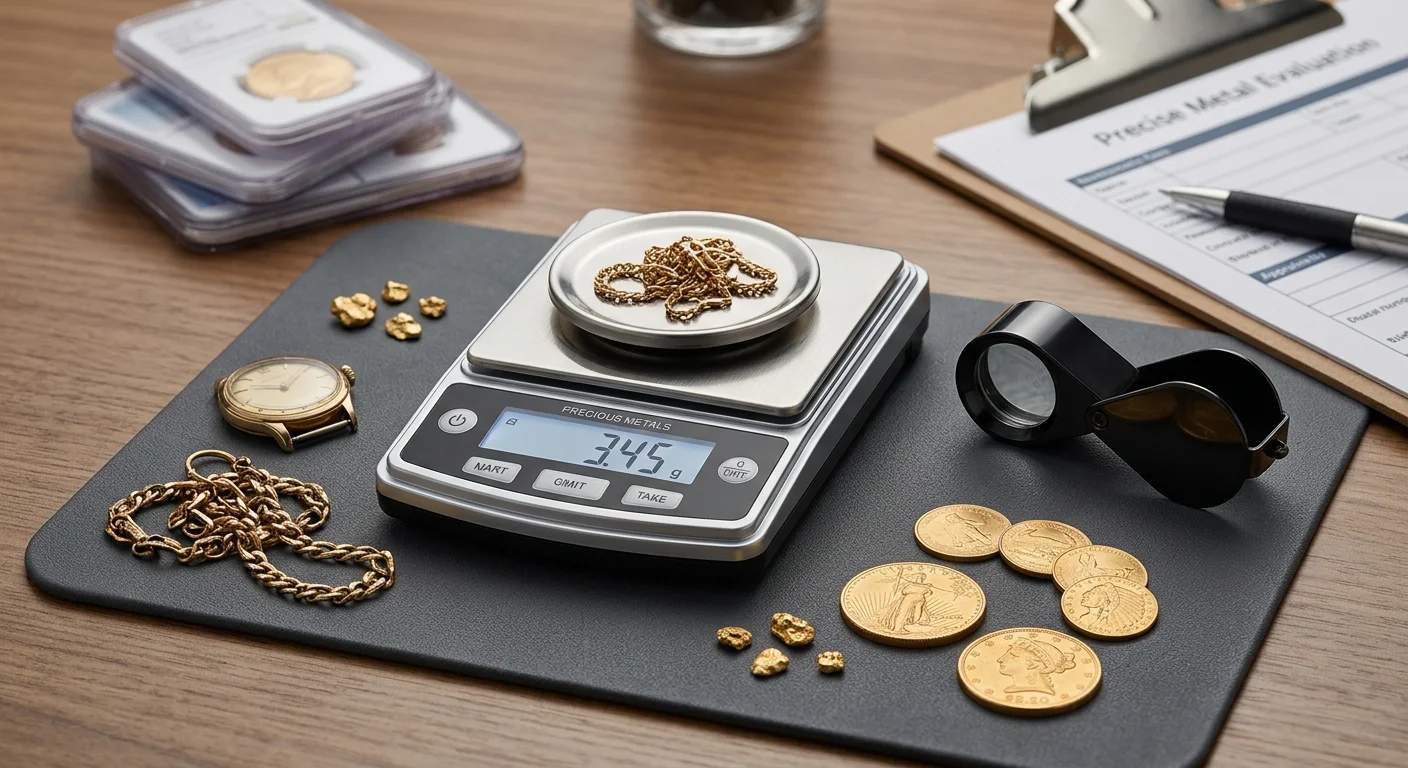
There is another reason to leave final testing to a buyer or appraiser. Testing the surface of a piece can mislead if the piece is plated or filled, and only an examination that accounts for construction can tell the difference. The DEI Gold and Silver Coins appraisal page describes a process built around a loupe, digital scales, testing acids and other verification methods, followed by a comparison with current market conditions. That combination of inspection, testing and weighing is what turns a hunch into a reliable answer.
Costume Jewelry Is Not Always Worthless
Calling something costume jewelry usually means it has little or no precious-metal content. That does not automatically mean it has no value.
Signed vintage costume pieces from established makers can attract collectors, and pieces set with genuine gemstones can be worth more than their metal. A buyer should look at the maker’s marks, the stones and the construction, not only the metal test. It is one reason to have unknown pieces looked at before discarding them.
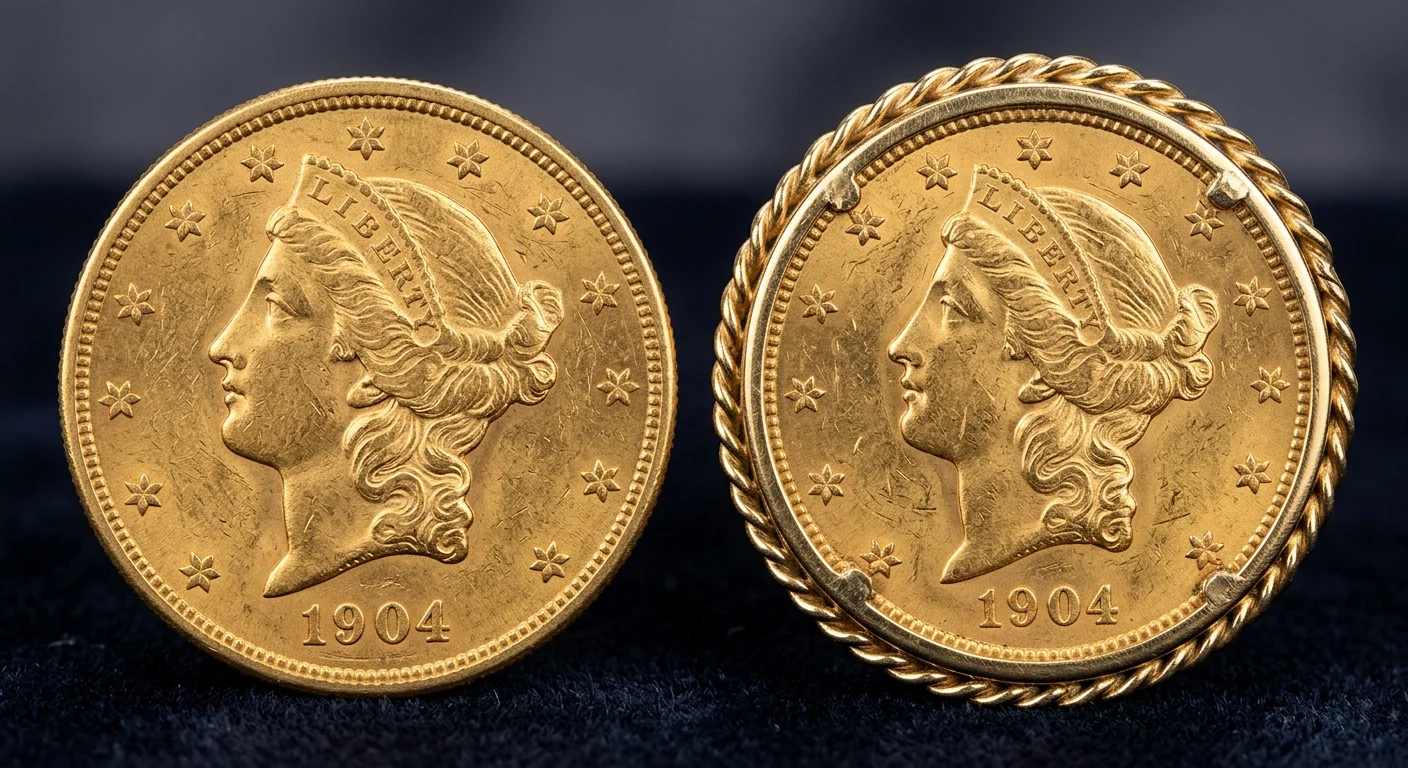
A related point comes up for coin collectors. A gold coin that has been mounted in a bezel, soldered to a loop, or made into a pendant can lose much of its collector value, because damage and alterations reduce what collectors will pay. A rare date may be worth more as a coin than as jewelry, while a common bullion coin may be worth about its gold content either way. That is the difference between numismatic value and melt value: numismatic value reflects rarity, condition and collector demand, and melt value reflects the metal alone. If you own a coin mounted as jewelry, ask a numismatist to look at it before selling it as scrap.
A Hypothetical Example
This scenario is illustrative, not a real transaction.
Suppose someone brings in a shoebox after a family estate. It holds a tangle of chains, a few rings, a brooch and a gold coin on a loop. A quick sort might produce four groups: pieces stamped 14K or 18K, pieces marked plated or filled, unmarked pieces that need testing, and a brooch with gemstones that deserves a closer look. The coin on a loop goes to a fifth pile for a numismatist.
Nothing in that sort requires guesswork about the final number. It simply routes each item to the right kind of evaluation. That is the practical goal of telling costume jewelry from gold: not to reach a verdict at home, but to arrive at an appraisal with your items organized.
How to Prepare Before You Sell
A few habits make the process smoother and protect the value of what you own.
- Do not clean or polish. Cleaning can remove evidence buyers look for and can damage delicate finishes and stones.
- Weigh only as a rough guide. A buyer will use professional scales, but knowing approximate weights helps you spot a mismatch.
- Separate by type. Group stamped gold, plated pieces, coins, and pieces with stones.
- Keep paperwork. Receipts, appraisals, boxes and family notes can add context, especially for older or signed pieces.
- Ask how an offer is reached. A clear explanation should cover weight, purity and how the market figure was applied. The article on how much your gold jewelry is worth walks through that math. Scrap value also differs from collector value, which is covered in the piece on scrap gold vs. collectible coins.
How DEI Gold and Silver Coins Evaluates Jewelry
DEI Gold and Silver Coins is a Las Vegas coin dealer that buys, sells and appraises gold coins, silver coins, rare coins, bullion, paper money and fine jewelry. Its appraisals are free and confidential, with no pressure to sell, and the company lists GIA and AGL among the credentials behind its evaluations. You can bring a single piece or a full estate.
If you want to sell after an appraisal, the process is explained on the page for selling gold in Las Vegas. Appointments can be set by calling or texting 702-460-5188.
Conclusion
Telling real gold from costume jewelry comes down to reading the marks, watching for signs of plating, and knowing when a home check has reached its limit. A stamp is a starting point. A magnet or a weight comparison can rule some things out. The reliable answer comes from someone who can test the metal and account for stones, makers and construction.
Sort what you have, leave the cleaning and scratching alone, and get a professional look before you decide what to sell or keep.
If you would rather compare coins, currency and collectibles in person and ask dealers questions face to face, Las Vegas collectors can also do that at coin shows produced by CK Shows. For dates, hours and admission details, check with CK Shows directly.
DEI Gold and Silver Coins is the official sponsor of these shows.
Held and produced by CK Shows, Las Vegas, NV.
IG @CKShows
By DEI Gold and Silver Coins | Articles by DEI Gold and Silver Coins