A woman came into our Eastern Ave showroom last fall carrying two shoeboxes — one full of loose coins, the other stuffed with rings, brooches, and a tangle of gold chains. Her father had passed away six months earlier, she was the named executor, and Clark County’s probate court was waiting on an inventory she didn’t know how to produce. “I don’t even know what’s real gold and what isn’t,” she told us. That’s the position most first-time executors find themselves in.
If you’re searching for estate appraisal Las Vegas services because you’ve inherited — or been named executor over — a loved one’s coin or jewelry collection, you’re not alone, and you don’t need a numismatics degree to handle it correctly. This guide walks through what Nevada probate actually requires, how coins and jewelry get valued differently, and how to liquidate a collection without leaving money on the table.
What a Las Vegas Estate Appraisal Actually Involves
An estate appraisal is a professional determination of what an asset was worth on the date the owner died — not what it’s worth today, and not what a family member thinks it’s worth. For real estate and business interests, this is usually straightforward. For coins, bullion, and jewelry, it’s more specialized, because two coins that look identical to the naked eye can be worth wildly different amounts depending on mint mark, grade, and condition.
Nevada’s 120-Day Inventory Deadline
Under Nevada probate law, the personal representative (the legal term for an executor or administrator) must file an inventory and appraisement of the estate’s known assets within 120 days of receiving letters of administration. That inventory has to list each asset along with its appraised fair market value as of the date of death. Coin collections and jewelry almost always fall into the “value not readily known” category, which means the court expects you to bring in someone qualified to appraise them — not guess.
When a Formal Appraisal Can Be Waived
If every beneficiary is in agreement and signs off in writing, Nevada courts will sometimes waive the formal appraisal requirement, particularly for smaller estates or items of modest value. But for any collection that includes rare coins, pre-1933 gold, certified coins, or a meaningful quantity of fine jewelry, getting a written appraisal on file protects the executor from disputes later — even when it isn’t strictly mandatory.
Probate Coin Collection Appraisal: Why Coins Are a Different Beast
A probate coin collection appraisal isn’t the same exercise as appraising furniture or a car. Coin values are driven by four things a general estate appraiser typically isn’t trained to evaluate:
Mint mark and date — a common-date coin and a rare-date coin from the same series can differ in value by 10x or more.
Grade and condition — professional grading services score coins on a 70-point scale, and a few points of wear can swing value dramatically.
Authenticity — counterfeit and altered coins circulate more than most people realize, especially in estate lots that were assembled decades ago.
Numismatic premium vs. melt value — some coins are worth only their gold or silver content; others carry significant collector demand on top of that.
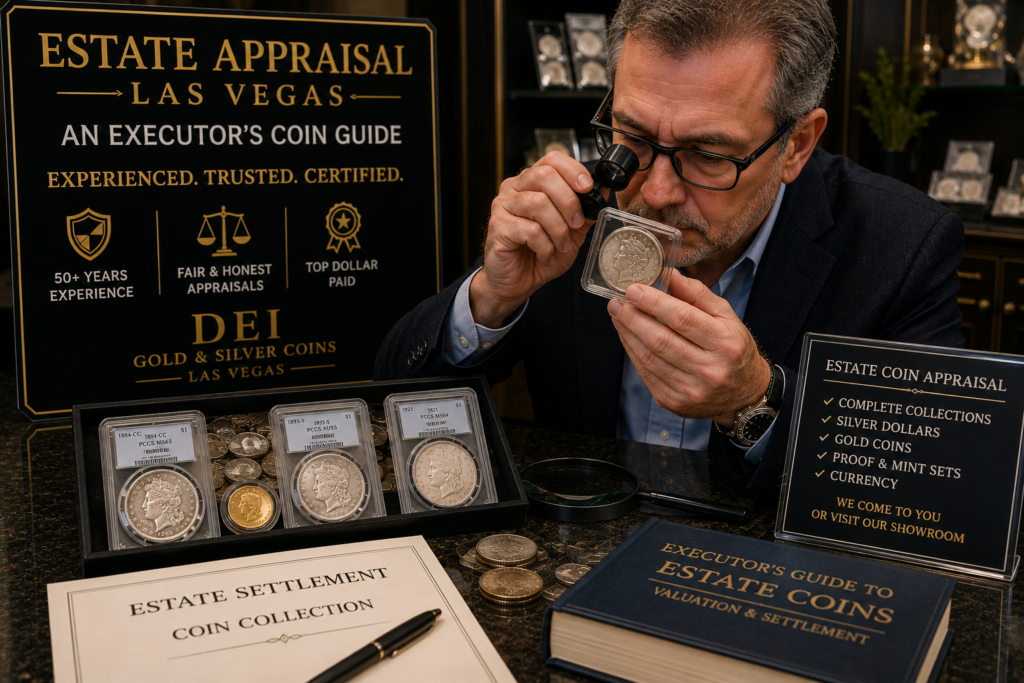
This is why a qualified coin dealer, not a general antiques appraiser, should be handling this part of the estate — ideally one with certifications from bodies like NGC and PCGS, the two grading services most respected among serious collectors and auction houses.
Jewelry Needs Its Own Evaluation
Estate jewelry gets appraised differently again. A proper appraisal weighs each piece, tests the metal purity (typically with an XRF analyzer or acid testing), and separately evaluates any stones for cut, clarity, and carat weight. Costume jewelry mixed in with real gold pieces is extremely common in estate lots, so professional testing — not visual inspection — is the only reliable way to sort one from the other.
Buy or Sell Gold & Silver Coins with Confidence
Work with a trusted Las Vegas coin dealer offering fair pricing, honest appraisals, and expert guidance every step of the way.
Step-by-Step: Appraising and Liquidating an Inherited Collection
Secure the collection. Before anything else, get coins and jewelry into a safe location — a bank box or home safe — and photograph everything for your own records.
Get a written appraisal. Bring the full collection to a dealer who will document each item’s condition, estimated grade, and fair market value as of the date of death.
File the inventory with the court, if required, using the appraised values.
Decide: sell, distribute, or hold. Beneficiaries may want to split items, sell everything and split proceeds, or keep specific pieces with sentimental value.
Liquidate through a reputable buyer if selling — ideally the same dealer who appraised the collection, since they already know exactly what they’re looking at.
Keep documentation of the sale for the estate’s final accounting and for any tax reporting.
The Tax Side Executors Often Miss
Here’s something that surprises a lot of families: inherited coins and jewelry get a stepped-up basis for tax purposes. That means the cost basis resets to the fair market value on the date of death, wiping out any gain that built up during the original owner’s lifetime. If your father bought a Morgan dollar for $10 in 1975 and it was worth $60 the day he passed, your basis is $60 — not $10.
A few things worth knowing:
The estate can elect an alternate valuation date six months after death instead of the date of death, if that produces a more favorable result.
When you do sell, gains on collectibles — including coins and gold jewelry — are taxed at a maximum federal rate of 28%, higher than the capital gains rate that applies to stocks or real estate.
None of this is a substitute for advice from a CPA or estate attorney familiar with Nevada probate; this guide is educational, not tax advice.
Choosing a Las Vegas Appraiser You Can Trust
Not every “we buy gold” storefront is equipped — or willing — to give you an honest, documented estate appraisal. A few things to look for:
Written appraisals, not verbal estimates, that you can submit to the probate court.
Industry certifications (NGC, PCGS, GIA for stones, AGL, or CAC) rather than a generic pawn license.
Decades of local experience, since Las Vegas has a large transient buyer market and a proven, established dealer is easier to hold accountable.
No pressure to sell on the spot. A trustworthy appraiser separates the appraisal from the sale decision, giving you time to consult beneficiaries or an attorney.
DEI Gold and Silver Coins has handled estate and probate collections in the Las Vegas valley for more than 50 years, with certifications from CAC, NGC, PCGS, GIA, and AGL, and private consultation rooms so families can go through a loved one’s collection without a crowded retail floor.
Frequently Asked Questions
Do I need a formal appraisal for probate in Nevada, or can I estimate the value myself? If all beneficiaries agree in writing, Nevada courts may waive a formal appraisal for lower-value items. For coin collections or jewelry with any meaningful value, a written third-party appraisal is strongly recommended and, in many cases, required by the court before the estate can be closed.
How long does an estate coin and jewelry appraisal take? A same-day appraisal is possible for most collections at DEI Gold and Silver Coins — larger or more complex collections with rare or certified coins may take longer if items need to be researched individually.
What’s the difference between an appraisal for insurance and an appraisal for selling? An insurance appraisal typically reflects replacement cost, which is often higher than what a dealer would pay to purchase the item. A selling or probate appraisal reflects fair market value — what a willing buyer would actually pay — which is the figure the court and the IRS care about.
Can I sell an inherited coin collection before probate closes? Sometimes, but it depends on the estate’s status and whether court approval is needed for the sale. Check with the estate’s attorney before liquidating anything, since some sales require a petition and a supporting appraisal filed with the court.
What if some of the coins turn out to be counterfeit or heavily cleaned? This happens more often than families expect, especially with older collections. A qualified dealer will identify authenticity issues during the appraisal so the estate’s inventory reflects accurate, defensible values rather than assumed ones.
Get Your Estate Appraised in Las Vegas
Settling an estate is stressful enough without wondering whether you’re getting an honest number on a loved one’s coin collection or jewelry box. DEI Gold and Silver Coins offers same-day, private appraisals for executors and families throughout Las Vegas and Henderson, backed by over 50 years of experience and certifications from CAC, NGC, PCGS, GIA, and AGL.
Call or text (702) 460-5188 to schedule a same-day, no-obligation consultation — our numismatists will walk you through exactly what the estate’s coins and jewelry are worth, and what your options are, before you decide anything.