Nearly every gold and silver dealer’s website includes some version of the phrase “we buy it back.” While this may sound reassuring, the statement itself tells you very little. A gold buyback guarantee could refer to a firm, clearly stated commitment to repurchase the gold you purchased, or it could simply mean, “We’re a dealer, so we’ll make you an offer at some point.” That distinction is important, particularly if you’re purchasing coins or bars as part of a retirement plan, a long-term savings strategy, or an investment you may need to sell quickly.
This article breaks down what a real buyback guarantee includes, how it differs from an ordinary dealer buyback policy, and what to check before you buy — so the promise on the website matches what happens when you actually walk in to sell.
What Is a Gold Buyback Guarantee?
A gold buyback guarantee is a dealer’s stated commitment to repurchase the coins, bars, or bullion products it sells, typically at a price tied to the live market rate — known as the spot price — minus a set buyback margin. It’s a guarantee of access, not a guarantee of price. No legitimate dealer can promise you’ll get back more than you paid, because gold and silver prices move daily. What a genuine guarantee promises is that the dealer will make you a fair, transparent offer when you’re ready to sell, rather than leaving you to search for a buyer on your own.
This is different from a manufacturer’s warranty or a retail return policy. You’re not returning a defective product for a refund. You’re selling a real, tradable asset back into the market, and the “guarantee” is really a statement about the dealer’s ongoing willingness to be that market for you.
Why Liquidity of Gold Coins Depends on the Buyback Promise
Liquidity simply means how quickly and easily an asset can be converted to cash without a steep loss in value. Gold and silver are liquid by nature — bullion and well-known coins are recognized and traded worldwide. But the liquidity of gold coins you personally own depends heavily on where you can actually sell them.
If your only path to cash is mailing coins to an unfamiliar online buyer and waiting for a check, that’s technically liquidity, but it’s slow and it puts you at the mercy of someone else’s grading and pricing. A dealer with a walk-in showroom, published buyback terms, and same-day payment gives you a much more practical form of liquidity — one you can act on the same day you decide to sell.
This is one reason buyback policies matter more for coins and bullion bought with retirement funds or as part of a long-term investment plan: you want to know, before you commit money, that there’s a straightforward way to convert the position back to cash years later.
Liquidity also varies by product type. Widely recognized coins — American Gold Eagles, American Silver Eagles, and other major world mint issues — tend to be the most liquid, since almost any dealer can quickly verify and price them. Less common coins, private-mint rounds, or unbranded bars can still be sold, but may take a little longer to evaluate, since the dealer has to confirm purity and authenticity from scratch rather than recognizing a familiar product on sight. None of this makes those items a poor choice; it just means it’s worth asking a dealer in advance how they’d handle a resale of that specific item.
What a Trustworthy Dealer Buyback Policy Actually Covers
Not all buyback language is created equal. A dealer buyback policy worth relying on should spell out specifics, not just goodwill. Here’s what to look for:
| Policy Element | What It Should Tell You |
| Pricing basis | Is the offer tied to live spot price, and is that price shown to you at the time of sale? |
| Products covered | Does the guarantee apply to everything the dealer sells, or only certain coins/bars? |
| Condition requirements | Are certified, graded, or sealed items treated differently from loose or worn pieces? |
| Payment method and timing | Same-day cash/check, or a delay while items are shipped and verified? |
| Documentation needed | Do you need the original receipt, certificate, or packaging? |
| In-person vs. mail-in | Can you sell in a showroom, or only by shipping items to the dealer? |
| Fees or deductions | Are there processing fees, shipping costs, or grading fees subtracted from the offer? |
A dealer that answers all seven of these clearly, in writing, is offering a real policy. One that just says “we always buy back what we sell” without addressing pricing or condition is offering a slogan.
Buyback Guarantee vs. Simple Resale: What’s the Difference
It helps to separate two things that get blurred together:
- A buyback guarantee is a dealer’s proactive, published commitment to repurchase products it sold you, generally at a spot-based price with clear terms.
- Simple resale is what happens any time you bring gold or silver to any dealer, whether or not you bought it there. Most licensed coin and bullion dealers will make an offer on gold or silver they didn’t originally sell, based on its metal content, purity, and condition.
The practical takeaway: a buyback guarantee is a convenience and a trust signal, not your only path to selling. Even coins or jewelry you inherited, bought elsewhere, or have owned for decades can typically be sold to a reputable local dealer — the guarantee simply means the dealer you bought from has already told you, in advance, what that process will look like.
How to Sell Back Gold Coins: The Process Step by Step
When you’re ready to sell back gold coins, the process at a reputable dealer generally follows the same basic steps:
- Bring in your coins, bars, or jewelry, along with any certificates, grading slabs, or original packaging you have.
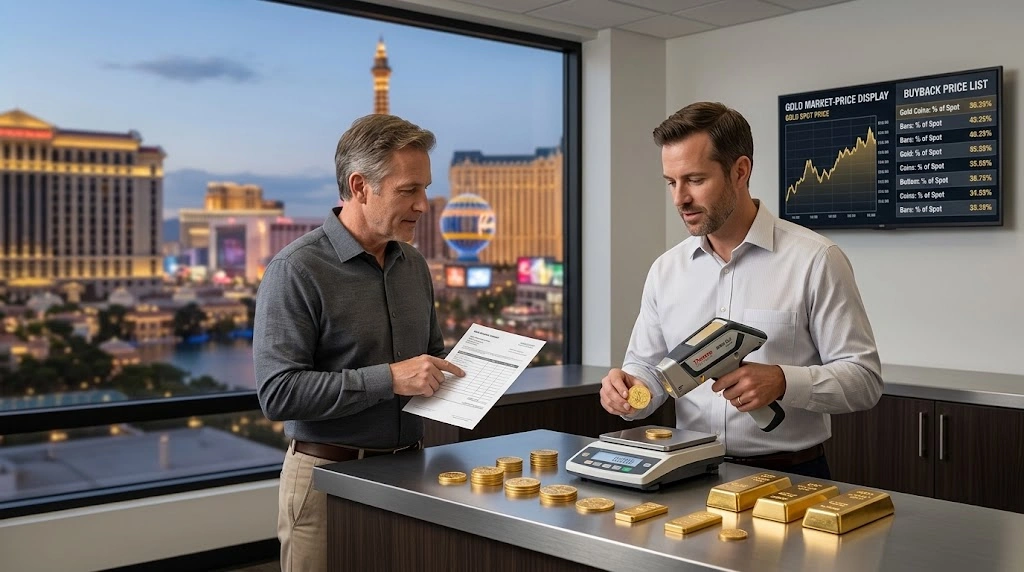
- The dealer inspects and tests the items — this may include visual examination, weighing, and non-destructive testing methods like XRF (X-ray fluorescence) analysis, which reads the metal’s composition without damaging the piece.
- You receive a price quote based on the current spot price, the item’s purity and weight, and any numismatic (collector) premium for certified or rare coins.
- You review and accept (or decline) the offer. A trustworthy dealer will explain how the number was calculated rather than just naming a figure.
- You’re paid, typically the same day, once you agree to the sale.
There’s no obligation to sell simply because you bring items in for a quote — a legitimate appraisal costs you nothing and commits you to nothing.
Buy or Sell Gold & Silver Coins with Confidence
Work with a trusted Las Vegas coin dealer offering fair pricing, honest appraisals, and expert guidance every step of the way.
Red Flags to Watch For in Buyback Promises
Some buyback claims are marketing more than policy. Watch for:
- Vague language like “best price guaranteed” or “we always pay top dollar” with no explanation of how the price is set.
- No mention of spot price anywhere in the buyback terms — a legitimate offer should be traceable back to the live market rate.
- Pressure to sell immediately rather than take time to compare offers or think it over.
- Mail-in-only policies with no in-person option, especially for larger transactions.
- Unusually high pressure toward store credit instead of cash, when you asked for a cash offer.
None of these automatically means a dealer is dishonest, but they’re worth asking direct questions about before you buy — not after. A simple test is to ask a dealer, before you ever purchase anything, exactly how they’d price a buyback of that same item today. If the answer is specific and tied to spot price, that’s a good sign. If it’s vague or deflects the question, treat that as useful information too.
A Real Example: Selling Back an Inherited Collection
Consider a Las Vegas resident who inherited her father’s collection of American Gold Eagles and a handful of pre-1965 U.S. silver coins. She had no idea what any of it was worth and was wary of mailing family heirlooms to a company she’d only found online. Instead, she brought the collection into a local showroom for a free appraisal.
The dealer used XRF testing and visual grading to confirm purity and condition, checked which coins carried certified grades from NGC or PCGS, and separated common-date coins (valued mainly for their gold and silver content) from a couple of pieces with numismatic premiums above melt value. She received an itemized quote the same day, tied to that morning’s spot price, and chose to sell part of the collection while keeping a few coins as keepsakes. Because the dealer’s buyback terms were public and specific — not just a general promise — she knew in advance roughly what to expect before she ever walked in.
This is the practical value of a real buyback guarantee: it turns an emotionally complicated situation, like handling an inheritance, into a transaction with clear, predictable steps.
What This Means Before You Buy
A gold buyback guarantee is only useful when it’s backed by specifics: a clear pricing basis, defined terms for condition and documentation, and a real, accessible way to sell — ideally in person, not just by mail. Before buying gold or silver from any dealer, ask directly how their buyback policy works, and get the answer in writing if you can. As a licensed dealer with over 50 years of combined experience and certifications from CAC, NGC, PCGS, GIA, and AGL, DEI Gold & Silver Coins publishes clear buyback terms and offers walk-in appraisals at its Las Vegas showroom.
Frequently Asked Questions
No. A buyback guarantee promises the dealer will make you a fair offer based on the live market price when you sell, not a fixed or guaranteed return. Gold and silver prices fluctuate daily, so your payout depends on the spot price and your coin’s condition and purity at the time of sale, not your original purchase price.
Yes. Most licensed coin and bullion dealers, including DEI Gold & Silver Coins, will appraise and buy gold or silver regardless of where it was originally purchased. A dealer’s buyback guarantee simply means they’ve made a specific, published commitment to buyers of their own products.
The main factors are current spot price, metal purity and weight, and any numismatic premium for rare, certified, or historically significant coins. Certified grading from NGC or PCGS can support a higher offer, since it removes uncertainty about authenticity and condition.
In-person selling generally offers more transparency and speed — you see the testing process, get an immediate quote, and receive payment the same day. Mail-in services can work for convenience, but you lose visibility into how your items are handled and graded until an offer is already made.
No. A legitimate appraisal or buyback quote should be free and come with no obligation to sell. You can walk in, get an itemized price based on that day’s spot rate, and decide afterward. Be cautious of any dealer that charges upfront fees just to look at or test your gold or silver coins.