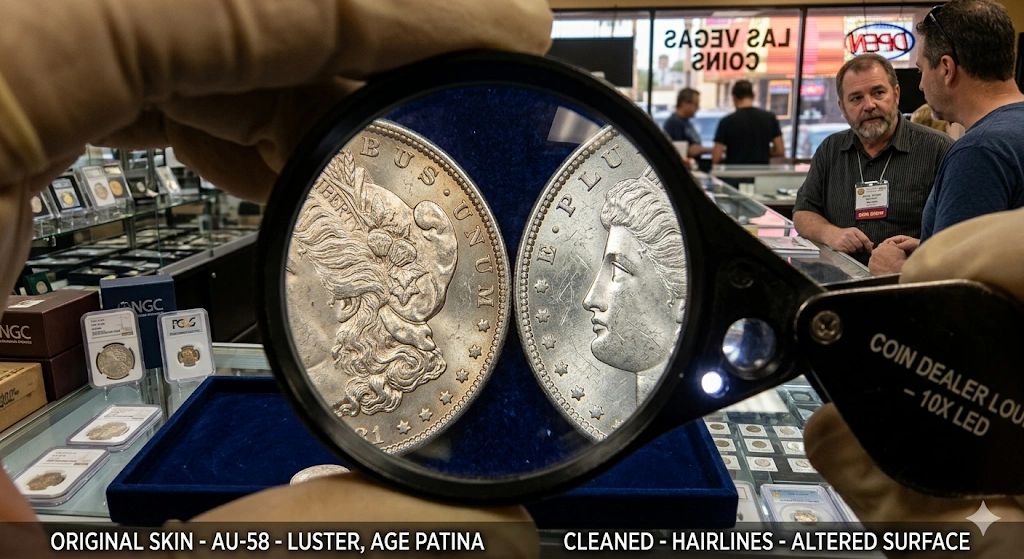
A 1921 Morgan dollar in original, uncirculated condition recently sold for $285 in MS-63 on GreatCollections. The exact same date and mint mark — same grade under a loupe — but with hairline scratches from a past cleaning? It crossed the auction block at $68. That $217 gap, on one of the most common Morgan dollars ever minted, is cleaned coin value loss in its starkest form.
According to PCGS CoinFacts, over 60% of pre-1933 U.S. silver coins that enter dealer hands show some evidence of past cleaning or improper storage treatment. For heirs evaluating an estate collection, or first-time sellers bringing coins to a shop, that statistic means the odds are better than even that your “nice-looking” coin has already been compromised. The question isn’t whether cleaning happened — it’s whether you know how to tell, and what it means for your bottom line.
This post teaches you exactly what professional coin dealers look for when they evaluate original surface versus cleaned coins, why the grading services penalize cleaned coins so severely, and what you can do right now to protect the coins you already own.
Why Cleaned Coin Value Loss Is So Severe — And Permanent
A cleaned coin suffers permanent, unrecoverable value loss because PCGS and NGC designate it as a “Details” coin, which removes it from competitive numerical grading and locks it out of the top-tier price tiers that drive collector premiums.
This isn’t a minor demerit. A “Details — Cleaned” designation is a coin’s permanent record. It follows the coin through every future sale, every dealer counter, every auction estimate. At Heritage Auctions and Stack’s Bowers, Details-graded coins routinely sell at 50–70% discounts to their problem-free counterparts — and that’s when they sell at all. Many serious collectors simply will not buy a Details coin regardless of price because they know the resale market for it is thin.
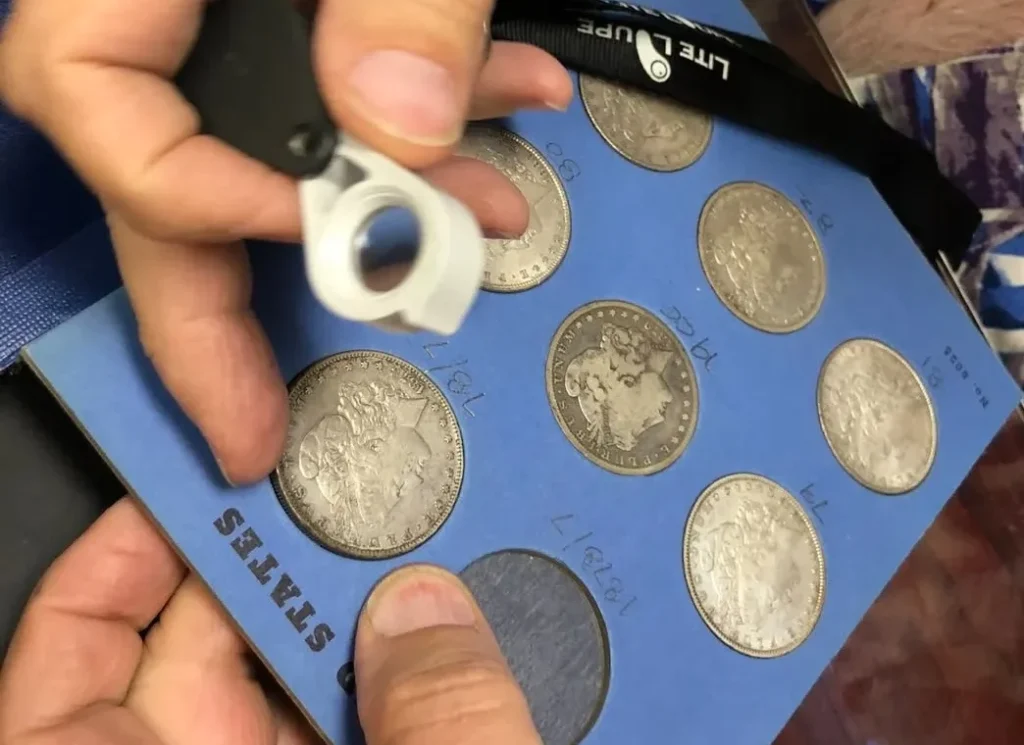
The mechanism of the damage matters here. When you clean a coin — even gently, even with the right product — you are moving metal. Under a 10x loupe (the standard dealer tool), cleaning leaves behind a distinctive pattern of fine parallel scratches called hairlines, running in the direction of the wipe or polish stroke. These hairlines catch light differently than original mint luster, creating a telltale “cartwheel” disruption that experienced dealers and graders recognize instantly. Original luster flows outward from the center of a coin in radial lines; hairlines interrupt and redirect that flow in unnatural ways.
There’s a second category of cleaning damage that’s subtler and arguably more dangerous: dipping. Chemical dipping (usually in a diluted acid or commercial coin dip solution) removes toning and surface oxidation without leaving visible scratches. A lightly dipped coin can fool a novice completely. But under proper lighting — specifically, directed incandescent light rotated around the coin — dipped surfaces show a flatness and uniformity that natural patina never produces. Dipped coins also lack the toning gradations in protected areas like lettering recesses and fields, where original coins almost always show differential color development.
📌 DEI Market Observation: In transactions at our Las Vegas showroom, we have found that coins submitted to NGC after prior chemical dipping are denied numerical grades at a rate roughly consistent with the industry-wide “Details” attribution frequency — and sellers are consistently surprised, because dipped coins look clean to the naked eye. The lesson: bright and shiny does not mean gradeable.
How to Tell if a Coin Has Been Cleaned: The 5 Signs Dealers Check First
Experienced coin dealers identify a cleaned coin within seconds by checking five specific surface attributes — luster flow, hairline patterns, field reflectivity, rim condition, and differential toning in protected areas.
Here is what a trained eye looks for, in the order a dealer actually checks:
1. Luster Flow Interruption Original mint luster on an uncirculated coin flows outward from the design high points in a consistent radial pattern visible as the coin is slowly tilted under a single light source. Cleaning disrupts this flow. On a cleaned coin, the luster appears fragmented, matte in some areas, or artificially bright in others. On a Morgan dollar, this is especially visible in the open fields of the obverse (Liberty’s face area) and the reverse eagle’s breast.
2. Hairline Scratches Under Directed Light Rotate the coin slowly under a focused incandescent light (not diffuse overhead light — that hides everything). Hairlines appear as fine, bright lines running in one general direction, corresponding to whoever cleaned it. They are most visible at a low angle. A 5x to 10x loupe makes them unmistakable. On proof coins, even a single cloth wipe can create hairlines visible to the naked eye.
3. Unnatural Field Reflectivity Cleaning often leaves coin fields (the flat background areas) with an unnaturally bright, almost mirror-like reflectivity that doesn’t match the design elements. This mismatch — bright fields, dull devices — is the opposite of what you see on naturally aged coins, where patina typically develops more in the fields than on raised design elements.
4. Rim and Edge Condition Cleaning strokes follow the path of least resistance. On a circled-cleaning job (common with silver polish), the rims show more evidence than the center. Check the rim edge under a loupe for fine parallel marks running along the circumference. On original coins, rims show only the normal wear pattern consistent with the rest of the coin’s grade.
5. Missing Toning in Protected Areas Letters, numerals, and design recesses naturally accumulate more toning than exposed high points, because they’re shielded from airborne contact and oxidize differently. On a properly original coin, look for darker, richer toning inside lettering. On a cleaned or dipped coin, these areas are uniformly bright — the cleaning stripped toning indiscriminately, including from places it would have survived naturally.
Original Coin Surface Grading: What PCGS and NGC Actually Look For
PCGS and NGC grade original-surface coins on a 70-point Sheldon scale, but a coin must first pass a surface integrity check — any evidence of cleaning, tooling, or artificial enhancement immediately routes the coin to a “Details” designation rather than a numerical grade.
The grading standard for original surface is not just about the absence of cleaning. It’s also about the presence of what numismatists call “original skin” — the combination of luster, toning, and surface texture that develops naturally on a coin over decades and cannot be replicated once removed. A coin with original skin in MS-63 condition is a fundamentally different product from a “Details — Cleaned” coin that would otherwise grade MS-63. The certified coin is liquid, desirable, and commands published price guide values. The Details coin is effectively illiquid at full value.
At DEI, when we submit coins to PCGS for grading on behalf of clients, the first conversation we have is always about whether the coin has original surfaces. A coin we’re confident about goes into a standard submission. A coin with surface questions goes into a consultation first, because a Details grade on a coin the seller expected to be MS-64 is a surprise neither party wants to receive after paying submission fees.
CAC (Certified Acceptance Corporation) adds a third layer on top of PCGS and NGC grades, placing a green or gold sticker on coins that CAC’s review team considers solid for the assigned grade. CAC-stickered coins with original surfaces command an additional premium — sometimes 10–20% above the non-stickered equivalent — precisely because CAC’s review provides additional confidence that the original surface determination was correct.
📊 Original vs. Cleaned Coin Value — DEI Quick Reference
| Attribute | Original Surface Coin | Cleaned / Details Coin |
|---|---|---|
| PCGS/NGC Grade | Numerical (e.g., MS-63) | “Details — Cleaned” |
| Collector Demand | High — liquid market | Low — thin secondary market |
| Auction Premium | Full price guide value | 40–70% discount typical |
| CAC Eligibility | Yes, if grade qualifies | No — Details coins excluded |
| Gold IRA Eligible | Yes (if fineness met) | No — IRS requires problem-free |
| Resale Trajectory | Appreciates with market | Discounts persist or widen |
| Heritage / Stack’s Appeal | Strong bidding competition | Often passes or sells below reserve |
The Most Common Coins Brought In Cleaned — And What Dealers See
Morgan and Peace silver dollars are the coins most frequently brought to dealers in cleaned condition, because their large open fields make surface damage more visible and their widespread availability made them household cleaning targets for generations.
At our counter on Eastern Ave, the pattern is consistent: someone inherits a collection from a grandparent, finds a roll of Morgan dollars, thinks they look “dull,” and cleans them with silver polish before bringing them in. The most painful version of this scenario involves a key date — a 1893-S, 1895-O, or 1921 Peace dollar — that may have been worth several thousand dollars in original circulated condition, now grading Details and worth a few hundred.
Here are the coins we see cleaned most frequently, ranked by frequency at DEI’s counter:
- Morgan Silver Dollars (1878–1921) — large open fields, stored in felt rolls that encouraged “brightening”
- Peace Silver Dollars (1921–1935) — matte-finished surfaces are especially unforgiving; any polish use is instantly apparent
- Lincoln Wheat Cents (pre-1958) — copper oxidizes visibly, prompting amateur cleaning
- Walking Liberty Half Dollars — popular as display pieces, leading to wipe-cleaning
- Pre-33 U.S. Gold Coins — Saint-Gaudens Double Eagles and Liberty Head coins cleaned with jewelry polish, which strips original surfaces on gold just as completely as on silver
For pre-33 gold specifically, the stakes are considerably higher. A Saint-Gaudens Double Eagle ($20 gold) in AU-55 with original surfaces can sell for $2,400–$2,800 at Heritage Auctions. The same coin cleaned to a Details grade moves for $1,800–$2,000 when it moves at all. That $600–$800 gap on a single coin, multiplied across an estate collection, can represent tens of thousands of dollars in lost value.
🪙 DEI Dealer Observation
In 50+ years of combined numismatic experience at our Las Vegas showroom, the single most consistent pattern we see is this: sellers who cleaned coins did it out of care, not carelessness — they wanted their coins to look their best. But coin grading rewards age and originality, not brightness. A naturally toned 1881-S Morgan dollar in MS-65 with original patina is worth $750–$1,000 on the PCGS price guide. The same coin bright-white and hairlined from cleaning? It becomes a $150 Details coin. The market is not penalizing the cleaner’s intention — it’s penalizing the permanent removal of something irreplaceable: the original surface the mint put there in 1881.
The practical implication: if you have coins that look “dull,” do not clean them. Bring them to a PCGS- or NGC-affiliated dealer for evaluation first. Dullness can mean toning — which often adds value on original coins — or it can mean wear, which a grader accounts for numerically without destroying the coin’s certification eligibility.
What “Original Coin Surface Grading” Means for Your Collection’s Value
Original coin surface grading by PCGS or NGC is the single most important factor in converting a raw coin into a certified, liquid, market-priced asset — and cleaning permanently prevents that conversion at full value.
If you’re holding raw (ungraded) coins from an estate or personal collection, here’s how surface condition affects your realistic options:
If surfaces are original and problem-free: PCGS or NGC submission is worth considering for any coin valued at $100+ in the expected grade. Certification creates a transparent, verifiable market for the coin at auction and in private sales. DEI handles PCGS and NGC submissions on behalf of clients and guides the process from evaluation to return.
If surfaces are questionable: A pre-submission consultation with a certified dealer is essential. Submitting a coin that comes back Details costs time and submission fees with no upside. At DEI, we offer free appraisals and pre-submission evaluations precisely to prevent this outcome.
If the coin is already in a Details holder: Your options are not zero, but they are more limited. Details coins sell best to type collectors — buyers assembling collections by coin design rather than investment grade — and to buyers focused on the coin’s historical or numismatic interest rather than certification grade. Price expectations should be set at 40–60% of the equivalent clean coin’s value.
One note on storage going forward: never store silver coins in PVC-based plastic holders (soft flips), which off-gas chlorine compounds that damage surfaces over time. Use Mylar flips, NGC-approved cardboard 2x2s, or hard plastic holders for any coin you’re not immediately submitting. Proper storage is how original surfaces stay original.
Buying Certified Coins in Las Vegas: What DEI Recommends
When buying certified coins at DEI or anywhere in the USA, buyers should verify the PCGS or NGC holder is genuine, confirm the certification number on the grading service’s official website, and avoid purchasing raw coins at MS-grade prices without dealer verification of original surfaces.
DEI’s certified coin inventory — both certified silver coins and certified gold coins — consists exclusively of problem-free, numerically graded examples. When you purchase a PCGS MS-65 coin from our showroom, you’re buying the grade, the surface determination, and the liquidity that certification provides. That’s a fundamentally different transaction from buying a raw coin based on a seller’s opinion of its grade.
For collectors new to certification: the holder matters as much as the coin. PCGS and NGC holders use proprietary sonically sealed cases with embedded security features. A genuine holder matched to the coin’s certification number on PCGS CoinFacts or NGC’s online registry is your primary fraud protection. If a number doesn’t verify, don’t buy.
For investors using precious metals in a Gold IRA structure, this issue carries additional weight: the IRS requires gold coins to meet .9950+ fineness and silver coins to meet .999+ fineness, and the coins must be problem-free for most custodians’ acceptance standards. A Details-graded coin may be rejected by your IRA custodian regardless of its metal content. Consult a tax professional and your IRA custodian before purchasing coins for retirement account purposes.
CONCLUSION
Before you sell, submit, or store a single coin from your collection, know its surface status. Cleaned coin value loss is not a nuance of the hobby — it’s the difference between a $900 MS-65 Morgan dollar and a $150 Details coin on the same date, and that gap is permanent once the cleaning happens.
Four things to take away from this post: (1) Never clean a coin, even lightly, without a professional evaluation first. (2) “Bright and shiny” is not the standard — original surfaces and natural toning are what graders reward. (3) PCGS and NGC certification is how you convert surface quality into documented, liquid value. (4) A free appraisal from a certified dealer costs nothing and protects you from the most expensive mistakes in numismatics.
If you have coins — inherited, collected, or purchased — and you’re not certain about their surface condition, the right move is a professional set of eyes before anything else happens to them.
Visit DEI Gold & Silver Coins at 8985 S. Eastern Ave, Suite 160, in Las Vegas, or call (702) 460-5188 for a free, same-day appraisal — no pressure, no obligation. Our PCGS- and NGC-certified team can evaluate your coins’ surfaces, advise on submission potential, and give you a realistic picture of what your collection is worth in today’s market.
Two related topics worth exploring next: how to read a PCGS or NGC coin holder and understand everything printed on the label, and what makes a coin CAC-eligible and whether submission is worth the cost for your specific coins.
FAQ SECTION
1. How much value does a cleaned coin lose compared to an original?
A cleaned coin typically loses 40% to 80% of its market value compared to an original-surface coin of the same date, mint mark, and grade. PCGS and NGC assign a “Details — Cleaned” designation to cleaned coins instead of a numerical grade, and Details coins sell at a steep discount at Heritage Auctions, Stack’s Bowers, and GreatCollections. For key-date coins, the dollar loss can be thousands.
2. How can I tell if a coin has been cleaned at home without a loupe?
Tilt the coin slowly under a single incandescent light source. A cleaned coin shows fine parallel scratches (hairlines) that catch light differently from the surrounding surface, and its fields often appear unnaturally bright compared to the design elements. Original coins show consistent, radial luster flow. Any unusual brightness or scratching pattern is a sign of cleaning and warrants a dealer evaluation before selling.
3. Does dipping a coin count as cleaning for grading purposes?
Yes. Chemical dipping is treated as cleaning by PCGS and NGC and results in a “Details” designation on most affected coins. Dipped coins lose their original toning and often show a flat, uniform surface reflectivity that trained graders identify immediately, even when the coin appears bright and problem-free to the naked eye.
4. Can a cleaned coin ever be graded numerically by PCGS or NGC?
In rare cases, a lightly cleaned coin may receive a numerical grade if the cleaning is extremely minor and the original surfaces are largely intact, but this is uncommon. Most cleaned coins receive a “Details” designation. Once a coin is in a Details holder, it cannot be resubmitted to “upgrade” out of the Details designation — the surface damage is permanent.
5. Is cleaned coin value loss the same for gold and silver coins?
The value loss pattern is similar for both, but the dollar impact is often larger on gold because base coin values are higher. A cleaned Saint-Gaudens Double Eagle can lose $600–$1,000 compared to an original-surface equivalent at Heritage Auctions. For silver, cleaned coin value loss is most severe on key-date Morgans, Peace dollars, and early American coinage where original surfaces are rare.
6. Does DEI Gold & Silver Coins buy cleaned coins?
DEI buys cleaned coins, but at prices that reflect their Details-grade market value rather than the equivalent problem-free price. If you’re selling and unsure whether your coins have been cleaned, DEI offers free same-day appraisals at our Las Vegas showroom at 8985 S. Eastern Ave — we’ll tell you honestly what you have, what it’s worth, and whether PCGS or NGC submission makes sense before you sell.